
Today there are thousands, even tens of thousands, of cryptocurrencies, each with very different functions, objectives, and levels of importance. From the altcoins, which seek to improve or expand upon the original ideas, up to the stablecoins, designed to maintain a stable value, or the popular meme coins, driven more by the community than by any real practical use.
However, among this vast array, there is one that stands out above the rest and serves as the foundation of the entire ecosystem: the most important, the most influential, and the one that started it all. Next, we’ll take a closer look at the foundation of cryptocurrencies: Bitcoin.
What is Bitcoin?
Bitcoin is the the first cryptocurrency ever created and the foundation of the entire crypto ecosystem, which is why it is often called the “mother of all cryptocurrencies.” It is a decentralized digital currency which allows you to send and receive money online without the need for banks or intermediaries.
His objective is to enable the direct exchange of value between individuals, eliminating the need for trusted third parties and ensuring transaction security through cryptography. In addition, transactions are recorded on a public, distributed network called blockchain, which makes the system more transparent and difficult to manipulate.
The Origin of Bitcoin
Bitcoin emerged at a pivotal moment in modern financial history. It is no coincidence that its emergence coincided with the crisis of confidence triggered by the collapse of Lehman Brothers in 2008, one of the largest bank failures in the United States. Against this backdrop of mistrust toward banks and traditional systems, a radical idea emerged: to create a digital currency that would not depend on any central institution.
On October 31, 2008, a person (or group of people) using the pseudonym Satoshi Nakamoto sent an email to a list of cryptographers with the subject line “Bitcoin P2P E-Cash Paper”, in which he presented the idea of a peer-to-peer electronic cash system without intermediaries. Shortly thereafter, he published the white paper which explained how it worked, and on January 3, 2009, he released the Bitcoin software and mined the Genesis Block, launching the network and securing the first 50 BTC. Since then, the network has grown thanks to an ever-expanding community of nodes and miners who validate transactions and keep the system running in a decentralized manner.
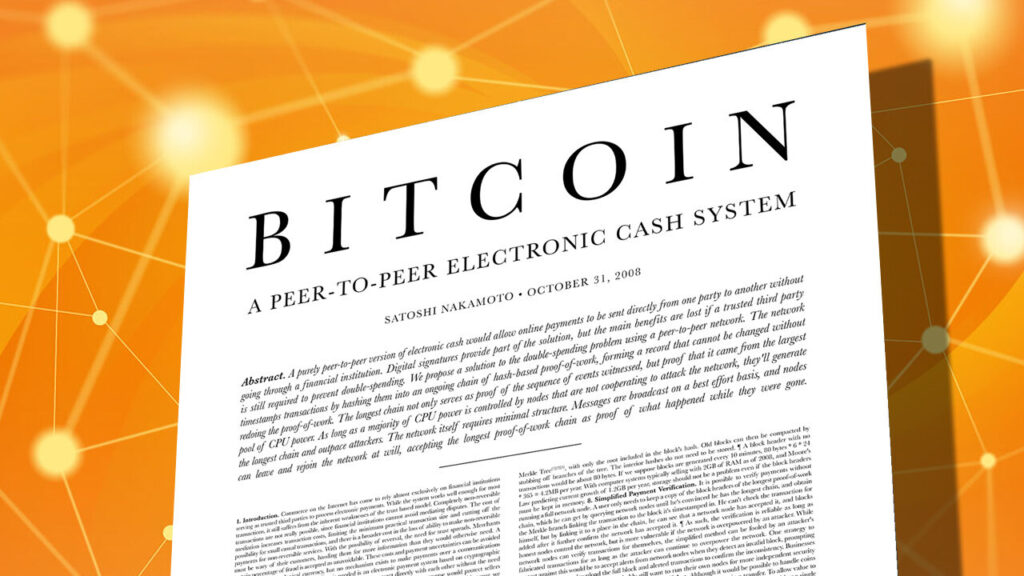
Figure 1. The original Bitcoin white paper Source: Crypto News
Who is Satoshi Nakamoto, really?
As of today, the true identity of Satoshi Nakamoto It remains one of the greatest mysteries in the worlds of technology and finance. No one knows for sure whether it was a single person or a group of developers who worked together to create Bitcoin.
After publishing the white paper After creating Bitcoin and actively participating in the project’s early development, Nakamoto gradually withdrew from the community until he stopped communicating entirely in 2011. Since then, nothing more has been heard from him.
Over the years, numerous theories have emerged regarding his identity, implicating programmers, cryptographers, and even major tech executives. However, none of these theories has been proven. Furthermore, it is estimated that Satoshi holds approximately 1 million bitcoins amassed during the network's early years—a fortune that has never been touched and that only adds to the mystery surrounding him.
Did you know that the first real-world purchase made with Bitcoin was two pizzas for 10,000 BTC in 2010? Today, that amount would be worth hundreds of millions of euros, making it one of the most expensive purchases in history.
Monetary characteristics of Bitcoin
There are 8 Key Points for a Better Understanding of Bitcoin's Monetary Characteristics and why this asset is so different from traditional money. These characteristics explain its value, how it works, and why it has become one of the most significant financial innovations of recent years.
- Decentralization: Bitcoin does not rely on central banks or any controlling authority. Instead, a global network of computers collectively validates transactions, eliminating intermediaries, reducing censorship, and preventing any single entity from manipulating the system.
- Limited release: Its code specifies from the outset that there will be only 21 million units. This built-in scarcity makes it a finite asset, similar to gold, but in digital form, with no possibility of unlimited creation.
- Halving: About every four years, the reward miners receive is cut in half. This means that fewer and fewer new bitcoins enter circulation, gradually increasing their scarcity and bolstering their long-term value.
- Deflationary: Because the supply is limited and the rate of issuance is steadily decreasing, its purchasing power tends to remain stable or even increase over time. This contrasts with traditional currencies, which typically lose value due to inflation.
- Divisibility: Each bitcoin can be divided into 100 million units called satoshis, which allows people to invest small amounts without having to buy a whole unit, making the system accessible to anyone.
- Digital: It does not exist in physical form. Its entire value lies on the network, where every transaction is recorded on the blockchain, eliminating production, transportation, and storage costs.
- Transparency and security: All transactions are recorded on a public blockchain. Although they are visible, they are protected by advanced cryptography, making them extremely difficult to tamper with or forge.
- Store of value: Many compare it to “digital gold” because of its scarcity, security, and resistance to censorship. Although its price is volatile, it is considered a potential store of value in the long term.
What is blockchain, and how does it make Bitcoin possible?
Behind Bitcoin lies a technology that has completely transformed our understanding of digital money: the blockchain or blockchain. Without it, Bitcoin simply couldn't exist.
Blockchain is a kind of giant digital ledger where all transactions made within the network are recorded. The big difference is that this ledger does not belong to any bank, company, or government, but is distributed among thousands of computers spread across the globe. They all share the same information and work together to keep the system running.
What makes this technology revolutionary is that, once a transaction is recorded, it is extremely difficult to alter it. Each block of information is linked to the previous one using cryptographic codes called hashes, forming a chain that is virtually impossible to alter without the entire network detecting it.
How do blocks work within the blockchain?
A blockchain consists of blocks that are continuously added to the chain. Each block stores information about the transactions that have taken place, such as who is sending bitcoins, who is receiving them, and how much is being transferred.
But in addition to that data, each block contains something essential: its own hash and the hash from the previous block. This acts as a unique digital fingerprint. If someone were to try to alter a single past transaction, it would automatically change the block’s hash and break the entire chain, immediately alerting the network.
Thanks to this system, Bitcoin achieves something that for decades seemed impossible: creating digital money without the need for a central authority to oversee transactions.
Nodes: Bitcoin's living copies
The Bitcoin network operates thanks to thousands of devices called nodes. A node is any computer connected to the network that stores a complete copy of the blockchain and verifies that all transactions comply with the system's rules.
When someone sends bitcoins, the transaction is automatically broadcast to all nodes. These nodes verify that the funds actually exist and that there is no attempt at fraud. If everything is in order, they accept the transaction and update their copy of the blockchain.
This makes Bitcoin extremely resilient. Even if some nodes fail or go offline, the network continues to function because there are thousands of copies distributed around the world.
Miners: the ones who keep the network running
One of the most important aspects of Bitcoin is the miners. Its function is to validate transactions and add new blocks to the blockchain using computing power. To do so, they compete by solving complex mathematical problems using massive computing systems. The first to solve the problem earns the right to add a new block to the chain and receives a reward in Bitcoin.
This process is known as mining and it is one of the cornerstones of Bitcoin's operation. In addition to validating transactions, mining secures the network security, since the greater the connected computing power, the more difficult it is to manipulate or attack the system.
Mining is also how new bitcoins are created. However, the reward miners receive is halved approximately every four years through the halving, a mechanism designed to gradually reduce the issuance of new coins and increase their shortage over time.
Did you know that some countries consume less energy than the entire Bitcoin network? The debate over its energy consumption remains one of the main criticisms leveled at the cryptocurrency.
Why was blockchain so revolutionary?
Before Bitcoin, the biggest challenge with digital money was preventing anyone from counterfeiting it or spending it twice without a bank’s oversight. Blockchain solved this problem by using cryptography, decentralization, and consensus among thousands of computers.
For the first time in history, a global digital financial system has been created that is capable of operating without intermediaries, is available 24 hours a day, and is accessible from anywhere in the world.
Bitcoin Today: From Digital Experiment to Global Asset
What began as an obscure project posted on a cryptography forum has become one of the most closely watched financial assets in the world. Today, Bitcoin moves hundreds of billions of dollars and is part of the global economic, technological, and political discourse.
In recent years, large companies and investment funds have begun to incorporate Bitcoin to their balance sheets or financial products, while the approval of the Bitcoin ETF brought cryptocurrencies even closer to traditional markets. Furthermore, countries such as El Salvador even went so far as to adopt it as legal tender, marking a historic moment for the crypto ecosystem.
Despite the criticism surrounding his volatility, Whether in terms of regulation or energy consumption, Bitcoin continues to establish itself as the market leader and as a technology that has forever changed the way we understand money and digital ownership.