
Before we dive into the detailed analysis, here’s a summary of KuCoin’s most important data at a glance.

KuCoin Quick Overview
| Score | |
| Established in | 2017 |
| Headquarters | Seychelles |
| Regulator | FSA (Seychelles) |
| Cryptocurrencies | +1035 |
| Trade Fee | 0.10% – 0.10% |
| MiCA regulation | Yes, starting in November 2025 |
| Minimum deposit | 5 € |
About KuCoin: Origins and Who It's Intended For
KuCoin is a global cryptocurrency exchange primarily aimed at experienced users who are looking for access to a wide variety of tokens, secondary markets, yield products, and advanced trading tools. Its offering stands out because it offers greater operational flexibility and early access to assets which other platforms tend to filter out or add later. It does not claim to be the simplest or the most conservative exchange, but rather an agile and flexible platform for those who prioritize diversity and exploration, even though this requires greater discernment and responsibility on the part of the user.
Pros
More than 1,000 cryptocurrencies available, including rare altcoins
Early access to new tokens and emerging markets
Competitive trading fees, with discounts when using KCS
Wide range of spot, futures, staking, and yield products
Cons
A regulatory framework that is less robust than that of exchanges authorized under MiCA
A complex and unintuitive platform for novice users
Some cryptocurrencies have low liquidity and higher volatility
Futures, leverage, and yield products involve high risk
Its offering is designed for a very specific audience: experienced users looking to access a wide variety of cryptocurrencies, new tokens, and advanced trading tools. The platform offers spot and futures markets, yield products, staking, and automated trading bots—all within a single environment. KuCoin prioritizes diversity, agility, and operational freedom over a simplified or highly guided experience.
Who is KuCoin for? For experienced users looking for a variety of cryptocurrencies and advanced trading tools.
Its listing selection is one of its main advantages. While other exchanges focus their offerings on assets with the highest market capitalization, KuCoin tends to list emerging projects and lesser-known tokens more quickly. This allows users to find more opportunities, but it also increases exposure to projects with lower liquidity, limited track records, or higher risk.
The platform also has its own token, the KuCoin Token (KCS). Holding it or using it to pay fees grants access to discounts, promotions, and certain benefits within the ecosystem.
What level of security does KuCoin offer?
KuCoin combines cold storage, multi-signature systems, hardware security modules, continuous monitoring, and periodic reserve audits. These technical measures are complemented by certifications such as SOC 2 Type II, ISO 27001, ISO 27701, and CCSS.
Even so, it is important to distinguish between the platform’s technological security and its regulatory status. KuCoin has made significant improvements in compliance and transparency, but its international structure and the pending issues involving KuCoin EU with the Austrian regulator make its profile more difficult to assess than that of a fully operational European exchange.
That trust is also reflected in how those who already use the platform rate it:
MiCA Regulation in Europe
On November 27, 2025, KuCoin EU Exchange GmbH obtained authorization as a crypto-asset service provider under MiCA, granted by the Austrian Financial Market Authority (FMA).
The authorization covers the following services:
- Custody and management of cryptoassets on behalf of clients.
- Exchange of cryptoassets for fiat currency.
- Exchange between different cryptoassets.
- Allocation of cryptoassets.
- Cryptoasset transfers on behalf of clients.
The license generally allows the provider to offer services in 29 countries within the European Economic Area through the MiCA regulatory passport, with the previously announced exception of Malta. (FMA of Austria)
However, the license does not currently equate to fully standardized European operations. In February 2026, the FMA temporarily banned the acceptance of new business due to vacancies in key positions related to anti-money laundering and sanctions compliance.
The regulator lifted that ban on May 18, 2026, after the positions were filled. However, it maintained the ban on KuCoin EU commencing operations because there were still outstanding requirements related to governance and other key management positions.
Therefore, as of the date of this update, KuCoin EU retains its MiCA authorization, but the actual start of its operations remains subject to the FMA’s approval. It should not be presented as a fully operational exchange in Spain until the regulator confirms that this restriction has been lifted.
Did you know? KuCoin is known as the “people’s exchange” for its focus on quickly listing new cryptocurrencies before many larger platforms.
Custody and protection of funds
KuCoin distributes its reserves among cold, warm, and hot wallets. According to the platform, most of the funds are held in cold storage, without a direct connection to the internet.
The most sensitive transactions require multi-signature authentication, so that a single compromised key should not be enough to move assets. KuCoin also uses HSM modules certified to NIST FIPS 140-2 Level 3 and secure execution environments to protect keys and sensitive data.
Key protection measures include:
- Segregation of funds among cold, warm, and hot wallets.
- Most assets are stored offline.
- Multi-signature authentication for critical operations.
- Key protection using HSM modules.
- 24-hour anomaly monitoring.
- Fraud detection systems using artificial intelligence.
- Additional controls on deposits and withdrawals.
- SOC 2 Type II, ISO 27001, ISO 27701, and CCSS certifications.
Reserve Test and transparency
KuCoin publishes a Proof of Reserves based on cryptographic verifications and Merkle trees. The platform states that it conducts monthly audits to verify that customer assets are backed at a ratio greater than 1:1. (KuCoin Security)
Each user can check whether their balance was included in a specific snapshot of reservations. This provides a significant degree of transparency, although it does not, on its own, reveal all of the company's financial obligations.
A verification of reserves is not the same as a full financial audit. It confirms the existence of certain assets at a specific point in time, but does not necessarily provide a comprehensive view of the debts, liabilities, or relationships among the various companies in the group.
Account Security
KuCoin offers various tools to protect accounts from unauthorized access and withdrawals:
- Two-factor authentication using Google Authenticator.
- A specific password to authorize transactions.
- Anti-phishing code in emails.
- Additional confirmations for pickups.
- Restrictions on pickup addresses.
- Management of Connected Devices.
- Alerts regarding access and suspicious activity.
- Identity verification and biometric checks.
- Automated fraud detection systems.
Users must enable and configure these features correctly. Relying solely on a password as a security measure leaves the account exposed to unnecessary risk.
Pros
MiCA Authorization Granted by the FMA to Its European Entity
Monthly proof of reserves, verifiable via Merkle trees
Most assets are stored in cold wallets
Multi-vendor protection, HSM, and continuous monitoring
Cons
Reserve Proof is no substitute for a full financial audit
There is no bank guarantee fund that applies to cryptocurrencies
Ultimate protection also depends on the user's security settings
According to the latest statement from the FMA, KuCoin EU has not yet been able to begin operations
Where is KuCoin available?
KuCoin Global claims to have a presence in more than 200 countries and regions, but this does not mean that all of its products are legally available in every jurisdiction. The platform restricts or modifies its services in accordance with the regulations of each market.
It does not provide its global services as usual in jurisdictions such as the United States, the United Kingdom, and other regions subject to regulatory restrictions. The availability of futures, margin trading, Earn, card purchases, or fiat deposits may also vary by country.
Availability in Spain and Europe
New users residing in the European Economic Area can no longer register on KuCoin Global. Instead, the company established KuCoin EU Exchange GmbH, headquartered in Vienna and licensed under MiCA to provide services in 29 EEA countries.
However, according to the latest publicly available information from the FMA, KuCoin EU was still unable to begin operations due to outstanding governance and management requirements. This means that the platform should not be considered fully available to new Spanish customers while that restriction remains in place.
KuCoin Fees: How Much Does Trading Really Cost?
KuCoin uses a tiered structure for maker and taker fees. The cost depends on the user's VIP level, monthly trading volume, the amount of KCS held, and the category assigned to each cryptocurrency.
This makes their rates competitive for frequent trading, but also less easy to understand than a flat fee.
Spot trading commission starting at 0.10%
At VIP Level 0, Class A cryptocurrencies have a fee of 0.10% for both maker and taker orders. Class B assets start at 0.20%, and Class C assets reach 0.30%.
| Platform | Maker | Taker |
|---|---|---|
 Bitget
|
0,10% | 0,10% |
 Bybit
Bybit
|
0,10% | 0,10% |
 Kucoin
|
0,10% | 0,10% |
 Bitvavo
|
0,15% | 0,25% |
 Kraken
|
0,25% | 0,45% |
 Coinbase
|
0,40% | 0,60% |
 eToro
eToro
|
1% | 1% |
The classification is based, among other factors, on the liquidity and risk level of each asset. For this reason, not all trades executed on KuCoin cost the 0.10% that is typically advertised.
Did you know? High-volume users can advance through the VIP tiers and gain access to lower rates. At the highest tiers, certain maker orders can reach 0%.
Discount when paying with KCS
KuCoin allows you to pay spot trading fees using KCS, its native token. When you enable this option, a standard discount of 20% is applied to the applicable fee.
In a Class A transaction, a commission of 0.10% could amount to approximately 0.08%. The savings can be significant for frequent traders, although this requires maintaining exposure to the price of KCS.
Futures Commissions
Futures are based on a different structure:
Fees decrease as the VIP level increases. However, the cost of trading futures is not limited to the opening and closing commissions; periodic financing charges and the risk of liquidation must also be taken into account.
The total cost of derivatives depends on both the commission and the time the position is held open, especially in markets with high funding.
Deposits and withdrawals
KuCoin does not typically charge a fee for cryptocurrency deposits, although users must pay the network fee when sending them from another wallet or exchange.
Cryptocurrency withdrawals are subject to a fee and a minimum amount, which vary depending on:
- The retired asset.
- The selected network.
- Blockchain congestion.
- KuCoin's Terms of Service.
Purchases made with a credit card or through third-party providers may incur a commission higher than the spot market rate. The exact cost depends on the provider, the country, the currency, and the payment method.
Bank deposits and withdrawals in euros depend on the user's bank and the availability of KuCoin EU.
| Concept | Price on KuCoin |
|---|---|
| Spot Trading — Class A | From 0.10% maker / 0.10% taker |
| Spot Trading — Class B | From 0.20% maker / 0.20% taker |
| Spot Trading — Class C | From 0.30% maker / 0.30% taker |
| Discount for paying fees with KCS | 20% in compatible operations |
| Futures Trading | Starting at 0.02% for makers / 0.06% for takers |
| Cryptocurrency Deposit | No commission charged by KuCoin |
| Cryptocurrency withdrawal | Varies depending on the asset and the network |
| Shop with a credit card | Varies by payment provider |
| Bank Deposits and Withdrawals | Varies by country and method |
| Care and Maintenance | 0 € |
| Trading bots | No additional fee; transaction fees apply to each transaction |
Step-by-Step Guide to Opening an Account on KuCoin
The registration process is entirely digital, but as of August 2023, identity verification is required for new users to access the platform's products and services.
In Spain and the rest of the EEA, the process will depend on the actual launch of KuCoin EU. KuCoin Global has indicated that European residents can no longer register on its international platform.
Step 1: Check availability
Before creating an account, check which KuCoin entity provides services in your country and which products are authorized.
For residents of Spain, registration should be completed through KuCoin EU once the platform is fully operational. It is not recommended to use incorrect residence information or tools designed to circumvent geographic restrictions.
Step 2: Initial Registration
Registration begins on the website or through the official app. The following information is typically required:
- Email address or phone number.
- Verification code.
- Secure password.
- Acceptance of the Terms and Conditions.
It is important to verify that the URL actually belongs to KuCoin to avoid phishing sites.
Step 3: Identity Verification
KYC is mandatory for new users as of August 31, 2023. KuCoin may request:
- Identification card or passport.
- Photograph of the document.
- Facial recognition or proof of life.
- Full name and date of birth.
- Country and residential address.
- Additional information on the source of the funds.
Unverified users have very limited functionality and cannot use the platform normally. (KuCoin KYC Guide)
Step 4: Configure Security
Before depositing funds, we recommend that you enable:
- Google Authenticator.
- Anti-phishing code.
- Trading password.
- Whitelist of addresses.
- Access Alerts.
- Confirmation of pickups.
Step 5: Make Your First Deposit
Depending on the country and the available services, KuCoin allows you to fund your account through:
- Bank transfer.
- Pay with a card.
- Third-party payment providers.
- Cryptocurrency transfers.
- P2P Market.
Fees and limits vary depending on the method. Before sending cryptocurrency, you must confirm that the network used matches the deposit address exactly.
Step 6: Perform the first operation
Once the funds are available, the user can access the spot market, select the appropriate pair, and place a market, limit, or stop order.
For a first-time purchase, the Convert mode may be easier, although it's a good idea to compare the quoted price with the price available in the order book.
Requirements for Opening an Account
- Be of legal age.
- Reside in an eligible country.
- Provide an email address or phone number.
- Complete the identity verification process.
- Present a valid document.
- Pass the facial recognition test when required.
- Provide proof of the source of the funds if requested by KuCoin.
- Agree to the restrictions applicable to your country of residence.
Available cryptocurrencies: more than 1,000 assets
The listing is KuCoin's main point of differentiation. The platform offers access to more than 1,000 cryptocurrencies and more than 1,100 trading pairs, including Bitcoin, Ethereum, Solana, XRP, and a wide selection of smaller-cap altcoins.
This diversity makes it an attractive platform for discovering emerging projects before they reach more conservative exchanges. At the same time, it requires users to conduct a thorough analysis: just because a cryptocurrency is listed does not mean that KuCoin guarantees its quality, solvency, or future.
Spot market
The spot market allows users to trade cryptocurrencies through an order book. Its features include:
- Market orders.
- Limit orders.
- Stop-limit.
- Stop-market.
- OCO on supported markets.
- Charts and technical indicators.
- Transaction History.
- API for external strategies.
Margin trading
KuCoin allows you to borrow funds to increase a position, whether you're going long or short. Margin trading can amplify the returns on a trade, but it also accelerates losses and can lead to a liquidation.
This product is intended for users who understand leverage, loan interest, and margin maintenance levels.
Futures
Futures allow you to open long or short positions without directly purchasing the underlying asset. KuCoin offers perpetual contracts and various leverage levels, depending on the region and the selected market.
In addition to maker and taker fees, the following should be considered:
- Periodic financing rates.
- Clearance price.
- Initial and maintenance margin.
- Risk of sudden movements.
- Possible geographic restrictions.
KuCoin Earn
KuCoin Earn brings together various products designed to generate returns on cryptocurrencies. The offerings may include flexible savings, promotional products, staking, and structured solutions.
Returns vary and should not be interpreted as a guaranteed bank interest rate. Depending on the product, there may be market, liquidity, and counterparty risks, as well as the risk of temporary lock-up or partial loss of principal.
Trading bots
KuCoin integrates automated bots directly into the platform. Among the available strategies are:
The KCS token serves a practical function within the ecosystem. Holding and using it to pay fees effectively reduces operational costs, especially for users with recurring spot trading activity.
It is not mandatory, but it makes a real difference in the final cost compared to operating without it.
| Trading bot | Main function |
|---|---|
| Spot Grid | Automatically buy and sell within a set price range |
| Futures Grid | Automate long or short trades using futures contracts |
| Infinity Grid | It maintains an active grid strategy without setting an upper price limit |
| DCA | Set up a regular buying plan to reduce the impact of market volatility |
| Smart Rebalance | Automatically rebalances the percentages in a cryptocurrency portfolio |
| Martingale | Gradually increase the position as the price moves against you |
| DualFutures AI | It uses artificial intelligence to automate futures trading strategies |
Bots do not eliminate risk or guarantee profits. They simply automate rules that the user could execute manually. If the strategy is configured incorrectly or the market breaks out of the expected range, losses also occur automatically.
Copy Trading
Copy trading allows you to replicate other traders' trades. It can provide easier access to more advanced strategies, but the past performance of the trader you are copying does not guarantee future returns.
Before copying a strategy, it’s a good idea to review its drawdown, how long it’s been active, its leverage level, and the consistency of its results.
Spotlight and New Projects
KuCoin Spotlight serves as a launchpad for certain tokens. Users can participate in campaigns or initial sales, subject to eligibility requirements.
It is one of the most interesting areas for those seeking early exposure, but also one of the riskiest: new tokens may experience high volatility, a lack of liquidity, or sharp declines following their launch.
KuCoin vs. Binance
The most natural comparison is between KuCoin and Binance. Both offer a comprehensive ecosystem, competitive fees, hundreds of cryptocurrencies, and advanced tools, but there are significant differences.
| Characteristic | KuCoin | Binance |
|---|---|---|
| Foundation | 2017 | 2017 |
| Headquarters | Seychelles; European entity in Vienna | International structure with local entities |
| European Regulation | MiCA license issued by the Austrian FMA; European operations subject to regulatory conditions | It varies by country and service provider |
| Initial Spot Commission | 0.10% maker / 0.10% taker for Class A assets | From 0.10% maker / 0.10% taker |
| Futures Commission | Starting at 0.02% for makers / 0.06% for takers | Varies depending on the contract and VIP level |
| Proprietary token | KCS | BNB |
| Discount with token | 20% on eligible spot commissions when paying with KCS | Discount on eligible fees when paying with BNB |
| Cryptocurrencies | More than 1,000 | Extensive catalog, generally more selective |
| Spot trading | Yes | Yes |
| Futures and Margin | Yes, depending on the region | Yes, depending on the region |
| Trading bots | Spot Grid, Futures Grid, DCA, Infinity Grid, Martingale, and Smart Rebalance | Spot Grid, Futures Grid, DCA, and Automatic Rebalancing |
| Copy trading | Yes | Yes |
| Earn and staking | Yes, through KuCoin Earn | Yes, through Binance Earn |
| Reservation Test | Yes, with periodic checks | Yes, through a verifiable system |
| Liquidity | Rising across major currency pairs; mixed performance among smaller altcoins | Very high in the major markets |
| Strength | A variety of altcoins and early access to new tokens | Liquidity and Scope of the Ecosystem |
| Platform | Website + mobile app + API | Website + mobile app + API |
| Ideal for | Experienced users looking for altcoins and advanced tools | Users who prioritize liquidity and a comprehensive ecosystem |
KuCoin stands out for its greater willingness to list emerging tokens and smaller-cap assets. Binance typically offers greater market depth in major trading pairs and an ecosystem with greater integration between trading, payments, and services.
For a Spanish user, the comparison should not be limited to fees or the number of cryptocurrencies. Legal and operational availability are key factors. As long as KuCoin EU remains unauthorized to begin operations, it does not represent a practical option for opening a new Spanish account.
Apps and Platform: How Do You Use KuCoin on a Daily Basis?
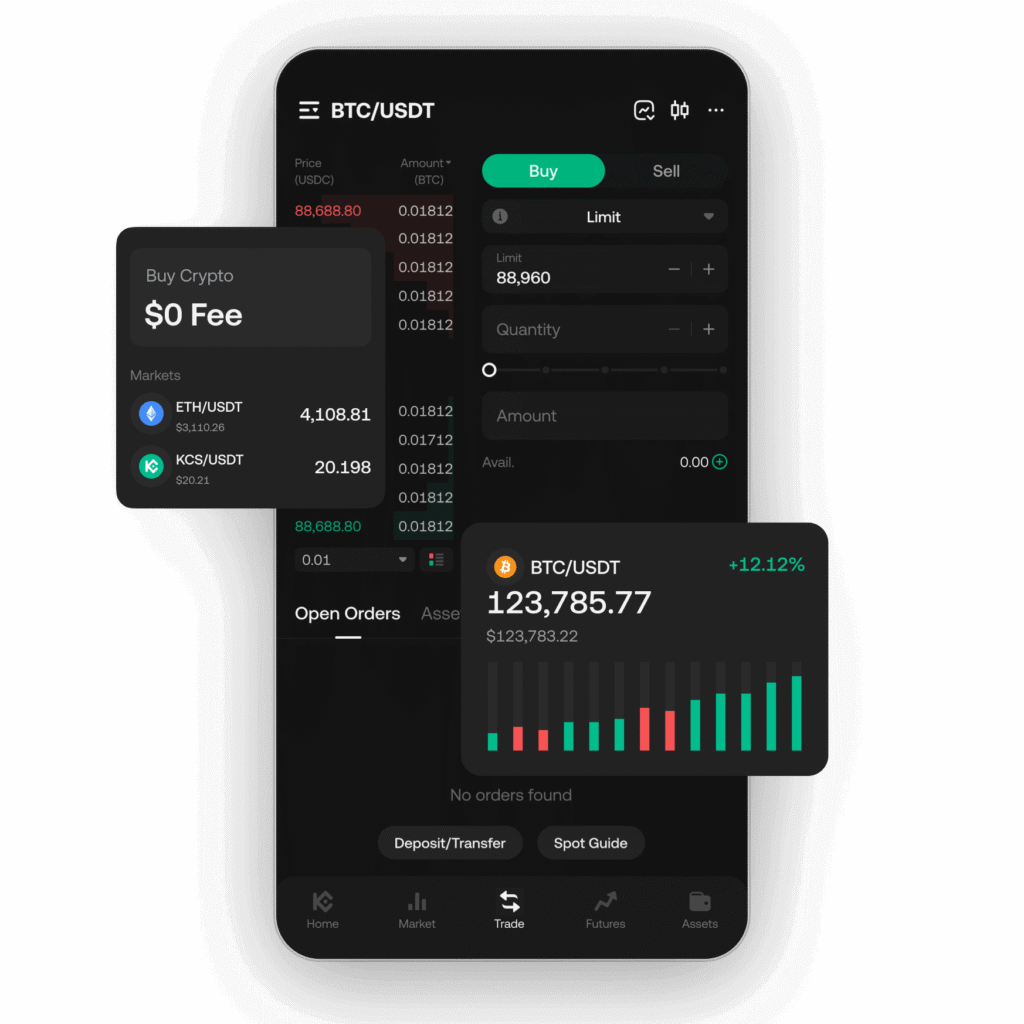
KuCoin is available via a web browser and through apps for iOS and Android. The platform offers access to markets, a wallet, bots, Earn, copy trading, and other features all from a single account.
The app lets you switch between simpler interfaces and advanced tools, although the number of menus, promotions, and products can be overwhelming at first.
The trading screen includes:
- Real-time order book.
- Advanced graphics.
- Technical indicators.
- Transaction History.
- Open positions and orders.
- Market, limit, and stop orders.
- Access to bots and automated strategies.
- Alerts and watchlists.
Final opinion: Is KuCoin Worth It in 2026?
KuCoin stands out for one very specific reason: it offers one of the most extensive selections of cryptocurrencies on the market and brings together a wide range of advanced tools within a single platform. Its spot trading fees start at 0.10%, include discounts via KCS, and allow users to trade futures, use margin trading, access Earn, engage in copy trading, and utilize various automated bots.
Its offering is particularly appealing to users who are already familiar with how an exchange works and want to explore tokens or strategies they can’t find on more conservative platforms. For this user base, the combination of variety, flexibility, and automation provides value that’s hard to match.
However, that breadth is also its main drawback. KuCoin isn’t a particularly user-friendly platform; some tokens have low liquidity, and leveraged products can result in significant losses. The fee structure isn’t as straightforward as it seems either, since the cost varies depending on the asset class and VIP level.
There is also a decisive factor in Europe. KuCoin EU holds a MiCA license, but as of May 2026, the FMA was still prohibiting it from commencing operations due to outstanding governance requirements. At the same time, KuCoin Global no longer allows new users from the EEA to register.
Therefore, KuCoin may be a competitive platform for advanced traders in the markets where it operates legally, but it should not be recommended as an option for new Spanish users until the FMA confirms that KuCoin EU can begin providing services.
Is KuCoin not for you? Explore other alternatives

Veteran exchange focused on security and compliance. Allows buying, selling, and staking, with pro tools and solid support.

Derivatives and copy trading-focused exchange with a fast app. Includes futures, multiple pairs, and advanced features for agile trading.

Leading global platform by trading volume. It offers spot and futures trading, staking, and a broad ecosystem with reduced fees through BNB.

European exchange with a clean interface and competitive fees. Ideal for trading crypto with SEPA transfers and stable liquidity in the European market.

Social trading and derivatives-focused platform with a simple interface. It includes copy trading, futures, and fast purchase options using a card.

Popular exchange for derivatives and spot trading, with high liquidity, a fast interface, and advanced tools geared toward active and professional traders.

Spanish exchange focused on ease of use, local support in Spanish, and integrated options for buying, saving, and custodial asset management.

Comprehensive platform offering spot, futures, and earn products. Strong global liquidity, pro tools, and a built-in Web3 wallet for active traders.
Frequently Asked Questions about KuCoin (FAQ)

Good exchange, new coins, staking options, you can also lend your cryptos with collateral.
No problems so far.
I was a little worried about this exchange because, with the new MiCA regulation, I wasn't sure if it would be available in the country where I live… but after reading the review, everything is much clearer to me now!
It offers a good variety of cryptocurrencies and trading options, although the interface can be a bit complicated at first, and there are aspects that could be more user-friendly.