
Before we dive into the detailed analysis, here's a summary of BingX's key metrics at a glance.

BingX Quick Overview
About BingX: Origins and Target Audience
BingX is a cryptocurrency exchange founded in 2018 that specializes in social trading, copy trading, and derivatives. By 2026, the platform will position itself as a global exchange and Web3-AI company, with a community of more than 40 million users.
Pros
Spot and futures copy trading with a wide selection of traders
More than 1,000 assets and competitive rates on futures
Spot, derivatives, bots, VST demos, Wealth, and AI tools
Proof of Reserves, a $150 million Shield Fund, and advanced security
Cons
It does not have a confirmed MiCA license as of August 2026
Does not accept customers from the U.S., the U.K., Canada, and other major markets
High Risk Due to Leverage and Automatic Copy Trading
It suffered a hot wallet attack in September 2024
BingX became known for making it easy to copy trades from experienced traders. Users can view a signal provider’s historical returns, risk, drawdown, number of followers, and trades before allocating capital.
The company was founded under the name Bingbon and adopted the BingX brand in 2021. As it evolved, it expanded its product offerings from contracts and copy trading to spot trading, perpetual futures, Wealth, bots, P2P, fiat purchases, APIs, and AI-powered tools.
Who is BingX for? Primarily for traders looking for derivatives, copy trading, and exposure to numerous altcoins. It can also be useful for users who want to practice using VST virtual funds before risking real money.
The experience isn't designed solely for professionals. The app offers simplified access to buying, spot trading, and copying trades, but the abundance of campaigns, futures, leverage, and promotions can be overwhelming for a beginner.
In 2026, BingX defines itself as a Web3-AI company. It integrates analytics, trader selection, and automated features designed to transform market data into signals or useful information. These tools do not guarantee results and are not a substitute for a risk management strategy.
The platform is an official partner of Chelsea FC and Scuderia Ferrari HP. These partnerships provide international visibility but do not constitute a financial or regulatory guarantee.
What level of security does BingX offer?
BingX combines hot and cold storage, Proof of Reserves using a Merkle tree, multi-factor authentication, passkeys, anti-phishing code, whitelists, security audits, and its own protection fund. Even so, it experienced a significant incident in 2024.
The public rating is displayed as follows:
Global Regulation and the Situation Under MiCA
BingX operates through a structure of regional entities. BINGX GLOBAL PTY LTD is registered as a Digital Currency Exchange with AUSTRAC in Australia, a registry focused on AML/CTF obligations and Australian financial oversight.
BINGX EU UAB has been registered as a virtual asset service provider with the Financial Crime Investigation Service of Lithuania. That pre-MiCA VASP registration does not constitute a CASP authorization under the new European framework.
As of August 2026, BingX is not listed in ESMA’s central register as an authorized CASP provider. Therefore, it should not be described as a MiCA-licensed exchange or as a platform authorized to provide services throughout the EU and the EEA.
Custody and protection of funds
BingX is a custodial exchange: the platform controls the keys to deposited funds. It claims to hold most of its assets in cold wallets and a limited operational amount in hot wallets to process withdrawals.
In June 2025, BingX launched a self-funded $150 million Shield Fund. The fund is intended to address technical vulnerabilities, cyberattacks, and certain platform incidents.
Fiat payments and card purchases are processed through third-party providers. Users should review the company receiving the payment, the currency, the exchange rate, and the refund policy before confirming.
Reserve Test and transparency
BingX publishes Proof of Reserves snapshots using Merkle trees. Users can log in, locate their leaf, and verify that specific balances are part of the audited set.
The company claims to hold BTC, ETH, USDT, USDC, and other major assets with ratios exceeding 100 %. In the snapshot from January 15, 2026, it reported 137.27 % for BTC, 119.14 % for ETH, 146.64 % for USDT, and 126.37 % for USDC.
The ratios change with each snapshot. They must be updated via the validator on the day of publication and should not be extrapolated to all tokens, entities, or corporate liabilities.
Account Security
The account supports two-factor authentication, passkeys, anti-phishing codes, fund passwords, address whitelisting, and alerts. Users must enable these features before making a deposit.
In September 2024, BingX detected anomalous activity in several hot wallets. External estimates put the losses at around $44–52 million. The platform temporarily suspended withdrawals, resumed service, and stated that it would cover the loss with its own funds.
The incident did not affect cold wallets in the same way, and users did not directly bear the reported shortfall. However, it demonstrates that custodial infrastructure can be compromised even when it maintains controls and reserves.
Pros
Verifiable Proof of Reserves and a declared minimum 1:1 reserve ratio
Proprietary Shield Fund of 150 million USD
2FA, passkeys, anti-phishing code, and whitelist
Cold Storage and Operational Controls
Cons
PoR does not replace a comprehensive audit of assets and liabilities
The fund is neither public insurance nor an unlimited guarantee
Hot wallet incident involving approximately 44–52 million USD in 2024
Unequal legal protection and confirmed absence of MiCA
Where is BingX available?
BingX claims to serve an international community across more than 100 markets, and industry sources estimate its reach extends to more than 160 countries. Its user base is particularly strong in Asia, Latin America, Eastern Europe, Australia, and parts of Africa.
To create an account, you must reside in one of the supported markets, complete identity verification, and use payment methods that are compatible with the account holder.
The platform offers services in numerous Latin American countries, including Argentina, Brazil, Mexico, Colombia, Chile, and Peru, subject to its terms and conditions and local laws. The availability of P2P and fiat payment methods varies by currency.
In the Asia-Pacific region, it maintains a significant presence in Thailand, Vietnam, Taiwan, Australia, Kazakhstan, and other markets. According to its disclaimer, it does not accept clients from mainland China, Hong Kong, Macau, or Singapore.
The United States, all of its territories, Canada, and the United Kingdom are restricted. Users must not use a VPN or provide a false address: doing so violates the terms of service and may result in the account being suspended or closed.
BingX Fees
BingX charges different fees for spot trading, perpetual futures, standard futures, copy trading, and fiat purchases. Your VIP level can reduce these costs based on your trading volume or account balance, while certain promotions offer temporary fee-free trading on certain pairs.
Spot commission: typically 0.10 % per trade
The standard spot fee is 0.10 % per trade for most pairs. The specific table may vary depending on the asset, promotion, and VIP level. For perpetual futures, the non-VIP rates are 0.02 % for makers and 0.05 % for takers.
| Platform | Maker | Taker |
|---|---|---|
 Bitget
|
0,10% | 0,10% |
 Bybit
Bybit
|
0,10% | 0,10% |
 BingX
BingX
|
0,10% | 0,10% |
 Binance
|
0,10% | 0,10% |
 Kraken
|
0,25% | 0,45% |
 Coinbase
|
0,40% | 0,60% |
 eToro
eToro
|
1% | 1% |
In spot trading, BingX lists a commission per pair and does not always visually distinguish between maker and taker in the standard fee. You should check the fees page in your account before executing a trade.
Did you know? A spot purchase of 1,000 € with a fee of 0.10 % costs approximately 1 €. In perpetual futures, a position with a notional value of €1,000 would cost €0.20 as a maker or €0.50 as a taker, but leverage can multiply both the notional value and the risk.
Global Fiat Deposits and Withdrawals
BingX does not charge a fee for cryptocurrency deposits, although the originating exchange or network may charge a transfer fee. It is essential to select the correct token, network, and memo.
Crypto withdrawals are subject to a variable fee depending on the asset and blockchain. BingX updates the amounts based on network congestion and costs; the withdrawal screen takes precedence over any published table.
P2P connects buyers and sellers using local methods. Although the platform may advertise zero P2P commission, the advertiser’s price includes their markup, and there is a risk of fraud if transactions are conducted outside the secure payment process.
Wealth, Copy Trading, and Advanced Products Committee
BingX Wealth offers flexible and fixed-term products in USDT, BTC, ETH, and other assets. The APR varies, and high-yield promotions are typically limited to a few days, small quotas, or new users.
Copy trading does not necessarily charge an additional fixed fee, but it does charge the standard market commission and shares a portion of the profits with the trader being copied. In spot trading, the standard ratio has been 10:1 (%); in futures trading, the share may vary by contract level and type.
Starting in February 2026, new copied orders will use the fee schedule associated with the user's main account. The copy may experience slippage because the follower's order is executed after the trader's.
| Concept | Cost on BingX |
|---|---|
| Standard commercial | Typically 0.10 % per transaction |
| Perpetual futures | 0.02 % maker / 0.05 % taker |
| Standard futures | Approximately 0.045 % at the close, by product |
| Cryptocurrency Deposit | 0 € via BingX; the source network covers the fee |
| Crypto Withdrawal | Rate varies depending on the asset and network |
| Quick Buy with a Card | Commission and Supplier Markup |
| Copy trading | Market rate plus profit sharing |
| Wealth | No single published rate; APR, term, and terms and conditions may vary |
Step-by-Step Guide to Opening an Account on BingX
Open an account on BingX It is a completely digital process. Users must confirm that their country is supported and that BingX is authorized to offer the service before making a deposit.
Step 1: Initial registration
Enter your email address or phone number and a password. BingX sends a verification code and allows you to enter a referral code if a campaign is running.
Your place of residence must be reported accurately. Using a VPN or providing false information to bypass a restriction may violate the terms and result in withdrawal limitations.
Before depositing funds, you should enable 2FA, a passkey, an anti-phishing code, a fund password, and whitelisting. You should also verify the official domain.
Step 2: Identity Verification (KYC)
BingX implements verification levels and requires KYC to increase limits and use regulated features. The process typically includes:
- National ID card, passport, or valid official document.
- Selfie or facial recognition.
- Country and residential address.
- Tax information or information on the source of funds, when requested.
Although some basic features have historically been available without full KYC, users should not assume they are anonymous. The platform may require verification before a withdrawal or after risk controls are triggered.
Documents must be legible and match the name on the payment method. An enhanced review may require bank statements, bank receipts, or an explanation of transactions.
Step 3: Make a deposit
Methods vary by country:
- Deposit cryptocurrency from an external wallet.
- Quick purchase with a card through a provider.
- P2P marketplace with local transfers and payment methods.
- Fiat transfers where regional integration exists.
- Internal transfer between fund, spot, and futures accounts.
An incorrect blockchain transfer may be irrecoverable. We recommend testing with a small amount first and verifying the network, address, and memo.
Did you know? BingX allows you to practice with VST, a virtual balance used to simulate futures trading. It’s a useful way to learn about orders and settlements, but demo results do not fully replicate real-world emotional pressure, liquidity, or slippage.
Step 4: First Operation
In spot trading, the user selects the currency pair, order type, price, and quantity. In copy trading, the user should review the trader’s drawdown, track record, number of trades, assets, leverage, and sample size.
In futures trading, before opening a position, you set the isolated or cross margin, leverage, take-profit, and stop-loss levels. A liquidation can result in the loss of all allocated collateral.
Summary of Requirements for Opening an Account on BingX
- Be older than 18.
- Reside in an eligible jurisdiction.
- Have your own email address or phone number.
- Present a valid document when KYC is required.
- Complete facial verification and AML checks.
- Use your own payment methods.
- Accept the risks associated with spot trading, copy trading, or derivatives.
Important note: Technical availability does not replace regulatory authorization. EU/EEA residents must check ESMA’s CASP registry before registering.
Available cryptocurrencies: more than 1,000 assets
BingX offers more than 1,000 cryptocurrencies and a wide selection of trading pairs. These include Bitcoin, Ether, Solana, XRP, BNB, Dogecoin, Cardano, Avalanche, Chainlink, SUI, TON, memecoins, DeFi tokens, and smaller-cap projects.
The catalog is one of its main selling points compared to more conservative exchanges. It also increases the risk of low liquidity, volatility, manipulation, and delistings for smaller tokens.
Availability varies by country and product. A spot token may not be enabled for futures, Wealth, copy trading, or all deposit networks.
BingX Academy, AI, and Social Trading: Education and Tools
BingX combines education, automation, and a community of traders. The Academy publishes guides on blockchain, trading, security, analysis, and risk management.
| Product | Focus |
|---|---|
| BingX Spot | Sale of more than 1,000 assets |
| Perpetual and Standard Futures | Leveraged derivatives with varying margins |
| Copy Trading | Copy spot and futures traders |
| BingX AI | AI-Powered Analytics and Tools |
| BingX Wealth | Flexible Plans, Fixed Plans, and Promotions |
| Grid/DCA Bots | Strategy Automation |
Beyond buying and selling, BingX offers:
- Public and private copy trading.
- VST demo for practicing futures.
- Grid Spot, Grid Futures, and DCA bots.
- API for algorithmic trading.
- P2P and Quick Buy with local payment methods.
- TradFi markets and contracts on certain assets, where available.
BingX Wealth: Earnings on Your Cryptocurrencies
BingX Wealth allows you to allocate assets to flexible or fixed-term products. Promotional rates may be high, but they are typically subject to time limits, quotas, and amount restrictions.
The most important thing about BingX Wealth:
- Variable APR, not guaranteed for future renewals.
- Flexible products with redemption options and fixed-term deposits with maturity dates.
- Three- or seven-day promotions that do not represent a sustainable annual rate.
- Counterparty risk associated with holding assets in the exchange's custody.
- Availability varies by country, tier, and campaign.
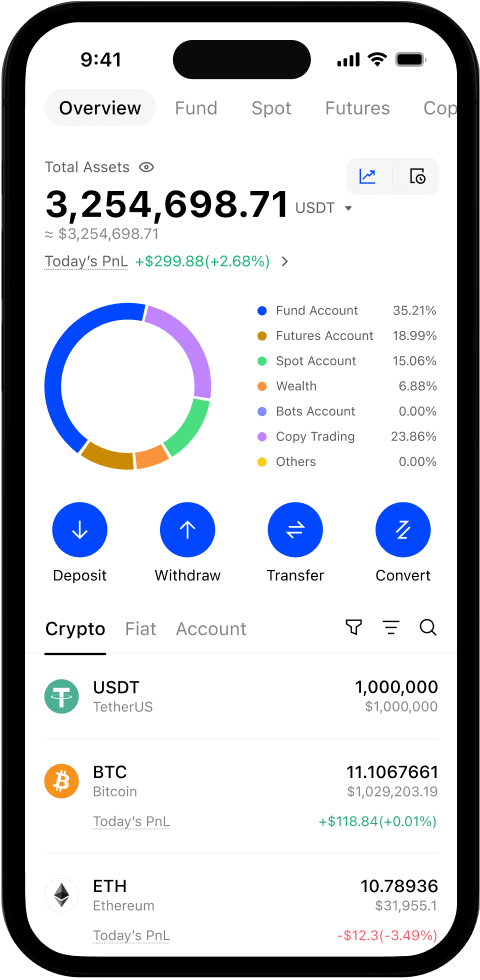
Regular Purchases (DCA): Automate Your Purchases
BingX offers DCA bots and scheduled buying tools on supported markets. Users define the asset, amount, interval, and conditions.
Automation reduces impulsive decisions, but it does not eliminate risk. Each trade incurs a commission and may result in purchases during a prolonged market decline.
Available order types
BingX offers different order types depending on the market:
- Market order: immediate execution as a taker.
- Limit order: sets a price and can provide liquidity.
- Trigger or stop: It is activated when the set price is reached.
- Take-profit and stop-loss: They automate trade closures.
- Trailing stop: adjusts the exit level as the market moves.
Futures offer isolated or cross margin, leverage, reduce-only, and partial closing. Bots execute repetitive rules without constant supervision.
BingX vs. Bybit
The most natural comparison is between BingX and Bybit. Both excel in derivatives, copy trading, bots, and a broad global selection.
| Characteristic | BingX | Bybit |
|---|---|---|
| Foundation | 2018 | 2018 |
| Focus | Copy trading, AI, spot, and futures | Advanced Trading, Spot Trading, Derivatives, and Web3 |
| European Regulation | No confirmed MiCA licence | MiCA License through Bybit EU in Austria |
| Spot Commission | Usually 0.10 % | 0.10 % maker / 0.10 % global taker |
| Perpetual futures | 0.02 % maker / 0.05 % taker | Approximately 0.02 % maker / 0.055 % taker |
| Cryptocurrencies | More than 1,000 | More than 700, according to the organization |
| Security | PoR, Shield Fund, and cold storage | PoR, cold storage, and institutional controls |
| Unique Product | Copy Trading and VST | Liquidity, Bybit EU, and Professional Tools |
| Availability | More than 100 markets; significant restrictions | Global and EU through separate entities |
| Ideal for | Users focused on copy trading | Traders who prioritize liquidity and European regulation |
BingX offers a wider selection of tokens, a highly developed copy trading feature, and an accessible VST demo. Its futures trading fees are competitive.
Bybit offers greater regulatory clarity for EEA residents through its authorized Austrian entity. For a European user in August 2026, that difference carries more weight than a small variation in fees.
Apps and Platform: How Do You Use BingX on a Daily Basis?
BingX offers an app for iOS and Android, a web platform, an API, and tools for traders and copy traders. The navigation menu includes markets, trading, futures, copy trading, and assets.
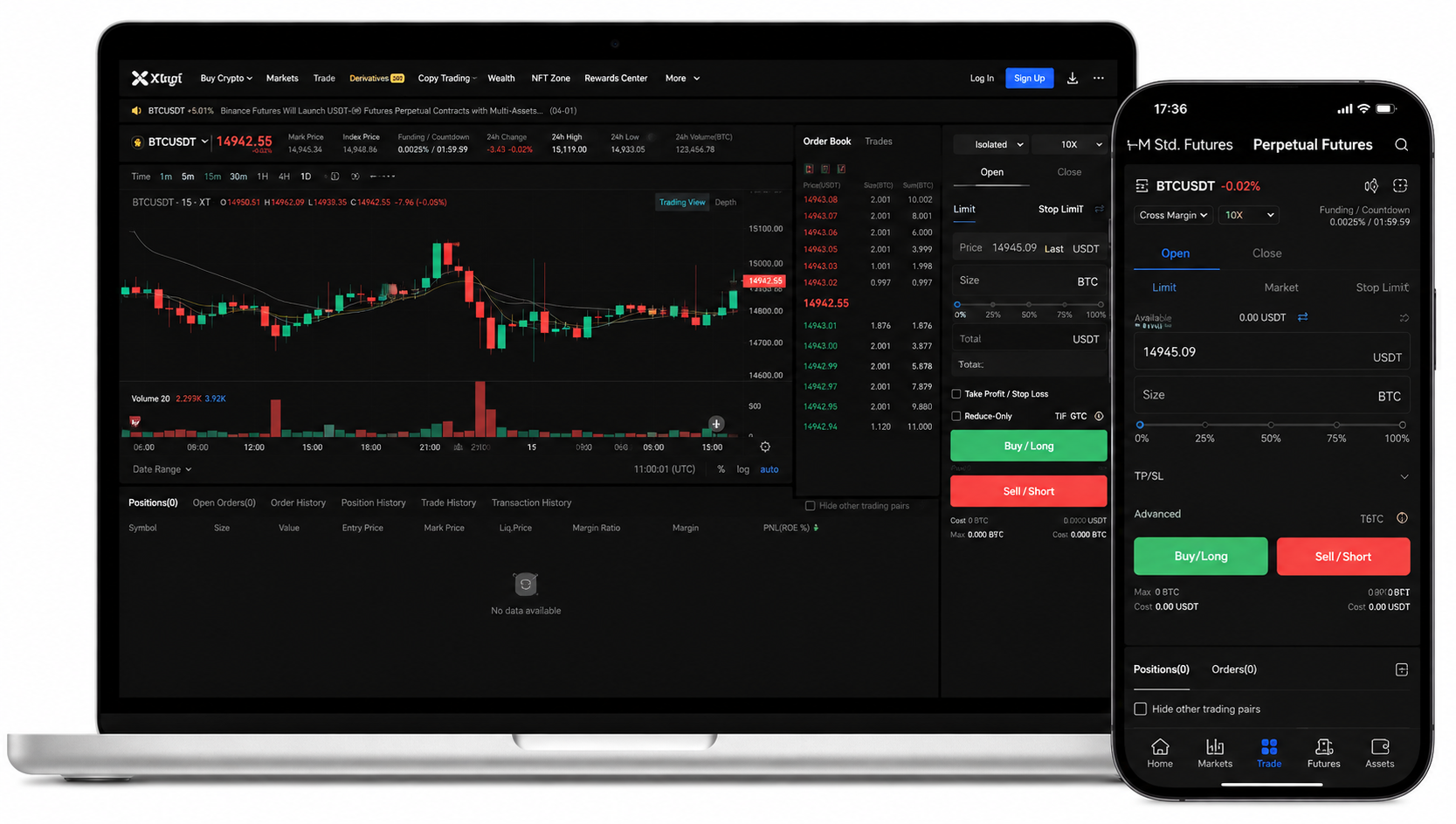
The navigation is organized into several sections:
- Markets: prices, rankings, and new listings.
- Trading: spot, buy, and bots.
- Futures: perpetual, standard, positions, and VST.
- Copy Trading: Selecting Traders and Monitoring Them.
- Assets: funds, deposits, withdrawals, and internal transfers.
The app provides a wealth of information in a compact format. Beginners should hide or avoid derivatives until they understand margin and liquidation.
Each copyable trader's profile displays metrics, but high returns over just a few weeks do not demonstrate consistency. It is best to prioritize trading history, controlled drawdown, and sample size.
Final Verdict: Is BingX Worth It in 2026?
BingX is one of the exchanges most specialized in social trading and trade copying. With over 1,000 assets, competitive futures, bots, VST, Wealth, and AI tools, it offers a powerful suite of features for active users.
In terms of security, the Proof of Reserves and the $150 million Shield Fund are positive factors. The response to the 2024 hot wallet incident prevented the reported losses from being passed on to customers, although this precedent should be taken into account.
Its main weakness as of August 2026 is regulatory. BingX is not listed as an authorized MiCA CASP, so it cannot present itself as a fully regulated option for EU/EEA residents after the end of the transition period.
With all of this in mind, BingX may be an attractive option outside of jurisdictions where copy trading and derivatives are restricted, provided that users understand leverage, custody, and the legal situation. For European residents, a MiCA-licensed alternative offers a clearer regulatory framework.
This review is based on our actual experience using BingX. We tested the platform by making deposits, purchases, sales, and withdrawals of cryptocurrencies, and we also evaluated its fees, security, and ease of use. The rating you see here reflects our hands-on experience, not just a first impression.
Is BingX not for you? Explore other alternatives

Veteran exchange focused on security and compliance. Allows buying, selling, and staking, with pro tools and solid support.

Derivatives and copy trading-focused exchange with a fast app. Includes futures, multiple pairs, and advanced features for agile trading.

Leading global platform by trading volume. It offers spot and futures trading, staking, and a broad ecosystem with reduced fees through BNB.

Dutch MiCA-regulated crypto exchange with a flat 0.15% trading fee, institutional-grade custody through Fireblocks, and no minimum deposit.
Social trading and derivatives-focused platform with a simple interface. It includes copy trading, futures, and fast purchase options using a card.

Popular exchange for derivatives and spot trading, with high liquidity, a fast interface, and advanced tools geared toward active and professional traders.

Spanish exchange focused on ease of use, local support in Spanish, and integrated options for buying, saving, and custodial asset management.

Comprehensive platform offering spot, futures, and earn products. Strong global liquidity, pro tools, and a built-in Web3 wallet for active traders.
Frequently Asked Questions about BingX (Frequently Asked Questions)

I think it's a good exchange, I also like its futures market, not to mention its very low fees, and it has a large number of tokens and cryptos in spot and futures.
It seems like a good exchange to me, and I really like the contests they run.
I've found that using this exchange makes cryptocurrency transactions very simple and fast. Transactions are processed quickly and, in general, with hardly any delays.