
Before we dive into the detailed analysis, here's a summary of Bitget's most important data at a glance.

Bitget Quick Overview
| Score | |
| Established in | 2018 |
| Headquarters | Seychelles |
| Regulator | Global |
| Cryptocurrencies | +740 |
| Maker/Taker | 0,10 % / 0,10 % |
| MiCA regulation | No |
| Minimum deposit | 10 € |
About Bitget: Origins and Target Audience
Bitget is a cryptocurrency exchange founded in 2018 and registered in the Seychelles, although it operates through an international structure with entities and registrations in various jurisdictions. It is available in more than 150 countries and regions, and its offerings focus primarily on spot trading, futures, copy trading, and automated investment tools.
Pros
Spot from 0.10 % and futures from 0.02 % maker
Copy trading integrated into spot and futures trading
More than 800 cryptocurrencies and a wide range of markets
Bitget Earn, bots, and a self-custody wallet
Cons
MiCA authorization is still pending as of August 2026
The sheer number of products can be overwhelming for beginners
Futures and leverage greatly increase risk
Some services are not available in all regions
Since its launch, it has grown to more than 120 million users, according to the company's own figures, with a clear focus from the start: to offer a comprehensive trading platform, with a special emphasis on derivatives and the ability to automatically copy other traders' trades.
Bitget operates globally through various entities and registrations. In Europe, it holds national VASP registrations, and in July 2026, Bitget EU announced that it had submitted a MiCA authorization application to the Austrian Financial Markets Authority. As of the date of this review, the application was still under review and should not be confused with a license that has already been granted.
Who is Bitget for? For users who are already familiar with the basics of how the market works and want to combine spot trading, futures, copy trading, bots, and yield products all on a single platform, while paying competitive fees and gaining access to a wide range of assets.
Bitget has become one of the most recognizable names in crypto copy trading. The platform allows users to view traders' public metrics, allocate a specific amount, and set limits before they start copying their trades.
Behind Bitget lies an expansion strategy that goes beyond the traditional exchange. In 2026, the company will introduce its model as UEX or Universal Exchange, bringing together cryptocurrencies, on-chain assets, and exposure to markets such as stocks, gold, forex, and commodities within a single ecosystem.
What level of security does Bitget offer?
Security is one of the areas that Bitget has strengthened to compete with the world’s largest exchanges. In addition to publishing a Proof of Reserves, the platform maintains a protection fund and employs a custody model that combines cold storage, internal access controls, and user-configurable security tools.
That confidence can also be contrasted with how those who already use the platform rate it:
European Regulation and Application Under the MiCA Framework
Bitget operates through an international structure and is registered as a virtual asset service provider in various jurisdictions. In Europe, it obtained national VASP registrations, including in Lithuania and Bulgaria, which allowed it to conduct business in accordance with the applicable local frameworks.
The European MiCA framework standardizes the requirements that crypto-asset service providers in the European Union must meet. On July 2, 2026, Bitget announced that its subsidiary, Bitget EU, had submitted an application for MiCA authorization to the Austrian Financial Market Authority (FMA).
This means that Bitget had formally initiated the process to operate under the harmonized European framework, but the company itself indicated that authorization was still pending the FMA’s evaluation. Therefore, as of August 5, 2026, it should not be presented as an exchange that has already been granted a MiCA license. If you’d like to see platforms that do have this authorization, you can check out our comparison of the best MiCA-regulated exchanges in Europe.
Custody and protection of funds
Customers' cryptocurrencies are stored using an infrastructure that combines cold wallets and operational funds. Bitget claims to keep most of its assets offline, thereby reducing the direct exposure of its reserves to attacks on connected systems.
In addition, Bitget uses internal controls to manage sensitive transactions and segregates custodial assets from funds used for daily operations. As is the case with any centralized exchange, users do not control the private keys for the balance deposited in their main account.
Key protection measures include:
- Most assets are stored in cold wallets.
- Multi-signature systems and internal controls for sensitive transactions.
- Two-factor authentication and device management.
- Anti-phishing code in official emails.
- Funds password and whitelist of withdrawal addresses.
- A dedicated contingency fund to respond to extraordinary situations.
Reserve Test and transparency
One of Bitget’s key transparency mechanisms is its Proof of Reserves, which is published periodically using a Merkle tree system. This process allows users to verify that the assets included in the snapshot back the customer balances shown on the platform.
Although a Reserve Check does not replace a full financial audit, it does allow each user to verify that their balance was included and provides an additional layer of transparency. The reserve ratio changes monthly and should be checked directly before updating the listing.
The combination of cold storage, Reserve Proof, a protection fund, and advanced account tools places Bitget among the global exchanges with the most public security mechanisms, even though its European regulatory framework was still in transition.
Account Security
At the user level, Bitget includes several features designed to secure access and prevent unauthorized withdrawals. The platform allows users to enable two-factor authentication, anti-phishing codes, a fund password, confirmation of new addresses, and a withdrawal whitelist.
It also includes device management, activity alerts, access reviews, and an official channel to verify whether a domain, email address, or social media profile actually belongs to Bitget.
Pros
Periodic and Verifiable Reserves Test
Proprietary protection fund with a published value
Cold Storage and Multi-Signature Controls
2FA, anti-phishing code, and withdrawal whitelist
Cons
MiCA authorization is still pending as of August 2026
The user does not control the fund keys
There is no bank or government guarantee for cryptoassets
Some services are not available in all regions
Where is Bitget available?
Bitget operates in more than 150 countries and regions through various entities and under different terms of service. The exchange is widely available, but products such as futures, copy trading, stocks, Earn, and cards may be restricted depending on the jurisdiction.
In these markets, users can access the available services as long as they meet the required identification and verification criteria. Spain is listed among the countries that support bank deposits in euros, subject to the provider and the financial institution available at any given time.
The platform does not offer all of its services in countries subject to sanctions or where local regulations prohibit certain products. The United States and other jurisdictions have specific restrictions, so it is advisable to review the current terms directly from your account.
Bitget Fees: How Much Does Trading Really Cost?
One of Bitget’s major draws is its fee structure, which is particularly competitive for spot and futures trading. Unlike an instant purchase, where the provider’s fee and the spread may be combined, trading through the order book allows you to see the applied fee separately.
Trading commission: 0.10 % on spot trades
Bitget charges a base fee of 0.10 % for makers and takers on the spot market. This means that buying 1,000 € worth of Bitcoin incurs a fee of 1 €, before taking into account the spread or potential slippage. Discounts are available based on VIP tier, trading volume, and—when available—for paying fees with BGB.
| Platform | Maker | Taker |
|---|---|---|
 MEXC
MEXC
|
0,00% | 0,05% |
 OKX
OKX
|
0,08% | 0,10% |
 Bybit
Bybit
|
0,10% | 0,10% |
 Bitget
|
0,10% | 0,10% |
 KuCoin
|
0,10% | 0,10% |
 Gemini
|
0,20% | 0,40% |
 Kraken
|
0,25% | 0,40% |
To give you an idea, Bitget is among the exchanges with the lowest initial spot trading fees. Finst charges a fixed rate of 0.15 %, Coinbase Advanced starts at higher rates, and platforms with simplified buying processes may add a significant spread.
Did you know? With a commission of 0.10 %, buying €1,000 worth of Bitcoin on Bitget’s spot market costs €1 in trading commission, before the spread or slippage.
No hidden fees in the order book
Bitget displays the commission for spot trades separately. Cryptocurrency deposits typically do not incur a fee from the exchange, although transfers from another platform are subject to the blockchain fee. Withdrawals are subject to a variable fee depending on the asset and network. Bank deposits, credit cards, and third-party providers may charge their own fees.
Futures and Copy Trading Commission
For futures, Bitget charges a base fee of 0.02 % for makers and 0.06 % for takers. In addition to these amounts, there are funding rates for perpetual contracts, slippage, and liquidation risk. Copy trading uses the fees of the corresponding market and may include profit sharing with the copied trader, subject to applicable terms and conditions.
Overall, Bitget’s fee policy is competitive, but the actual cost depends much more on the product than it does on a spot-only exchange. With derivatives, you need to consider the funding rate and trading frequency, not just the maker or taker fee.
| Concept | Cost on Bitget |
|---|---|
| Spot Commission | 0.10 % maker / 0.10 % taker |
| Futures Commission | 0.02 % maker / 0.06 % taker |
| Cryptocurrency Deposit | 0 € via Bitget; the source network fee is paid |
| Bank deposit in EUR | Varies depending on the method and provider |
| Standard Custody / Maintenance | 0 € |
| Copy trading | Market rate and potential profit sharing |
| Withdrawal to an external wallet | Commission varies depending on the asset and network |
Step-by-Step Guide to Opening an Account on Bitget
Open an account on Bitget It is a digital process that can be completed online or through the app. Each step is detailed below, along with the requirements and necessary documentation.
Step 1: Initial registration
The process begins by downloading the Bitget app or accessing the site through a web browser. Registration requires an email address or phone number and the creation of a password. Bitget then sends a confirmation code and asks you to accept the terms applicable to your country of residence.
Step 2: Identity Verification (KYC)
Bitget requires identity verification to use the platform normally and to access fiat deposits or withdrawals. The process includes:
- A photo of a valid form of identification, such as a national ID card or passport.
- A selfie or "proof of life" to confirm that the user matches the ID.
The required documents vary by country and verification level. In some cases, Bitget may request proof of address, tax information, or documentation regarding the source of funds.
Most automated checks are resolved quickly. Cases that require manual review may take longer, especially if the images are unclear or the data does not match.
Step 3: Link a bank account
To deposit or withdraw euros, Bitget may require a bank account in the same name as the account holder. Depending on the account and the available provider, deposits can be made via:
- SEPA or bank transfer in euros.
- Debit or credit card.
- Apple Pay, Google Pay, or compatible third-party providers.
Did you know? Bitget includes Spain among the countries that support bank deposits and withdrawals in EUR, although the provider, cost, and processing time may vary.
Step 4: First deposit and first trade
The minimum amount depends on the asset and the method used. Once the funds have been credited, the user can make their first purchase either through the direct purchase option or on the spot market with an order book.
Except in cases that require manual review, the process is completed digitally. Before proceeding, it is recommended that you enable 2FA, the anti-phishing code, and the address whitelist.
Summary of Requirements for Opening an Account on Bitget
- Be older than 18.
- Reside in a country supported by Bitget.
- Have a national ID card, passport, or other accepted form of identification.
- Have a phone or device with a camera for the facial recognition test.
- Use a bank account in the same name for fiat transfers.
- Provide tax information or information on the source of funds upon request.
Important note: The availability of spot trading, futures, copy trading, Earn, and the card varies by jurisdiction and the contracting entity.
Available cryptocurrencies: Over 800 assets
Beyond buying and selling Bitcoin or Ethereum, Bitget has expanded its product lineup with offerings designed for trading, automating strategies, and accessing tokens both on and off the traditional order book.
Bitget has announced more than 800 assets, including Bitcoin, Ethereum, Solana, XRP, Dogecoin, and numerous altcoins. The exact number of cryptocurrencies and trading pairs changes with new listings and may vary depending on the user's country.
Copy Trading: Copy strategies with a single click
Copy trading is one of Bitget's most distinctive features. It allows you to automatically replicate the trades of selected traders, rather than executing each order manually. It is available for spot, futures, and other supported trading products.
| Format | Focus |
|---|---|
| Spot Copy Trading | Copy cryptocurrency trades (buys and sells) without direct leverage |
| Futures Copy Trading | Replicate long and short positions with potential leverage |
| Bot Copy Trading | Use automated settings shared by other users |
| Private Copy Trading | Copy strategies via invitation in compatible modes |
| CFD Copy Trading | Exposure broken down by compatible markets, by region |
Beyond choosing a trader, it’s important to understand how this works in practice:
- You can set a specific amount and establish loss limits.
- Past performance is no guarantee of future results.
- There may be a difference in execution between the trader and the follower.
- In futures trading, leverage can lead to rapid losses or liquidation.
Bitget Earn: Earnings on Your Cryptocurrencies
Bitget offers yield products for various cryptocurrencies through flexible options, locked options, staking, and limited-time promotions. The APY varies depending on the asset, demand, network conditions, and the product’s term.
The following is the format that should be used to display the APYs available on the publication date:
| Cryptocurrency | APY |
|---|---|
| Cosmos (ATOM) | 8,70%–15,00% |
| Near Protocol (NEAR) | 3,40%–8,00% |
| Polkadot (DOT) | 4,88%–6,30% |
| Avalanche (AVAX) | 3,60%–6,00% |
| Solana (SOL) | 5,08%–5,66% |
| Cardano (ADA) | 1,01%–4,80% |
| Ethereum (ETH) | 2,23%–2,90% |
Highlights of Bitget Earn:
- Flexible and locked-in products, depending on the asset.
- Variable rewards and deadlines.
- Direct access from the app and the website.
Auto Invest (DCA): automate your purchases
For those who prefer to invest on a recurring basis without having to monitor the price, Bitget offers automatic purchases and periodic investment bots based on the DCA strategy. These allow you to specify the assets, amount, and frequency based on the available options.
Available order types
In addition to direct purchases, Bitget offers:
- Market order: Buy or sell at the best available price.
- Limit order: It is executed when the market reaches the specified price.
- Stop-loss: triggers a sale or order when the set level is reached.
- Take-profit: allows you to close a position when a target is reached.
- Conditional Orders and OCO in compatible markets.
- Auto Invest and bots: automate purchases or execution rules.
Bitget vs. Bybit
The most natural comparison for Bitget pits the platform against Bybit: both exchanges are geared toward active trading, charge similar spot fees, and offer futures, copy trading, bots, and yield products. If you'd prefer to explore this interactively, you can also use our exchange comparison tool.
| Characteristic | Bitget | Bybit |
|---|---|---|
| Foundation | 2018 | 2018 |
| European Regulation | MiCA Application in Austria, Pending as of August 2026 | It depends on the entity and the current authorization |
| Spot Commission | 0.10% maker / 0.10% taker | 0.10% maker / 0.10% taker |
| Futures Commission | 0.02% maker / 0.06% taker | Varies depending on the contract and level |
| EUR Deposits | Available depending on the country and provider | Available depending on the country and provider |
| Cryptocurrencies | 800+ | Approximately 600+ |
| Security | Reserve Test and Protection Fund | Reserve Test and Insurance Fund |
| Copy trading | Spot, Futures, and Additional Trading Methods | Futures and Compatible Modalities |
| Bots | Grid, DCA, Martingale, and others | Grid, DCA, and others |
| Platform | Web, mobile app, and desktop | Website, mobile app, and Pro tools |
| Ideal for | Copy trading, futures, and a wide selection | Derivatives Trading and Advanced Tools |
Bitget is particularly focused on copy trading and on integrating an increasing number of asset classes into its UEX concept. Bybit offers an equally trader-centric experience, with a strong focus on derivatives and execution tools.
For those looking to copy strategies and access a very broad ecosystem, Bitget offers a particularly comprehensive solution. For those who prioritize a derivatives-focused interface and professional tools, Bybit remains a direct alternative.
Apps and Platform: How Do You Use Bitget on a Daily Basis?
Bitget offers a mobile app for iOS and Android, a web platform, and a desktop client. Most features are available on both mobile and desktop, allowing users to trade spot, futures, copy trading, bots, and Earn from the same account.
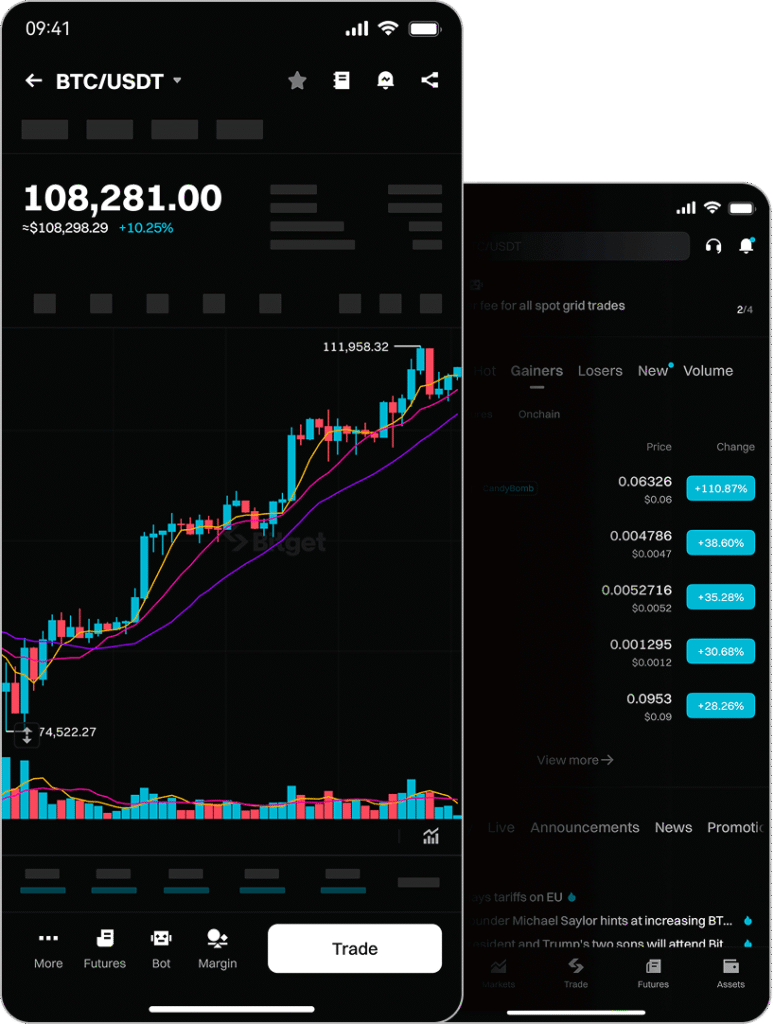
The navigation is organized into several sections:
- Markets: Access to prices, listings, and available trading pairs.
- Trading: spot, margin, futures, and orders.
- Copy Trading: Selecting and Monitoring Traders.
- Earn: flexible products, locked-in products, and campaigns.
Bitget includes charts, an order book, indicators, history, P&L, and risk management tools. It also offers watchlists and alerts to track assets without having to hold them in your portfolio.
In terms of execution, it offers market, limit, stop, take-profit, and conditional orders, as well as bots and an API. This provides much more control than an app focused solely on buying and selling.
Pros
App, web, and desktop with advanced features
Advanced Orders, Bots, and APIs
Built-in charts and technical indicators
Copy trading accessible from the main platform
Cons
Complex Interface for Beginners
A wide variety of promotions and products available while browsing
Some features vary by country
Futures appear to be highly integrated and require an understanding of their risks
Final Verdict: Is Bitget Worth It in 2026?
Bitget works especially well for users who prioritize trading tools, copy trading, and a wide variety of assets. Its spot trading fee of 0.10 %, combined with competitive futures fees, the Reserve Proof, and the breadth of its ecosystem, make it a solid choice for frequent traders who want to consolidate multiple strategies onto a single platform.
That said, Bitget has clear limitations. The interface can be complex for a beginner, and the constant presence of futures, bots, and yield products makes it easy to access tools that involve greater risk. Furthermore, its MiCA authorization was still pending as of August 2026, so it does not offer the same level of regulatory clarity in Europe as an exchange that has already been granted a license.
All things considered, Bitget is a good option for active traders and users interested in copy trading, but not so much for those who are simply looking to buy and hold cryptocurrencies in a minimalist app. If you fall into the first category, the fees and tools make up for its complexity; if not, you should consider simpler, EU-regulated alternatives.
This review is based on actual use of Finst. We have tested the platform by making deposits, purchases, sales and withdrawals of cryptocurrencies, as well as evaluating its fees, security and ease of use. The assessment you read reflects practical experience, not a first impression.
Not for you, Bitget? Explore other alternatives

Veteran exchange focused on security and compliance. Allows buying, selling, and staking, with pro tools and solid support.

Regulated exchange licensed in New York, focused on institutional-grade security, certified custody, and transparent operations for demanding investors.

Leading global platform by trading volume. It offers spot and futures trading, staking, and a broad ecosystem with reduced fees through BNB.

European exchange with a clean interface and competitive fees. Ideal for trading crypto with SEPA transfers and stable liquidity in the European market.

Social trading and derivatives-focused platform with a simple interface. It includes copy trading, futures, and fast purchase options using a card.

Popular exchange for derivatives and spot trading, with high liquidity, a fast interface, and advanced tools geared toward active and professional traders.

Spanish exchange focused on ease of use, local support in Spanish, and integrated options for buying, saving, and custodial asset management.

Comprehensive platform offering spot, futures, and earn products. Strong global liquidity, pro tools, and a built-in Web3 wallet for active traders.
(FAQ) Frequently Asked Questions About Bitget

I use Bitget, and honestly, it does everything you'd expect for spot trading. Good review.
I've been using it for a while now, and overall it's fine, but there are times when the app gets a little confusing, and if you run into any issues, customer support takes a long time to respond.
All of a sudden, my bitcoins stopped showing up in Bitget Wallet, even though no withdrawals or transactions had been recorded. In the end, it turned out to be an app glitch, but it was quite a scare.
Good analysis. I like that you highlighted Bitget’s strengths in copy trading and futures, but also noted that the interface can feel too cluttered for beginners. That’s an important point that many exchange reviews overlook.
I've used Bitget before, and it's a powerful tool if you already know what you're doing. But for everyday crypto trading, I've recently been spending more time on BYDFi because the experience feels more streamlined and easier to navigate. I still compare fees, liquidity, withdrawals, and security before trusting any platform, but simplicity matters more than people realize.
For most users, the best exchange isn't always the one with the most features. It's the one they can use without making avoidable mistakes.