
Before we dive into the detailed analysis, here's a summary of Bitso's key metrics at a glance.

Bitso Quick Overview
| Score | |
| Established in | 2014 |
| Headquarters | Mexico |
| Regulator | GFSC DLT License in Gibraltar and Locally Regulated Entities |
| Cryptocurrencies | +100 |
| Maker/Taker | 0,60% / 0,78% |
| Minimum deposit | 1€ |
About Bitso: Its Origins and Who It's Intended For
Bitso is a cryptocurrency exchange founded in Mexico in 2014 and one of Latin America's leading cryptocurrency platforms. It combines a user-friendly app for investing with Bitso Alpha, weekly returns, international transfers, more than 5,000 stocks and ETFs, and B2B solutions.
Pros
More than a decade of experience and nearly 10 million users analyzed in its key markets
More than 100 cryptocurrencies, 5,000 stocks/ETFs, and Bitso Alpha
Earnings paid out every Monday with no hold period
DLT License, CCSS AAA, ISO 27001, and Monthly Proof of Solvency
Cons
It does not have MiCA authorization and expressly excludes residents of Spain
Alpha's initial rates were high in some local-currency books
Rates are subject to change and are not guaranteed
Products and terms vary by country
Bitso focuses its retail business on Latin America and connects SPEI, PIX, PSE, and CBU/CVU. Bitso Business expands the ecosystem with cross-border payments, APIs, and settlement via stablecoins for businesses.
Who is Bitso for? For users in Mexico, Argentina, Brazil, and Colombia who are looking to invest in cryptocurrency and stocks, earn returns, or transfer money through local banking systems.
What level of security does Bitso offer?
Bitso combines an international DLT license, local entities, multi-signature custody, KYC, two-factor authentication, ISO/IEC 27001, and monthly solvency testing. In 2026, it also earned the highest AAA rating (three stars) under CCSS 2025.
That confidence is also reflected in how those who already use the platform value it:
Global Regulation
Bitso International operates through The Badger Technology Company Limited, which is authorized as a DLT provider by the Gibraltar Financial Services Commission under license number FSC1348B. This license imposes requirements regarding custody, controls, and auditing, but does not constitute a CASP authorization under MiCA.
In Mexico, it uses Nvio Pagos México, an IFPE regulated under the Fintech Law; in Brazil, it operates through a local payment institution; and it maintains specific structures in Argentina and Colombia. The exact scope depends on the entity assigned to the user.
Custody and protection of funds
Bitso segregates client funds from corporate capital and uses multi-signature wallets and audited custody controls. The CCSS Version 9.0 certification with AAA rating specifically evaluates the management of keys and digital assets.
The company maintains continuous monitoring, a bug bounty program on Bugcrowd, automated fraud detection, and an internal investigation unit called Quetzal. The account requires KYC and offers 2FA, PIN, Face ID, and session management.
Investments in stocks may be covered by specific insurance policies of up to 500,000 USD under the provider's terms, but that protection does not automatically extend to cryptocurrencies, earnings, or market losses.
Reserve Test and transparency
Bitso publishes a monthly Solvency Test based on zero-knowledge proofs. The system allows each customer to cryptographically verify that their balances are included without revealing the private information of other users.
This verification provides more information than a static list of addresses, but it does not replace a comprehensive financial audit of the entire group. The date of the most recent audit and the assets included should also be verified.
Earnings involves different risks than standard custody. The platform does not list all the mechanisms used to generate each return on a single page, so users must read the terms and conditions for each asset and country.
Account Security
The platform requires KYC and implements access controls, encryption, and internal procedures. Users must use a unique password, biometric authentication when available, and always verify their email address, domain, and withdrawal information.
ISO 27001 certification attests to a security management system that is subject to controls, but it does not guarantee that an incident will never occur. Bitso has not publicly suffered a massive loss of customer funds comparable to major international hacks.
Blockchain transfers are irreversible. Sending funds to the wrong network, disclosing codes, or following instructions from a fake support team can result in losses beyond the platform’s control.
Security Pros
Gibraltar DLT License and Locally Regulated Entities
CCSS 2025 AAA and ISO/IEC 27001
Monthly Solvency Test Using Zero-Knowledge Proofs
2FA, multi-signature, Bugcrowd, and monitoring
Security Drawbacks
No MiCA authorization for Spain or the EEA
There is no public fund for crypto balances
Earnings Adds Counterparty Risk and Strategy
Centralized custody: the user does not control the keys
Bitso's Global Availability
Bitso operates primarily in Mexico, Argentina, Brazil, and Colombia. It also holds an international license in Gibraltar and offers business services in other regions, but the app and retail products are not available globally on a uniform basis.
Local payment methods include SPEI in Mexico, PIX in Brazil, PSE in Colombia, and CBU/CVU in Argentina. Earnings, Alpha, stock transactions, and international transfers may be subject to different terms and conditions in each country.
In the United States, Europe, and other markets, the presence of Bitso Business or a group company should not be interpreted as automatic access to the retail app. Eligibility must always be verified during registration.
Bitso Fees
Bitso separates simple in-app conversions from trading via Bitso Alpha. Alpha uses tiered maker/taker fees based on the order book, the currency, and the cumulative volume over the last 30 days.
Trading Commission: Tiered Maker/Taker Structure by Market
For MXN trading pairs, the published initial level is around 0.60 % for makers and 0.78 % for takers. For pairs with USDC or USDT, base fees can start at approximately 0.30 % and 0.36 %, respectively, and decrease as volume increases.
| Platform | Maker | Taker |
|---|---|---|
 Bitso
Bitso
|
From 0.60 1Q3Q | From 0.78 1Q3Q |
 Finst
Finst
|
0,15 % | 0,15 % |
 Bitvavo
|
0,15 % | 0,25 % |
 BLOX
BLOX
|
Not applicable | 0.25 % flat |
 Bit2Me
|
Variable | Variable by volume |
 Kraken
|
0,25 % | 0,45 % |
 Coinbase Advanced
|
0,40 % | 0.60 % in the reference segment |
The main app uses a simplified conversion, and the final price is displayed before you confirm. To compare costs, you should check the amount received and not assume that Alpha's rate applies to a retail conversion.
Did you know? A taker order of 10,000 MXN at 0.78 % results in a commission of 78 MXN. The same order with a rate of 0.26 % would cost 26 MXN, so the 30-day volume has a direct impact.
Global Fiat Deposits and Withdrawals
Fiat deposits and withdrawals vary by country: SPEI in Mexico, PIX in Brazil, PSE in Colombia, and CBU/CVU in Argentina. Many deposits made via local bank transfer are free or low-cost, although the bank or provider may charge fees.
International transfers and conversions between local currency and digital dollars may include exchange rates or broker fees. The app displays the limits and the final amount before you confirm.
Crypto deposits do not have a general receiving fee, but the source network charges a fee. Blockchain withdrawals incur a variable fee depending on the asset, the chain, and network congestion.
Earnings Commission and Advanced Products
Bitso Earnings displays the applicable APY before the product is activated and does not list a separate fee for the user. Earnings are paid out every Monday; there are no fixed terms, and funds can be withdrawn when the product is deactivated.
Rates fluctuate with the market. Stocks and ETFs are advertised as commission-free on compatible markets, but there may be trading, execution, spread, or provider fees under the terms and conditions.
| Concept | Cost at Bitso |
|---|---|
| Alpha MXN, Beginner Level | Approximately 0.60 % maker / 0.78 % taker |
| Alpha USDC/USDT, starting level | Approximately 0.30 % maker / 0.36 % taker |
| Local Bank Deposit | Usually free or varies depending on the method |
| International transfer | Variable costs and exchange rates |
| Crypto Deposit | 0 via Bitso; the originating network is responsible for the payment |
| Crypto Withdrawal | Variable Network Commission |
| Earnings | No visible direct fee; variable APY |
| Stocks and ETFs | No commission announced; review changes and implementation |
Step-by-Step Guide to Opening an Account on Bitso
Registration is completed through the app or website and requires identification. The residence determines payment methods, terms, and product availability.
Step 1: Initial registration
The user enters an email address or phone number, creates a password, and verifies their contact information. They should always log in through the website or official apps.
Residence and nationality must be reported accurately. This information determines the contracting entity and the applicable controls.
Step 2: Identity Verification (KYC)
Bitso requests an official document, a selfie, or a video, along with personal information. It may also ask for your address, tax residence, economic activity, and the purpose of the account.
For large amounts or unusual transactions, proof of the source of funds, pay stubs, bank statements, or tax returns may be required. This is an AML requirement and not an optional procedure.
Step 3: Link a bank account
Users can deposit local currency via SPEI, PIX, PSE, or CBU/CVU, depending on their country. The bank account must belong to the verified account holder.
You can also deposit supported cryptocurrencies. Before sending, be sure to check the asset, network, address, and memo; a quick test can help prevent errors.
Did you know? Bitso Business connects the four main local payment systems in its markets through a shared infrastructure for regional settlements.
Step 4: First Purchase or Activation of Earnings
To make a purchase, the user selects the asset, enters the amount, and reviews the price and final quantity. If you need to place limit or market orders, you can use Bitso Alpha with the same account.
Before activating Earnings, you should check the APY, the asset, availability, and risks. Payments are made on Mondays, and there is no lock-in period, but the rate may change.
Summary of Requirements for Opening an Account with Bitso
- Be older than 18.
- Reside in an eligible jurisdiction.
- Have a valid official document.
- Complete the selfie or biometric verification.
- Provide your mailing address and tax residence.
- Use your own bank account or card.
- Provide proof of the source of funds when requested.
Important note: Make a small initial transfer and withdrawal before holding a large amount and/or activating high-yield products.
Available cryptocurrencies: more than 100 assets
Bitso offers more than 100 crypto assets, including BTC, ETH, XRP, SOL, ADA, DOGE, USDC, USDT, DOT, ATOM, and numerous emerging tokens. The specific list varies by country and regulatory criteria.
Earnings supports assets such as USDC, USDT, ETH, DOT, ATOM, and SOL. Not all cryptocurrencies offer yields, nor do they all support the same deposit and withdrawal networks.
The app also includes more than 5,000 U.S. stocks and ETFs on supported markets. These securities are not cryptocurrencies and are subject to different terms, providers, and coverage.
Bitso Learn, Actions, and Business: Education and Tools
Bitso combines trading, returns, and educational content. Its blog explains cryptocurrencies, investing, stocks, and international money transfers.
| Product | Focus |
|---|---|
| Bitso App | Buying, selling, transfers, and easy investing |
| Bitso Alpha | Order Book and Advanced Tools |
| Bitso Earnings | Flexible returns with weekly payments |
| Stocks and ETFs | More than 5,000 U.S. securities by country |
| Bitso Business | Global Payments, APIs, and Settlement with Stablecoins |
| Bitso Learn | Education on Cryptocurrency, Investing, and Finance |
Beyond buying and selling, Bitso offers:
- More than 100 cryptoassets.
- More than 5,000 stocks and ETFs.
- Earnings are paid out every Monday.
- Local and international transfers.
- Bitso Alpha with an order book.
- Services for individuals and businesses.
Bitso Earnings: Earnings on Your Cryptocurrencies
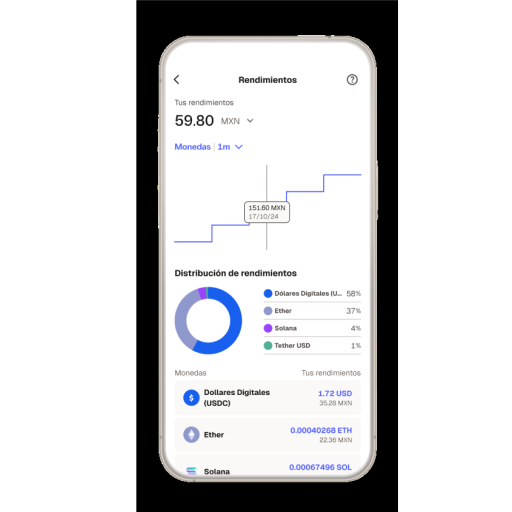
Rates depend on the asset and fluctuate with the market. Earnings is flexible, does not lock up funds, and pays out rewards every Monday.
| Product | Focus |
|---|---|
| Buy Crypto | Simple buying and selling with a predetermined final price |
| Ripio Returns | Variable return on eligible assets |
| Crypto Card | Visa Payments and Cashback by Country |
| Local Payments | QR, PIX, and services in eligible markets |
| Ripio Business | APIs, OTC, Liquidity, and Tokenization for Businesses |
| Ripio Launchpad | Education and News from the Crypto Ecosystem |
The most important thing about Bitso Earnings:
- Rewards are credited every Monday.
- No fixed terms or mandatory lock-in periods.
- Turn on and off from the app.
- APY varies by asset and terms.
- Counterparty risk and stablecoin; this is not a bank deposit.
Regular Purchases (DCA): Automate Your Purchases
The availability of recurring purchases may vary by country and app version. When this feature is enabled, the user sets the amount, asset, and frequency to implement a dollar-cost averaging (DCA) strategy.
Each trade is subject to the applicable price and cost. For frequent purchases, you should compare the retail conversion rate with the rates offered by Alpha and other platforms.
Available order types
Bitso Alpha offers a professional order book and various execution types. Its main trading features are:
- Instant buying and selling through conversion.
- Market and limit orders on Alpha.
- Stop-loss and stop-limit orders.
- Fiat or crypto deposits and withdrawals.
- Flexible activation of Earnings.
The separation between the app and Alpha makes it easier to get started, although it requires switching platforms to monitor price, execution, and the order book.
Bitso vs. Ripio
The most natural comparison is between Bitso and Ripio. Both were founded in Latin America, support local currencies, offer returns, and provide services for businesses, but Bitso adds Alpha and a wide range of stocks.
| Characteristic | Ripio | Bitso |
|---|---|---|
| Foundation | 2013 | 2014 |
| Main Market | Argentina, Brazil, and other countries in Latin America | Mexico and other countries in Latin America |
| Assets | More than 100 | Catalog Varies by Market |
| Retail Commission | 0.5 %; BTC with no commission | Varies depending on the product and volume |
| Maker/Taker in the main app | Not applicable | Available on Bitso Alpha |
| Card and Payments | Visa, QR, PIX, and country-specific services | Cards and Transfers by Country |
| Local stablecoins | Regional wFiat Ecosystem | Greater Focus on Digital Currencies and Payments |
| Security | SOC 1/2, PoR, and 2FA/MFA | Local Regulatory Controls and Records |
| MiCA | No license confirmed | No license confirmed |
Bitso stands out for combining simple investing, Alpha, Earnings, and stocks within a single ecosystem. It has a particularly strong presence in Mexico.
Ripio offers a service that focuses more on local payments and stablecoins, particularly in Argentina and Brazil. The best option depends on the country, banking method, and product you're looking for.
Apps and Platform: How Is Bitso Used on a Day-to-Day Basis?
Bitso offers an app for iOS and Android, web access, and Bitso Alpha. The navigation menu focuses on the portfolio, investing, Earnings, stocks, transfers, and transactions.
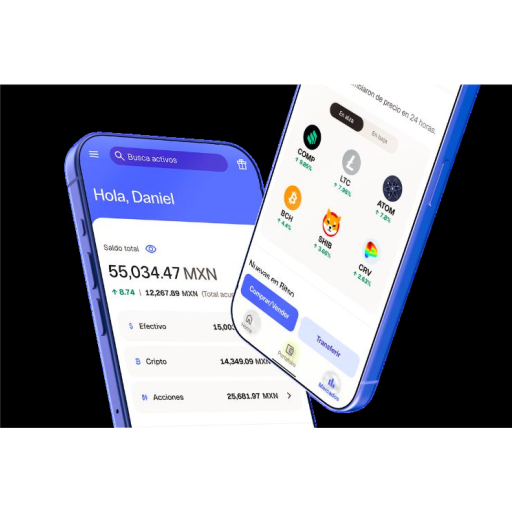
The main app avoids complex charts and guides users through trading. Alpha includes charts, books, market orders, limit orders, and stop orders for advanced users.
Public reviews highlight ease of use and customer support, although there are also criticisms regarding fees, spreads, and occasional app glitches.
Final Verdict: Is Bitso Worth It in 2026?
We believe Bitso is one of the most comprehensive platforms for users in Mexico, Argentina, Brazil, and Colombia. It combines more than 100 cryptocurrencies, Bitso Alpha, weekly earnings, transfers, and more than 5,000 stocks and ETFs, with a track record spanning more than ten years.
Its main strengths are its integration with local banks, its DLT license, its AAA CCSS rating, and its monthly solvency test. On the other hand, Alpha's initial fees may be high, its products vary by jurisdiction, and Earnings does not guarantee either principal or returns.
Ultimately, Bitso is a worthwhile option in its Latin American markets for anyone who wants to combine investing, trading, and payments in a single account. It is not an option for residents of Spain: the company itself states that it does not have MiCA authorization and prohibits opening accounts or trading from within the country.
This review is based on our actual experience using Bitso. We tested the platform by making deposits, purchases, sales, and withdrawals of cryptocurrencies, and we also evaluated its fees, security, and ease of use. The assessment you are reading reflects hands-on experience, not a first impression, and does not constitute financial advice. Cryptocurrencies are high-risk assets.
Is Bitso not for you? Explore other options

Veteran exchange focused on security and compliance. Allows buying, selling, and staking, with pro tools and solid support.

Derivatives and copy trading-focused exchange with a fast app. Includes futures, multiple pairs, and advanced features for agile trading.

Leading global platform by trading volume. It offers spot and futures trading, staking, and a broad ecosystem with reduced fees through BNB.

European exchange with a clean interface and competitive fees. Ideal for trading crypto with SEPA transfers and stable liquidity in the European market.

Social trading and derivatives-focused platform with a simple interface. It includes copy trading, futures, and fast purchase options using a card.

Popular exchange for derivatives and spot trading, with high liquidity, a fast interface, and advanced tools geared toward active and professional traders.

Spanish exchange focused on ease of use, local support in Spanish, and integrated options for buying, saving, and custodial asset management.

Comprehensive platform offering spot, futures, and earn products. Strong global liquidity, pro tools, and a built-in Web3 wallet for active traders.