
Before we dive into the detailed analysis, here's a summary of Bitunix's key metrics at a glance.

Bitunix Quick Overview
| Score | |
| Established in | 2021 |
| Headquarters | Saint Vincent and the Grenadines |
| Regulator | FinCEN (U.S.) |
| Cryptocurrencies | 750+ spot pairs |
| Maker/Taker Spot | 0,08 % / 0,10 % |
| Futures Maker/Taker | 0,02 % / 0,06 % |
| Minimum deposit | 0 € |
About Bitunix: Origin and Target Audience
Bitunix is a cryptocurrency exchange founded in 2021 that specializes in spot trading and, above all, in highly leveraged derivatives. The company does not list a single corporate headquarters and operates under a Money Services Business (MSB) registration with FinCEN in the United States, while various industry sources indicate that it operates out of Saint Vincent and the Grenadines. It has grown rapidly to more than 3 million users in over 100 countries and handles more than $5 billion in daily trading volume, placing it among the top ten exchanges by open interest in derivatives.
Pros
Futures starting at 0.02% / 0.06% and up to 200x
Initial registration without KYC
Monthly Proof of Reserves and MPC Custody
Copy Trading, Dual Investment, and Staking
Cons
No MiCA license for the EEA as of July 2026
Corporate headquarters: undisclosed
KYC is required for withdrawals exceeding certain limits
No public guarantee or compensation fund
Bitunix was founded with a clearly different approach from that of exchanges geared toward European retail investors: its priority has been to offer active trading tools (spot trading, highly leveraged futures, copy trading) rather than a simple «buy-and-hold» experience. Its business model relies on competitive commissions for high-volume traders and a VIP tier system that rewards active trading over occasional use.
Unlike Finst, Bitvavo, or Coinbase, Bitunix does not hold a MiCA authorization or any equivalent registration with a European Union regulator. Its regulatory coverage is limited to registration as an MSB in the United States, a designation that is far less stringent than a European CASP license and does not entail comparable prudential oversight or investor protection.
Who is Bitunix for? Outside the EEA, for active traders who prioritize low futures commissions, high leverage, and a quick registration process over local regulation.
Bitunix relies on its own Care Fund, valued at 30 million dollars in USDC, intended to cover emergencies affecting users. It is a mechanism similar in spirit to Binance’s SAFU, although smaller in scale and without the same track record.
What level of security does Bitunix offer?
Bitunix’s technical security is based on predominantly cold storage, MPC custody through providers such as Cobo and Fireblocks, external audits by firms such as Hacken, and a Proof of Reserves system published monthly. However, for a European user, security must be weighed against the lack of a MiCA license and the lack of transparency regarding the company’s headquarters.
That confidence is also reflected in how those who already use the platform value it:
European Regulation and Lack of a MiCA License
Bitunix is not listed in the European Securities and Markets Authority (ESMA) registry of authorized crypto-asset service providers under MiCA. The transitional period for the European regulation ended on July 1, 2026, after which only platforms with CASP authorization may acquire clients and provide services as usual in the 30 countries of the European Economic Area.
Unlike Binance, which did apply for a MiCA license in Greece and withdrew it before a potential denial, there is no public record that Bitunix has initiated an authorization process in any Member State. This places the platform in an even weaker regulatory position than that of other unlicensed global exchanges, as there is also no officially communicated transition plan or orderly exit strategy for EEA customers.
Important note: Bitunix has added France to its own list of prohibited jurisdictions after being included on the list of unauthorized platforms published by the AMF, the French financial regulator.
This means that, as of August 2026, a resident of Spain who opens or maintains an account with Bitunix does so without the protections required by MiCA: without mandatory asset segregation rules overseen by a European regulator, without a complaint procedure before a national authority, and without a guarantee of service continuity. If you’re looking for a platform that operates normally in Spain, you can check out our comparison of the best MiCA-regulated exchanges in Europe.
Custody and protection of funds
Bitunix states that it maintains a 1:1 reserve ratio for user funds, which is verifiable through a Proof of Reserves system based on Merkle trees and published monthly. Asset custody relies on third-party providers specializing in MPC (Multi-Party Computation) technology, which reduces the risk that a single private key could compromise the funds.
Added to this is the Care Fund, a $30 million fund denominated in USDC that the company has set up to respond to exceptional incidents. However, this is a unilateral commitment by the company, without the legal backing of a bank guarantee fund or the oversight of a European regulator.
Key protection measures include:
- Custody using MPC technology with providers such as Cobo and Fireblocks
- Most funds are stored in cold storage
- Monthly Proof of Reserves with Merkle Tree Validation
- $30 million Care Fund in USDC for exceptional incidents
- Audits and bug bounty programs managed by Hacken
Reserve Test and transparency
Bitunix publishes its Proof of Reserves on a monthly basis—more frequently than many of its competitors—allowing users to regularly verify that the declared assets back the platform’s balances. CoinGecko gives Bitunix a Trust Score of 8 out of 10, calculated based on factors such as security, the availability of Proof of Reserves (PoR), and assurance measures.
Although this level of transparency is a plus, it still does not replace a full financial audit or the prudential supervision required by a regulator such as the AFM or the CSSF under MiCA. Nor does it make up for the lack of public information regarding the company’s corporate structure and actual registered office—an area in which Bitunix is notably less transparent than publicly traded or European-licensed exchanges.
Important note: A Proof of Reserves is not the same as a financial audit, nor does it offer the same protection as a regulated guarantee fund.
Account Security
At the user level, Bitunix offers two-factor authentication via Google Authenticator or SMS, anti-phishing codes, in-app facial recognition, and whitelisted withdrawal addresses. These tools are in line with those offered by other global exchanges geared toward active trading.
One of Bitunix’s distinctive features is that it allows users to trade without mandatory identity verification in the early stages, with withdrawal limits of around $10,000 per day without full KYC. Exceeding those limits, as well as making purchases with a credit card, requires completing the verification process. Furthermore, as of July 2026, withdrawals will require completed KYC, which reduces the level of anonymity the platform initially offered.
Pros
Monthly Proof of Reserves with a Merkle tree
MPC Custody with Cobo and Fireblocks, Audits by Hacken
$30 million Care Fund in USDC
2FA, anti-phishing codes, and facial recognition
Cons
No MiCA license or equivalent protection for EEA users
Corporate headquarters not publicly disclosed
Signing up without initial KYC verification is offset by low withdrawal limits
No guarantee fund backed by a banking regulator
Where is Bitunix available?
Bitunix claims to operate in more than 100 countries worldwide, with a particularly strong presence among traders seeking high leverage on derivatives. The platform explicitly excludes the United States and its territories from its full range of operations (it only allows limited crypto-to-crypto trading through its MSB registration), and since May 2026, it has expanded its list of restricted jurisdictions.
In the European Union, the situation changed significantly in 2026. The French regulator (AMF) added Bitunix to its list of unauthorized platforms, and the end of the MiCA transition period on July 1, 2026, left the platform without any EEA country in which it can operate normally and attract new customers—a situation that sets it apart even from other unlicensed exchanges that had already begun the application process.
Bitunix Fees: How Much Does Trading Really Cost?
Bitunix's commission structure is designed for active traders, particularly those trading derivatives, where fees are among the lowest in the industry. The platform clearly distinguishes between spot and futures trading and applies progressive discounts based on the VIP level achieved through monthly trading volume or account balance.
Trading commission: 0.08 % / 0.10 % for spot trades and 0.02 % / 0.06 % for futures
On the spot market, Bitunix charges a base fee of 0.08 % for makers and 0.10 % for takers. For futures, the fee drops to 0.02 % for makers and 0.06 % for takers at the initial level, with additional discounts as users move up through VIP tiers. Users reach the first VIP level with a monthly trading volume of 100,000 USDT in spot trading, 1,000,000 USDT in futures trading, or an account balance of at least 1,000 USDT.
| Platform | Maker | Taker |
|---|---|---|
 MEXC
MEXC
|
0,00% | 0,05% |
 OKX
OKX
|
0,08% | 0,10% |
 Bybit
Bybit
|
0,10% | 0,10% |
 Bitunix
|
0,08% | 0,10% |
 Binance
|
0,10% | 0,10% |
 Kraken
|
0,25% | 0,45% |
At the highest VIP levels, Bitunix can reduce futures commissions to as low as 0.006 % for makers and 0.03 % for takers—rates that compete directly with those of major global derivatives-focused exchanges, such as Bybit and OKX.
Did you know? With a base futures fee of 0.06 % for takers, opening a position of 1,000 € costs 0.60 €. On Binance, the same spot trade with a standard fee of 0.10 % would cost 1 €.
Deposits and withdrawals: free for crypto, variable fees for fiat
Cryptocurrency deposits are free on Bitunix; users only pay the network fee charged by the source blockchain. Purchases with fiat currency through third-party providers (credit card, Apple Pay, or other payment methods) do incur a fee, which varies depending on the provider used, since Bitunix does not offer a direct banking channel equivalent to SEPA used by regulated European exchanges.
Dual Investment, Staking, and Copy Trading Committee
Bitunix does not charge an additional commission for Dual Investment transactions, a structured product linked to a target price and date. As for staking and interest-bearing accounts, the platform retains 15% of the interest earned as a risk reserve, paying the remaining 85% to the user. Copy trading does not incur any additional fees beyond those associated with standard spot or futures trading, although the traders being copied may charge a performance fee on the profits generated.
Overall, Bitunix’s fee structure is very competitive for derivatives trading, although it is less relevant for European investors who can no longer access the platform normally following the end of the MiCA transition period.
| Concept | Cost on Bitunix |
|---|---|
| Spot Trading Commission | 0.08 % maker / 0.10 % taker |
| Futures Trading Commission | 0.02 % maker / 0.06 % taker |
| Maximum VIP Commission (Futures) | 0.006 % maker / 0.03 % taker |
| Cryptocurrency Deposit | 0 €; network fee only |
| Buy with a card / fiat onramp | Varies by external provider |
| Dual Investment | No additional fee |
| Staking / Interest-Bearing Accounts | 15 % risk reserve on interest earned |
| Withdrawal to an external wallet | Commission varies depending on the asset and network |
Step-by-Step Guide to Opening an Account on Bitunix
Opening an account on Bitunix is, on paper, faster than on a MiCA-regulated exchange, since the initial registration does not require identity verification. However, for a resident of the European Union, this speed loses much of its practical value, given that the platform cannot provide services normally after the end of the transition period.
Step 1: Initial registration
The process begins on the Bitunix website or app (available for iOS and Android) by providing an email address or phone number and creating a password. Unlike MiCA-licensed exchanges, Bitunix does not require you to complete KYC in this first step in order to trade with reduced limits.
Identity verification (KYC), optional at the start but required to trade normally
Although it is not required during initial registration, identity verification becomes mandatory to exceed certain withdrawal limits, make purchases with a card, or access products with higher limits. The process includes:
A photo of a valid ID (national ID card or passport, depending on the country). A proof-of-life photo or selfie to confirm that the user matches the ID. Important note: As of July 1, 2026, Bitunix requires completed KYC verification to withdraw funds, regardless of the trading level, which significantly reduces the platform’s initial level of anonymity.
Step 3: Link a payment method
To deposit funds, Bitunix primarily supports direct cryptocurrency deposits and, for fiat currencies, external payment providers (credit cards, Apple Pay, or other methods depending on the region), since it does not offer its own SEPA banking channel like EU-regulated exchanges do.
Did you know? Bitunix does not have its own SEPA deposit channel, so making purchases in euros usually involves using a third-party provider, which entails additional costs compared to a direct bank deposit.
Step 4: First deposit and first trade
Once the funds have been credited, the user can trade on the spot market or open a leveraged futures position. Bitunix does not set a minimum deposit, although the practical minimums depend on the network used or the chosen payment provider.
Summary of requirements for opening an account with Finst
- Be older than 18.
- Reside in a country where Bitunix accepts new sign-ups (this does not include the United States or, normally, EEA countries after the end of the MiCA transition period).
- A valid ID to complete KYC when required to withdraw funds or trade without limits. A compatible payment method or wallet to deposit funds. A phone or device with a camera to complete facial verification when requested.
Important note: For a resident of Spain or any other EU country, in August 2026, the most prudent course of action is to choose an exchange with an active MiCA license rather than opening a new account with Bitunix.
Available cryptocurrencies: 750+ spot pairs and 400+ perpetual futures
Bitunix offers a comprehensive catalog geared toward active trading, with more than 750 spot trading pairs and more than 400 USDT-margin perpetual futures contracts, including both large-cap cryptocurrencies such as BTC, ETH, and SOL, as well as faster-turning altcoins such as TON and AVAX.
Futures with leverage of up to 125x–200x
Bitunix's flagship product is perpetual futures. The platform offers leverage of up to 125x on major pairs, with some select markets reaching up to 200x, according to industry sources. Bitunix employs a tiered risk limit system, which adjusts the maximum leverage and maintenance margin as the position size grows, to reduce the risk of cascading liquidations.
Staking and Interest Accounts: Passive Income from Your Cryptocurrencies
Bitunix groups its passive income offerings under the "Easy Earnings" (Earn), featuring flexible and fixed-term products across a broad range of cryptocurrencies—from stablecoins like USDT and USDC to major assets such as BTC and ETH, as well as dozens of altcoins including SOL, ADA, DOT, AVAX, TRX, and LINK. Returns vary significantly depending on the asset and the type of product chosen: flexible accounts allow withdrawals at any time without penalty, while fixed-term products—available for major assets such as USDT, USDC, BTC, and ETH—lock up funds for a set period in exchange for a significantly higher APR, which, in the case of BTC and ETH, can exceed 100% in promotional products.
| Coin | Est. APR | Period |
|---|---|---|
| USDT | 1,68 % ~ 11,60 % | Flexible / Fixed |
| USDC | 1,20 % ~ 4,00 % | Flexible / Fixed |
| Bitcoin | 0,12 % ~ 100,00 % | Flexible / Fixed |
| Eth | 1,30 % ~ 100,00 % | Flexible / Fixed |
| GRAM | 1,20 % ~ 3,50 % | Flexible |
| LTC | 1,00 % | Flexible |
| Advanced Persistent Threat | 2,00 % ~ 5,00 % | Flexible |
| XAUT | 1,50 % ~ 6,50 % | Flexible |
As with the rest of Bitunix’s Earn services, the platform retains 15 % of the interest earned as a risk reserve, distributing the remaining 85 % to the user, and the product is available directly through the app without the need for additional setup or a waiting period to start earning returns in the flexible staking options. This approach makes Bitunix staking an attractive option for diversifying income without leaving the same account already used for spot or futures trading, although it’s always advisable to compare the actual APR offered against the asset’s risk, since higher returns tend to be concentrated in more volatile cryptocurrencies.
Available order types
In addition to instant market orders, Bitunix offers:
- Limit Order: It is triggered when the price reaches the level set by the user.
- Stop-Loss/Take-Profit Order: It automatically closes the position when the specified level is reached, directly from the chart.
- Trailing Stop: The price continues to maintain a user-defined distance.
- Reduce-only commands: allow you to close part of a position without taking on new exposure
Bitunix vs. Bybit
The most natural comparison for Bitunix pits the platform against Bybit, another global exchange focused on high-leverage derivatives, targeting the same profile of active traders who operate outside the MiCA framework.
| Characteristic | Bitunix | Bybit |
|---|---|---|
| Foundation | 2021 | 2018 |
| Headquarters | Not disclosed | Dubai (UAE) |
| European Regulation | Not MiCA-licensed | Migrated to an authorized entity in Vienna (MiCA) |
| Spot Commission | 0.08 % maker / 0.10 % taker | 0.10 % maker / 0.10 % taker |
| Futures Commission | 0.02 % maker / 0.06 % taker | Similar in the initial phase, with VIP discounts |
| Maximum leverage | Up to 125x–200x, depending on the pair | Up to 100x–125x depending on the pair, up to 200x for specific products |
| Cryptocurrencies | 1,000+ spot pairs / 400+ futures contracts | A similar catalog, with a slightly wider range of options |
| KYC | Optional at the start, required for pickup | KYC required by the authorized European entity |
| Unique Product | Copy Trading, Dual Investment, Care Fund | Wide range of derivatives, including options |
| Ideal for | Active trader outside the EEA who prioritizes low commissions | European user seeking MiCA-compliant hedged derivatives |
Bitunix charges slightly lower futures commissions and has a more streamlined registration process, but currently does not offer any regulated options for European users. Bybit, on the other hand, resolved its regulatory status by migrating its EEA clients to an authorized entity in Austria, which allows it to continue operating normally in the European Union, while Bitunix remains outside that framework.
For a trader outside the EEA who prioritizes cost and leverage exclusively, both platforms are comparable. For a European resident, the regulatory difference clearly tips the scales in favor of Bybit or any other exchange with an active MiCA license.
Apps and Platform: How Is Bitunix Used on a Day-to-Day Basis?
Bitunix offers an app for iOS and Android, as well as a web platform, with an interface geared toward active traders rather than passive investors. The app uses TradingView charts with professional indicators and low-latency matching, designed for those who manage leveraged positions and need to react quickly to market movements.
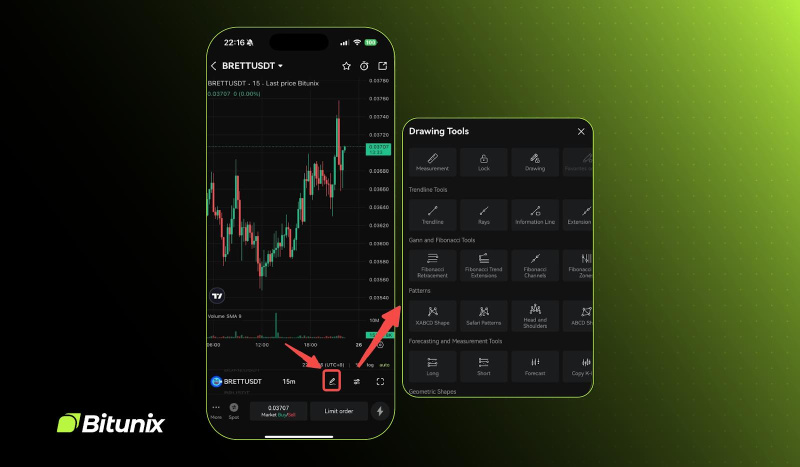
Navigation is structured into a few clear sections:
- Spot: Spot buying and selling using standard order types.
- Futures: Perpetual contracts with a choice of leverage, cross-margin, or isolated margin.
- Copy Trading: Searching for and tracking traders available on the platform.
- Earn: staking, interest-bearing accounts, and Dual Investment
Bitunix also includes risk management tools that are visible directly on the chart, such as stop-loss and take-profit levels, and a tiered limit system that adjusts the maximum position size based on the selected leverage.
In terms of execution, the platform is designed for users who trade fairly frequently and want tools similar to those offered by a professional exchange, rather than for those seeking the simplest possible buying and selling experience.
Pros
An interface designed for active trading with TradingView charts
A wide range of order types and tiered risk management
Built-in copy trading without leaving the app
The app runs smoothly even during high-frequency operations
Cons
A steeper learning curve than that of a beginner-friendly exchange
No direct bank deposit option (SEPA) for European users
No MiCA-licensed version is available in the European Union
Support and Troubleshooting for Disputes Among Users
Final Opinion: Is Bitunix Worth It in 2026?
Bitunix works particularly well for active traders who prioritize low commissions on derivatives, high leverage, and a quick sign-up process over local regulation. Its futures fees of 0.02 % / 0.06 %, its monthly Proof of Reserves, and its combination of copy trading, Dual Investment, and staking make for an attractive proposition for anyone who already knows what they’re looking for in a derivatives exchange.
However, for readers in Spain or any other European Union country, there is a critical limitation: Bitunix does not have a MiCA license as of August 2026 and, unlike other global exchanges in the same situation, has not announced a specific transition plan for EEA customers. This regulatory issue outweighs its competitive fees and product offerings.
With all this in mind, Bitunix is not a suitable recommendation for opening a new account from Spain in August 2026. European investors looking for an exchange that operates normally may want to consider platforms with active MiCA authorization, such as Bitvavo, Finst, Coinbase, Kraken, or OKX; those operating outside the EEA who prioritize fees and leverage may consider Bitunix, provided they are aware of its regulatory limitations in advance.
This review is based on our actual experience using Bitunix. We tested the platform by making deposits, purchases, sales, and withdrawals of cryptocurrencies, and we also evaluated its fees, security, and ease of use. The assessment you are reading reflects our hands-on experience, not a first impression or financial advice.
Is Bitunix not right for you? Explore other alternatives

Veteran exchange focused on security and compliance. Allows buying, selling, and staking, with pro tools and solid support.

Derivatives and copy trading-focused exchange with a fast app. Includes futures, multiple pairs, and advanced features for agile trading.

Leading global platform by trading volume. It offers spot and futures trading, staking, and a broad ecosystem with reduced fees through BNB.

European exchange with a clean interface and competitive fees. Ideal for trading crypto with SEPA transfers and stable liquidity in the European market.

Social trading and derivatives-focused platform with a simple interface. It includes copy trading, futures, and fast purchase options using a card.

Popular exchange for derivatives and spot trading, with high liquidity, a fast interface, and advanced tools geared toward active and professional traders.

Spanish exchange focused on ease of use, local support in Spanish, and integrated options for buying, saving, and custodial asset management.

Comprehensive platform offering spot, futures, and earn products. Strong global liquidity, pro tools, and a built-in Web3 wallet for active traders.