Before we dive into the detailed analysis, here's a summary of OKX's key metrics at a glance.

OKX Quick Overview
| Score | |
| Established in | 2017 |
| Headquarters | Seychelles |
| Regulator | VARA (Dubai), Global |
| Cryptocurrencies | +460 |
| Maker/Taker | 0,08 % / 0,10 % |
| MiCA regulation | Yes, since 2025 |
| Minimum deposit | 10 € |
About OKX: Origins and Who It's Intended For
OKX is a cryptocurrency exchange founded in 2017 that has become one of the most comprehensive global platforms in the industry. In Europe, it operates through OKX Europe Limited, which is headquartered in Malta and has held a MiCA license granted by the Malta Financial Services Authority (MFSA) since January 2025.
Pros
MiCA license valid throughout the European Economic Area
Advanced platform with spot trading, derivatives, bots, and a Web3 wallet
Monthly Reserves Test with Cryptographic Verification
SEPA and SEPA Instant Transfers for European Customers
Cons
High standard spot commission if an X-Perps account is not opened
A feature-rich interface for users who just want to buy and maintain
Derivatives and some functions require evaluation
Trustpilot shows quite a few complaints about account suspensions, verification issues, and customer support
Since its launch, it has grown to become one of the exchanges with the highest trading volume and greatest international recognition, with a clear focus: bringing together centralized trading, professional tools, automation, and Web3 access within a single ecosystem.
OKX Europe Limited operates under the supervision of the MFSA. On January 27, 2025, it obtained full authorization as a crypto-asset service provider under MiCA, which allows it to serve users in European Economic Area countries through regulatory passporting.
Who is OKX for? For European users looking for a regulated platform but who don't want to compromise on advanced charts, different order types, bots, yield products, and a self-custody wallet integrated into the same ecosystem.
The company was one of the first major international platforms to obtain a full MiCA license. In addition, in 2026, it strengthened its European structure by securing additional financial and payment licenses from the MFSA, expanding its integration with the euro and regulated services.
OKX is more than just an app for buying Bitcoin. Its platform combines a centralized exchange, tools for active traders, and a standalone Web3 wallet. This breadth of features offers many possibilities, but it requires users to clearly distinguish between spot trading, derivatives, Earn products, and on-chain protocols.
What level of security does OKX offer?
Security is one of the areas where OKX has invested the most to strengthen its position among global exchanges. In addition to being regulated under MiCA in Europe, the platform publishes monthly Proof-of-Reserves reports, keeps European assets segregated, and uses cryptographic systems so that each user can verify that their balance is included.
That confidence is also reflected—albeit with a much more critical assessment—in how current users rate the platform:
European regulation under the MiCA framework
OKX Europe Limited is headquartered in Malta and is authorized by the Malta Financial Services Authority as a crypto-asset service provider. Since January 27, 2025, it has been operating under a full MiCA license, which is valid via passport for customers in the European Economic Area.
The European MiCA regulatory framework standardizes supervisory requirements for cryptocurrency exchanges within the European Union. In addition to the CASP authorization, OKX announced that it obtained a MiFID II license in March 2025 and a payment institution license in February 2026, both through the MFSA and subject to the applicable scope.
This means that the European entity must comply with regulations regarding asset segregation, capital, cybersecurity, customer protection, anti-money laundering, and formal complaint handling. It offers a clearer legal framework than a platform that serves Europeans exclusively from an offshore jurisdiction. If you’d like to explore other platforms with the same regulatory framework, check out our comparison of the best MiCA-regulated exchanges in Europe.
Custody and protection of funds
European clients' assets are held in segregated accounts, separate from OKX Europe's operating funds. The platform combines cold storage with operational wallets and internal controls to limit access to the reserves.
Segregation is particularly important when the institution faces financial difficulties, as it prevents customer assets from being treated as the company’s common equity. However, this does not make cryptocurrencies bank deposits, nor does it protect users from market losses.
Key protection measures include:
- Most storage is in cold wallets, and the architecture uses multi-factor authorization.
- European client assets are segregated from OKX's own funds.
- Monthly reserve verification using Merkle trees and zk-STARK proofs.
- Two-factor authentication, passkeys, and anti-phishing code.
- Whitelist of addresses and temporary blocking of new addresses.
- Offline Mode to block withdrawals during a configured time period.
Reserve Test and transparency
One of the things that sets OKX apart is its monthly publication of its Proof of Reserves. The platform uses Merkle trees and zk-STARK cryptographic proofs to demonstrate that the balances listed are backed by on-chain assets at a ratio of 1:1 or higher for the covered assets.
Users can check their account to confirm that their balance was included in the snapshot and review the published addresses. The ratios for BTC, ETH, and stablecoins change every month, so they must be updated directly from the latest report before publishing the review.
Although a Reserves Test does not replace a full financial audit, it does provide a useful verification of the assets held in custody as of a specific date. The combination of MiCA licensing, segregation, and verifiable reserves sets OKX apart from many international exchanges in terms of operational transparency for European users.
Account Security
At the user level, OKX offers various tools to secure access and withdrawals. It allows users to set up 2FA, passkeys, anti-phishing codes, authorized devices, a whitelist of addresses, and a specific block for new addresses.
In July 2026, it also launched Offline Mode, a feature that allows users to set a protected time window of up to 12 hours during which withdrawals are automatically blocked. This includes crypto withdrawals, P2P sales, API-based withdrawals, and certain top-ups.
Pros
Full MiCA license granted by the MFSA
Monthly Reserve Audit with Merkle and zk-STARK
Legally Segregated European Assets
2FA, passkeys, allowlist, and Offline Mode
Cons
MiCA does not cover losses caused by market volatility
The Allowance Test is not a substitute for a full financial audit
The user does not control the private keys for the custodial balance
Compliance reviews may temporarily block transactions
Where is OKX available?
OKX operates in numerous international markets, although the entity, assets, and available products vary by country. In Europe, OKX Europe Limited is authorized to serve residents of the European Economic Area under its MiCA license.
Spanish users can access the European platform, complete the KYC process, and use the services available for their account. OKX supports SEPA and SEPA Instant transfers in euros for European customers, as well as other compatible payment methods.
Availability in Europe includes European Union member states and other EEA countries such as Norway, Iceland, and Liechtenstein. X-Perps, Earn, certain tokens, and other products are subject to additional conditions and may not be available to all users.
OKX Fees: How Much Does Trading Really Cost?
One of the aspects that requires the most attention on OKX is its European fee structure. Starting in July 2026, the spot trading fee will vary depending on whether or not the user has opened an X-Perps derivatives account. Therefore, it is incorrect to present a single rate of 0.08 % / 0.10 % as the general fee for all Spanish customers.
Trading commission: starting at 0.20 % / 0.35 % in the EEA
A European user with Regular status who has not opened any X-Perps pays 0.20 % as a maker and 0.35 % as a taker. That means a €1,000 buy order executed as a taker costs €3.50, before taking into account the spread or slippage.
If a user opens an X-Perps account and passes the relevant checks, the Regular spot fee drops to 0.08 % for makers and 0.10 % for takers. In that case, the same €1,000 taker execution costs €1.
| Platform | Maker | Taker |
|---|---|---|
 OKX
OKX
|
0,08% | 0,10% |
 Bybit
Bybit
|
0,10% | 0,10% |
 Finst
Finst
|
0,15% | 0,15% |
 Bitvavo
|
0,15% | 0,25% |
 Kraken
|
0,25% | 0,45% |
 Coinbase
|
0,40% | 0,60% |
 eToro
eToro
|
1% | 1% |
To give you an idea, OKX is very competitive when X-Perps is enabled, but its standard fee for a European user who only trades spot is higher than that of Finst or Bitvavo. VIP tiers progressively reduce the cost based on the assets held or the trading volume over the last 30 days.
Did you know? A €1,000 taker order costs €3.50 under the Regular spot rate without X-Perps, but €1 under the Regular rate associated with X-Perps.
OKX does not charge fees on SEPA deposits
OKX allows European customers to deposit euros via SEPA and SEPA Instant. The platform does not typically charge a fee for receiving the transfer, although the user’s bank may apply its own fee. Bank withdrawals and card purchases depend on the method, provider, and terms displayed before confirmation.
OKX does not charge any fees for cryptocurrency deposits. On-chain withdrawals are subject to a variable fee depending on the asset and network, which is displayed before the transaction is executed.
Simple Earn Commission and Advanced Products
Simple Earn Flexible generates returns by lending assets to users in the margin market, while fixed-term products can combine staking and platform rewards. The APY shown is variable and depends on demand, the asset, and the product type.
Futures and X-Perps use their own maker/taker structure, in addition to funding rates on perpetual contracts. Bots typically do not have a separate fee, but each order they execute incurs the commission associated with the market used.
Overall, OKX may be inexpensive for advanced trading, but it no longer has a universal European fee structure. Users should check whether their account is on the standard plan or the X-Perps plan before calculating the cost.
| Concept | Cost on OKX Europe |
|---|---|
| Regular Spot without X-Perps | 0.20 % maker / 0.35 % taker |
| Regular Spot with X-Perps | 0.08 % maker / 0.10 % taker |
| SEPA Deposit / SEPA Instant | Usually €0 on OKX |
| Cryptocurrency Deposit | 0 € via OKX; the source network fee is paid |
| Custody / maintenance / inactivity | 0 € in the standard account |
| Trading bots | No specific fee; they pay the commissions for each order |
| Withdrawal to an external wallet | Commission varies depending on the asset and network |
Step-by-Step Guide to Opening an Account on OKX
Opening an account on OKX is a digital process that can be completed through the app or a web browser. To use the European platform, you must verify your identity and accept the terms and conditions of OKX Europe Limited.
Step 1: Initial registration
The process begins by downloading the OKX app or accessing the site through a browser. Registration requires an email address or phone number, a password, and a confirmation code. Next, select Spain as your country of residence and accept the applicable terms.
Step 2: Identity Verification (KYC)
OKX Europe must comply with MiCA and anti-money laundering regulations. Verification typically includes:
- A photograph of a valid identification document, such as a national ID card or passport.
- A selfie or "proof of life" to verify that the holder matches the photo on the document.
Depending on the circumstances, OKX may request your address, tax residence, occupation, source of funds, and supporting documentation. Complex products may require an additional knowledge or suitability questionnaire.
Most automated checks are resolved quickly. Cases that require manual review may take longer if there are discrepancies or if the documentation is illegible.
Step 3: Link a bank account
To deposit and withdraw euros, the bank account must be in the same name. Spanish customers can find:
- Standard SEPA.
- SEPA Instant is available 24 hours a day if your bank supports it.
- Credit card and other providers, when they are enabled on the account.
Did you know? With SEPA Instant, a deposit in euros can be credited almost in real time, while a standard transfer can take up to one business day.
Step 4: First deposit and first trade
The minimum amount depends on the method and the asset. Once the euros have been credited, the user can select a EUR pair or convert the balance to another asset. Before trading, it’s a good idea to check the account’s fee structure.
Except for occasional reviews, the entire process is completed digitally. We recommend enabling 2FA, passkey, anti-phishing code, allowlist, and Offline Mode before maintaining a significant balance.
Summary of Requirements for Opening an Account on OKX
- Be older than 18.
- Reside in an eligible EEA country.
- Have a national ID card, passport, or other accepted form of identification.
- Have a cell phone with a camera to complete the facial recognition test.
- Use a bank account in the same name for transfers.
- Provide tax information and information on the source of funds upon request.
Important note: X-Perps derivatives and other products require additional verification and may not be available to all investor profiles.
Available cryptocurrencies: more than 350 assets, depending on the region
Beyond Bitcoin and Ethereum, OKX offers a wide selection of altcoins and trading pairs denominated in euros or dollars. The exact number varies by region, as the European platform can only list assets that meet its regulatory and documentation criteria.
Assets such as BTC, ETH, SOL, XRP, DOGE, ADA, AVAX, DOT, and hundreds of other tokens are traded on the EEA. In 2026, OKX significantly expanded the EUR and USD trading pairs on its European platform, but the listing remains subject to additions and removals.
Trading Bots: Automated Strategies with a Single Click
Bots are one of OKX's most distinctive features. They allow you to automate strategies without having to program each order manually. The platform offers predefined settings and customizable parameters, although no strategy guarantees profits.
| Bot | Focus |
|---|---|
| Spot Grid | Buy and sell within a price range |
| Futures Grid | Apply a grid to derivatives with potential leverage |
| DCA / Martingale | Makes staggered purchases according to predefined rules |
| Recurring Purchase | Recurring Cryptocurrency Purchases Program |
| Smart Portfolio | Rebalance an asset portfolio based on percentages |
| Arbitrage / Signal Bots | Automate advanced strategies wherever they are available |
Beyond simply choosing a bot, it's important to understand how they work in practice:
- Each executed order incurs the corresponding market commission.
- A grid works best within a range and may fail when the price breaks out of it.
- Futures bots may be subject to liquidations if they use leverage.
- Automation eliminates manual labor, but it does not eliminate market risk.
Simple Earn: Earnings on Your Cryptocurrencies
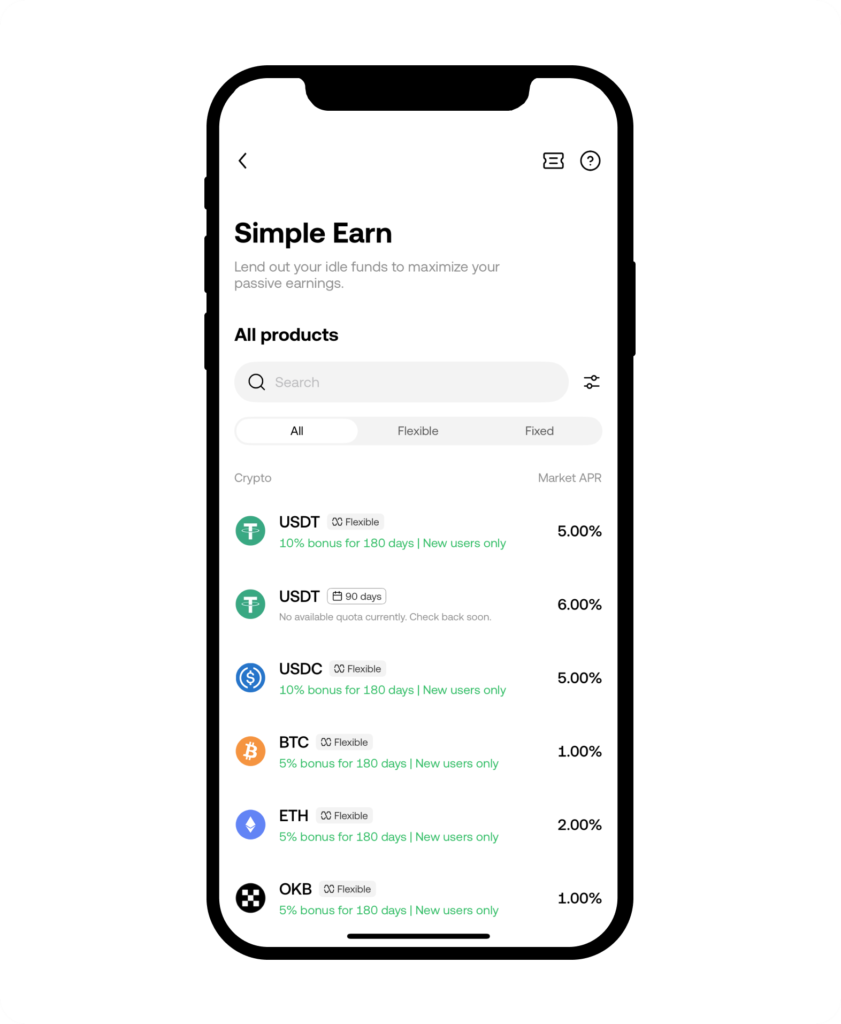
OKX offers Simple Earn Flexible and fixed-term products for eligible assets. In the flexible mode, funds can provide liquidity to margin trading users; in fixed-term products, returns may come partly from staking and platform incentives.
The best features of Simple Earn:
- Flexible and fixed terms depending on the asset.
- Variable returns linked to demand or staking.
- Direct access from the app and the web platform.
Recurring Buy (DCA): Automate Your Purchases
For those who prefer to invest on a recurring basis without having to keep an eye on the price, OKX offers recurring purchases and DCA bots. These allow you to select the assets, amount, and frequency, facilitating an automatic accumulation strategy.
Available order types
In addition to direct purchases, OKX offers:
- Market order: Executed at the best available price.
- Limit order: Executed when the specified price is reached.
- Stop-loss: Triggers an order when the specified level is reached.
- Take-profit: Allows you to close the position when a target is reached.
- Trailing stop: tracks the price while maintaining a set distance.
- OCO, iceberg, and TWAP in supported markets.
OKX vs. Bitget
The most natural comparison for OKX pits the platform against Bitget: both exchanges offer spot trading, derivatives, trading bots, Earn, and advanced tools. OKX stands out for its full MiCA license in Europe and its Web3 wallet, while Bitget maintains an identity closely tied to copy trading.
| Characteristic | OKX | Bitget |
|---|---|---|
| Foundation | 2017 | 2018 |
| European Regulation | MiCA via the MFSA starting in January 2025 | MiCA application submitted; pending as of August 2026 |
| Standard EEA Spot Commission | 0.20 % maker / 0.35 % taker (excluding X-Perps) | 0.10 % maker / 0.10 % taker |
| Advanced Spot Commission | 0.08 % maker / 0.10 % taker with X-Perps | VIP, Volume, and BGB Discounts |
| SEPA deposits | Yes, standard and instant | Yes, depending on the supplier and account |
| Cryptocurrencies | Approximately 350+, depending on the region | 800+ announced globally |
| Security | Monthly Reserve Test and MiCA Segregation | Reserve Test and Protection Fund |
| Unique Product | Bots, Advanced Trading, and Web3 Wallets | Copy Trading in Spot and Futures Markets |
| Platform | Web, app, desktop, and Web3 wallet | Web, app, desktop, and Bitget Wallet |
| Ideal for | European users looking for regulation and advanced tools | Traders focused on copy trading and derivatives |
OKX is committed to combining European regulation, professional trading, and Web3 access. Its standard fee structure is less attractive for users who don't open X-Perps accounts, but the platform offers a particularly comprehensive range of order types and bots.
Bitget starts with a lower spot fee and excels in copy trading. However, as of August 2026, its MiCA authorization was still pending, while OKX had already been operating with a full European license since 2025.
Apps and Platform: How Do You Use OKX on a Daily Basis?
OKX offers a mobile app for iOS and Android, a web platform, and a desktop application. The European account allows you to manage euros, trade spot, use bots, access Earn, and connect to the Web3 wallet—all within a single ecosystem.
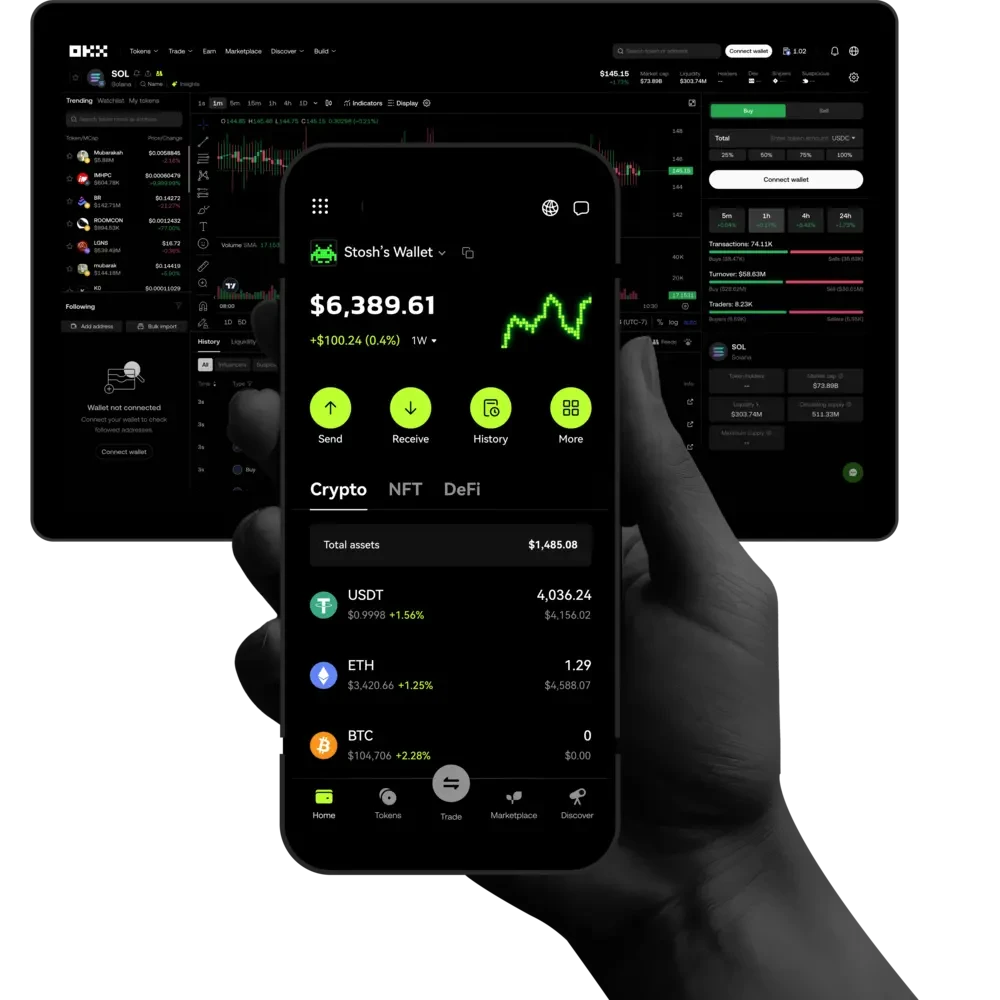
The navigation is organized into several sections:
- Markets: prices, listings, and available trading pairs.
- Trading: Direct purchase, spot trading, margin trading, and derivatives are available.
- Grow / Earn: Simple Earn and yield products.
- Web3 Wallet: self-custody, swaps, dApps, and on-chain assets.
OKX features advanced charts, an order book, indicators, order depth, historical data, and portfolio analytics. It also offers watchlists, alerts, bots, and an API for automated strategies.
In terms of order execution, it offers market, limit, stop, trailing stop, OCO, iceberg, and TWAP orders, depending on the market. It is a significantly more comprehensive platform than an exchange focused solely on buying and custody.
Pros
App, Web, and Desktop with Professional Tools
Built-in charts, indicators, bots, and APIs
Separate Web3 wallet for self-custody
Same account for EUR, spot, and eligible products
Cons
A steeper learning curve than that of a simple retail exchange
The navigation section features many products and promotions
Confusing a custodial account with a wallet can lead to errors
Some features and assets vary by institution and country
Final Verdict: Is OKX Worth It in 2026?
OKX works particularly well for European users who want to combine regulation with advanced tools. The MiCA license, segregated assets, monthly Proof of Reserves, and SEPA transfers provide a solid framework, while its bots, advanced order types, and Web3 wallet allow users to go far beyond basic trading.
That said, OKX has clear limitations. The EEA Regular spot fee—excluding X-Perps—of 0.20 % for makers and 0.35 % for takers is no longer among the cheapest. The interface may be overwhelming for beginners, and Trustpilot features complaints about reviews, frozen funds, and support response times—all of which are worth keeping in mind.
All things considered, OKX is a good choice for users who value a genuine MiCA license and want trading tools, bots, and Web3 features all on a single platform. For those who only buy and hold cryptocurrencies occasionally, Finst or Bitvavo may offer a simpler experience and more predictable upfront fees.
This review is based on our actual experience using OKX. We tested the platform by making deposits, buying, selling, and withdrawing cryptocurrencies, and we also evaluated its fees, security, and ease of use. The rating you see here reflects our hands-on experience, not just a first impression.
Is OKX not right for you? Explore other options

Veteran exchange focused on security and compliance. Allows buying, selling, and staking, with pro tools and solid support.

Derivatives and copy trading-focused exchange with a fast app. Includes futures, multiple pairs, and advanced features for agile trading.

Leading global platform by trading volume. It offers spot and futures trading, staking, and a broad ecosystem with reduced fees through BNB.

European exchange with a clean interface and competitive fees. Ideal for trading crypto with SEPA transfers and stable liquidity in the European market.

Social trading and derivatives-focused platform with a simple interface. It includes copy trading, futures, and fast purchase options using a card.

Popular exchange for derivatives and spot trading, with high liquidity, a fast interface, and advanced tools geared toward active and professional traders.

Spanish exchange focused on ease of use, local support in Spanish, and integrated options for buying, saving, and custodial asset management.

One of Europe’s oldest exchanges. Focused on serious spot trading, with strong regulation, low complexity, and direct fiat access.
Withdrawals and deposits are very fast, and the platform is very easy to use. The only thing I'd improve is the spot trading fees, but overall, it's one of the exchanges I use the most.