
Before we dive into the detailed analysis, here's a summary of Ripio's most important data at a glance.

Ripio Quick Overview
| Score | |
| Established in | 2013 |
| Headquarters | Argentina |
| Regulator | CNV in Argentina and local authorities by country |
| Cryptocurrencies | +100 |
| Maker/Taker | 0,25 % / 0,50 % |
| Minimum deposit | Varies by country and currency |
About Ripio: Origin and Target Audience
Ripio is a cryptocurrency platform founded in Argentina in 2013 by Sebastián Serrano and one of the longest-standing projects in the Latin American crypto ecosystem. Its offerings go beyond simply buying and selling: it combines a custodial wallet, over 100 assets, a Visa card, QR and PIX payments, automated returns, DeFi products, stablecoins pegged to local currencies, and infrastructure services for businesses.
The company claims to have reached more than 25 million users, processed more than 170 million transactions, and worked with more than 2,500 institutional clients. Unlike Bitunix, whose business model focuses on futures and leveraged trading, Ripio is designed around the everyday use of cryptocurrencies and the specific needs of Latin America.
Pros
More than 13 years of experience in the crypto market
Over 100 assets and commission-free BTC trading
Visa card, QR/PIX payments, returns, and local stablecoins
SOC 1 and SOC 2 Type II, Proof of Reserves, and 2FA/MFA
Cons
The offerings and terms vary considerably by country
It is not intended for futures trading or professional trading in derivatives
Does not hold a MiCA license to operate with EEA clients
Centralized custody: the user does not control the private keys
Ripio also develops B2B infrastructure through Crypto as a Service, APIs, liquidity, tokenization, and an OTC desk. This second line of business includes projects such as Meli Dólar in partnership with Mercado Libre, the crypto integration of OCA Blue in Uruguay, and the tokenization of the Argentine sovereign bond AL30.
Who is Ripio for? For users in Latin America who want to buy, hold, and use cryptocurrencies through an app connected to local payment methods.
What level of security does Ripio offer?
Ripio offers a more advanced security infrastructure than many regional platforms. The company reports full reserves, 2FA/MFA authentication, real-time monitoring, controls over applications, APIs, and smart contracts, as well as external audits and SOC certifications.
However, technical security and regulatory protection are not the same thing. Ripio remains a centralized custodian, and legal coverage depends on the local entity with which each user contracts. Cryptocurrencies are also not covered by a bank deposit insurance fund.
That confidence is also reflected in how those who already use the platform value it:
Global Regulation
Ripio uses different companies and registrations to operate in each market. In Argentina, Moonbird S.R.L. and other affiliated entities are listed in the National Securities Commission’s registry of Virtual Asset Service Providers. This registry imposes local obligations regarding identification, anti-money laundering, and reporting, but it does not make Ripio a bank nor does it guarantee the value of the assets.
Ripio’s corporate infrastructure also complies with local regulations in Brazil, Mexico, Chile, Colombia, and Uruguay. In the United States, its institutional operations are conducted through OTCIS LLC and licenses or registrations applicable to money transmission. The available product, the contracting entity, and the protections vary depending on the user’s country of residence.
Ripio was registered in Spain as a currency exchange and custody provider under the Bank of Spain’s former registry. That registry served solely as a preventive measure against money laundering and did not constitute a financial license.
Custody and protection of funds
Ripio safeguards users' assets and maintains public addresses to demonstrate a portion of its reserves. The company states that it holds 100 % of the funds and distributes liquidity among cold, warm, and hot wallets according to operational needs.
Centralized custody simplifies access recovery and the use of integrated products, but requires users to trust Ripio’s financial stability, controls, and business continuity. Users do not own the private keys to the internal wallets and must rely on the platform to authorize and process withdrawals.
Notable among the measures announced are SOC 1 and SOC 2 Type II certifications, multi-factor authentication, real-time monitoring, and external audits conducted by KPMG, EY, and PwC. Ripio also maintains a bug bounty program on HackerOne and conducts ongoing checks of code, applications, servers, and APIs.
Reserve Test and transparency
Ripio publishes a Proof of Reserves page where users can view the blockchain addresses associated with its custody. This allows for the verification of on-chain balances and provides a higher level of transparency than platforms that do not disclose any public reserves.
The company itself explains that the page displays addresses with varying levels of liquidity and that there are additional funds in other operational wallets. Therefore, the publicly available information should not be interpreted as a complete audit of assets, liabilities, and obligations owed to each client.
Account Security
The account uses identity verification, a password, and 2FA/MFA mechanisms. Users should enable two-factor authentication, use a unique password, verify the domain and official apps, and be wary of any supposed employee who asks for passwords or codes.
Blockchain withdrawals are irreversible. Before sending funds, you should verify the asset, the network, the address, and any required memo. For significant amounts, a test transfer reduces the risk of losing your balance by selecting the wrong chain.
Security Pros
SOC 1 and SOC 2 Type II Certifications
Proof of Reserves with verifiable addresses
Bug Bounty, Audits, and Continuous Monitoring
2FA/MFA and KYC/AML Controls
Security Drawbacks
There is no public fund that guarantees cryptoassets
The PoR alone does not show all corporate liabilities
DeFi products introduce smart contract risk
The user delegates custody and does not control the keys
Where is Ripio available?
Ripio's corporate website lists its presence in seven countries: Argentina, Brazil, Mexico, Colombia, Chile, Uruguay, and the United States. Its most comprehensive retail offering is concentrated in Latin America; its U.S. operations are more closely tied to institutional services and money transfers than to an exact replica of the regional app.
Its wFiat infrastructure also extends to Peru and connects virtual accounts, local stablecoins, and payments across eight markets. This does not mean that the entire app, the card, the returns, and every cryptocurrency are available uniformly in all eight countries.
International sanctions, AML controls, and specific conditions may exclude certain territories or users, even within an eligible country. Your actual place of residence must be disclosed during the KYC process and must not be circumvented using a VPN.
Ripio Fees
Ripio does not use a maker/taker table like Bitunix's in its main app. The user selects the asset and the amount, and the app displays the cost and the final quantity before confirmation. According to official information current as of August 2026, the standard fee for buying or selling cryptocurrencies is 0.5%.
Bitcoin is the most notable exception: Ripio announces commission-free BTC buying and selling. This does not necessarily mean that all possible costs are zero, because the executed price, the deposit method, currency conversion, or an on-chain withdrawal may result in additional fees or charges.
Trading commission: 0.5%; Bitcoin: commission-free
In a standard transaction of 1,000 units of local currency, a fee of 0.5 % amounts to a cost of 5. The app must display the details before the order is completed. For Bitcoin, Ripio lists an explicit fee of 0%, although it’s also a good idea to compare the final price with the market rate.
| Platform | Maker | Taker / Buy/Sell |
|---|---|---|
 Ripio
Ripio
|
Not applicable | 0.5 %; BTC with no commission |
 Bitso
Bitso
|
Variable | Varies by volume and market |
 Bitcoin Market
|
Variable | Variable by product and volume |
 Binance
|
0,10 % | 0,10 % |
 Kraken
|
0,25 % | 0,45 % |
 Coinbase Advanced
|
0,40 % | 0.60 % in the reference segment |
 Bit2Me
|
Variable | Variable by volume |
Global Fiat Deposits and Withdrawals
Deposit methods vary by country. Ripio supports bank transfers and local payment systems such as Mercado Pago, PIX, SPEI, PSE, or regional equivalents. In some markets, bank deposits are free, while card issuers or third-party providers may charge their own fees.
Ripio typically does not charge a fee for crypto deposits, although the issuer pays the source network. Blockchain withdrawals incur a dynamic fee based on the network, the asset, and network congestion; the exact amount is displayed before confirmation.
Withdrawals in local currency, limits, and processing times depend on each country's banking system. It is not advisable to use an Argentine table for Brazil, Mexico, or Colombia, because each local financial institution may have different amounts and conditions.
Did you know? Buying 1,000 of a cryptocurrency with a 0.5% commission costs 5, while the same purchase of BTC is advertised as commission-free.
Advanced Yields and Products Committee
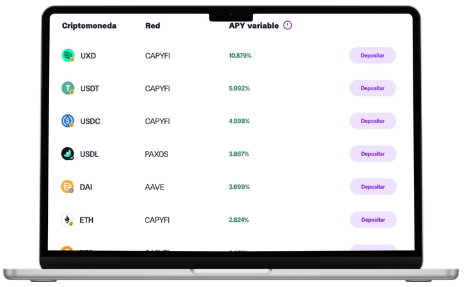
Ripio offers automatic yields and access to DeFi protocols on certain assets. Rates are variable and may depend on platforms such as Aave, Compound, or other integrated protocols. The yield shown is not a guaranteed bank deposit.
The Crypto Card Visa can offer up to 4 % in crypto cashback at eligible merchants and through eligible promotions. The percentage, reward assets, conversion rates, and availability vary by country and are subject to current terms and conditions.
| Concept | Cost in Ripio |
|---|---|
| General Buying or Selling | 0,5 % |
| Buying or Selling BTC | 0 % of the announced commission |
| Deposit in local currency | Varies; some banking methods are free |
| Crypto Deposit | No reception fee; the originating network is billed |
| Crypto Withdrawal | Dynamic network commission displayed before confirmation |
| Automatic Returns | Variable Rate and Protocol or Counterparty Risks |
| Crypto Visa Card | Terms and cashback vary by country |
| OTC / Business | Price negotiated with the sales team |
Step-by-Step Guide to Opening an Account on Ripio
You can sign up on the website or through the official app. Your country of residence determines the contracting entity, the currency, the payment methods, and the products that will appear in your account.
Step 1: Initial registration
The user enters their email address or phone number, creates a password, and confirms their contact information. We recommend downloading the app only from the App Store or Google Play using the links provided by Ripio.
You must also accept the terms applicable to your country. Providing false residential information may result in account suspensions, additional reviews, or the inability to withdraw funds.
Step 2: Identity Verification (KYC)
Ripio requests your name, date of birth, official identification document, and a photograph or biometric data. Depending on the market, it may also request your address, tax ID, economic activity, and intended use.
For larger transactions or unusual patterns, we may require documentation verifying the source of the funds. These checks are part of our AML obligations and should not be confused with an account error.
Step 3: Link a bank account
The user adds a bank account or uses the available local payment system: bank transfer, Mercado Pago, PIX, SPEI, PSE, or another payment gateway. The payment account must normally be in the name of the same verified account holder.
You can also deposit supported cryptocurrencies. Before sending, make sure that Ripio supports both the token and the specific network; just because an asset appears in the app doesn’t mean that all of its blockchains are enabled.
Did you know? Deposits made via bank transfer, PIX, SPEI, PSE, or Mercado Pago may be free in compatible markets, while an external payment gateway may add its own fee before the purchase.
Step 4: First Purchase or Deposit into Investment Account
After adding funds, select the cryptocurrency, enter the amount, and review the price, fee, and final total. The order should only be confirmed after verifying all of this information.
Users interested in returns should review the rate, liquidity, protocol, risks, and withdrawal terms. For payments via card or QR code, availability will be limited to enabled markets.
Summary of Requirements for Opening an Account with Ripio
- Be at least 18 years old.
- Reside in an eligible jurisdiction.
- Provide a valid email address or phone number.
- Present a valid official document.
- Provide a selfie or biometric verification when requested.
- Use your own bank account or payment method.
- Provide proof of the source of funds when applicable.
Available cryptocurrencies: more than 100 digital assets
Ripio has expanded its catalog from approximately 50 cryptocurrencies in previous versions to more than 100 assets. The list includes Bitcoin, Ethereum, USDT, USDC, altcoins, DeFi tokens, local stablecoins, and products such as xStocks in supported markets.
The selection is sufficient for a diversified retail portfolio, although it remains smaller than that of international exchanges focused on listing hundreds of tokens. Specific availability varies depending on regulations, the local currency, and the institution serving the user.
Ripio Launchpad, Payments, and Business: Education and Tools
Ripio complements its app with 'Launchpad,' an educational portal that explains concepts, products, and updates from the ecosystem in Spanish and Portuguese. Within the app, payments via QR codes, PIX, and other services allow users to use their digital balances for everyday transactions when the feature is enabled in the user’s country.
For businesses, Ripio Business offers 'Crypto as a Service,' APIs, liquidity, tokenization, and an OTC desk for higher-volume transactions. This institutional business has enabled the development of integrations for Mercado Libre and OCA Blue, as well as infrastructure for stablecoins pegged to Latin American currencies.
The 'Crypto Card Visa' lets you spend compatible funds at merchants that accept Visa and receive cashback in crypto according to the terms of each market. The app also supports QR code payments in Argentina, PIX in Brazil, and, in certain cases, bill and utility payments.
| Product | Focus |
|---|---|
| Buy Crypto | Simple buying and selling with a predetermined final price |
| Ripio Returns | Variable return on eligible assets |
| Crypto Card | Visa Payments and Cashback by Country |
| Local Payments | QR, PIX, and services in eligible markets |
| Ripio Business | APIs, OTC, Liquidity, and Tokenization for Businesses |
| Ripio Launchpad | Education and News from the Crypto Ecosystem |
- More than 100 digital assets available.
- QR payments, PIX payments, and utility bill payments, depending on the country.
- Local stablecoins integrated into wFiat.
- Visa card with variable cashback.
- Educational resources in Spanish and Portuguese.
- Services for individuals, businesses, and institutions.
The 'Crypto Card Visa' lets you spend compatible funds at merchants that accept Visa and receive cashback in crypto according to the terms of each market. The app also supports QR code payments in Argentina, PIX in Brazil, and, in certain cases, bill and utility payments.
Ripio Returns: Returns on Your Cryptocurrencies
Ripio offers returns on eligible assets and access to DeFi protocols. For certain products, interest accrues automatically without locking up the balance, allowing users to withdraw or use the funds according to the terms displayed in the app.
Rates fluctuate based on demand, liquidity, and the protocol. A high percentage may indicate greater risk related to smart contracts, counterparties, stablecoins, or the market; it should never be presented as a fixed and guaranteed return.
Regular Purchases (DCA): Automate Your Purchases
Ripio is designed for recurring investments, although the availability of an automatic DCA feature may vary by country and app version. When scheduled purchases are enabled, you can set an amount and frequency to buy cryptocurrency without trying to predict every market movement.
If automation is not available in the account, the user can implement a DCA strategy by making periodic manual purchases. In both cases, the user should review the 0.5 % fee, the closing price, and the fact that investing on a recurring basis reduces the risk associated with choosing a single entry point, but does not prevent potential losses.
Available order types
The app focuses on simple actions rather than professional orders. Depending on the country and product, users can:
- Instant buying and selling based on a quote.
- Conversion between local currency and eligible assets.
- Cryptocurrency deposits and withdrawals.
- Access to returns on eligible assets.
- OTC transactions for high-volume clients.
Ripio is not the right platform for those looking for perpetual futures, high leverage, trading bots, or a professional trading terminal comparable to Bitunix, Binance, or Bybit. Its strength lies in the connection between crypto and regional payments.
Ripio vs. Bitso
Ripio and Bitso are two of the most well-known crypto platforms in Latin America, but their market positions are not identical. Ripio has a particularly strong presence in Argentina and Brazil, offering local stablecoins, a card, payment services, and B2B solutions. Bitso maintains a particularly strong presence in Mexico and a regional infrastructure that is also geared toward money transfers and institutional clients.
| Characteristic | Ripio | Bitso |
|---|---|---|
| Foundation | 2013 | 2014 |
| Main Market | Argentina, Brazil, and other countries in Latin America | Mexico and other countries in Latin America |
| Assets | More than 100 | Catalog Varies by Market |
| Retail Commission | 0.5 %; BTC with no commission | Varies depending on the product and volume |
| Maker/Taker in the main app | Not applicable | Available on Bitso Alpha |
| Card and Payments | Visa, QR, PIX, and country-specific services | Cards and Transfers by Country |
| Local stablecoins | Regional wFiat Ecosystem | Greater Focus on Digital Currencies and Payments |
| Security | SOC 1/2, PoR, and 2FA/MFA | Local Regulatory Controls and Records |
| MiCA | No license confirmed | No license confirmed |
Ripio is particularly appealing to residents of Argentina or Brazil who are looking for everyday payments and tokenized currencies from the region. Bitso may be a more natural choice for users in Mexico or for those who prioritize regional transfers and a specialized trading platform.
Apps and Platform: How Is Ripio Used on a Day-to-Day Basis?
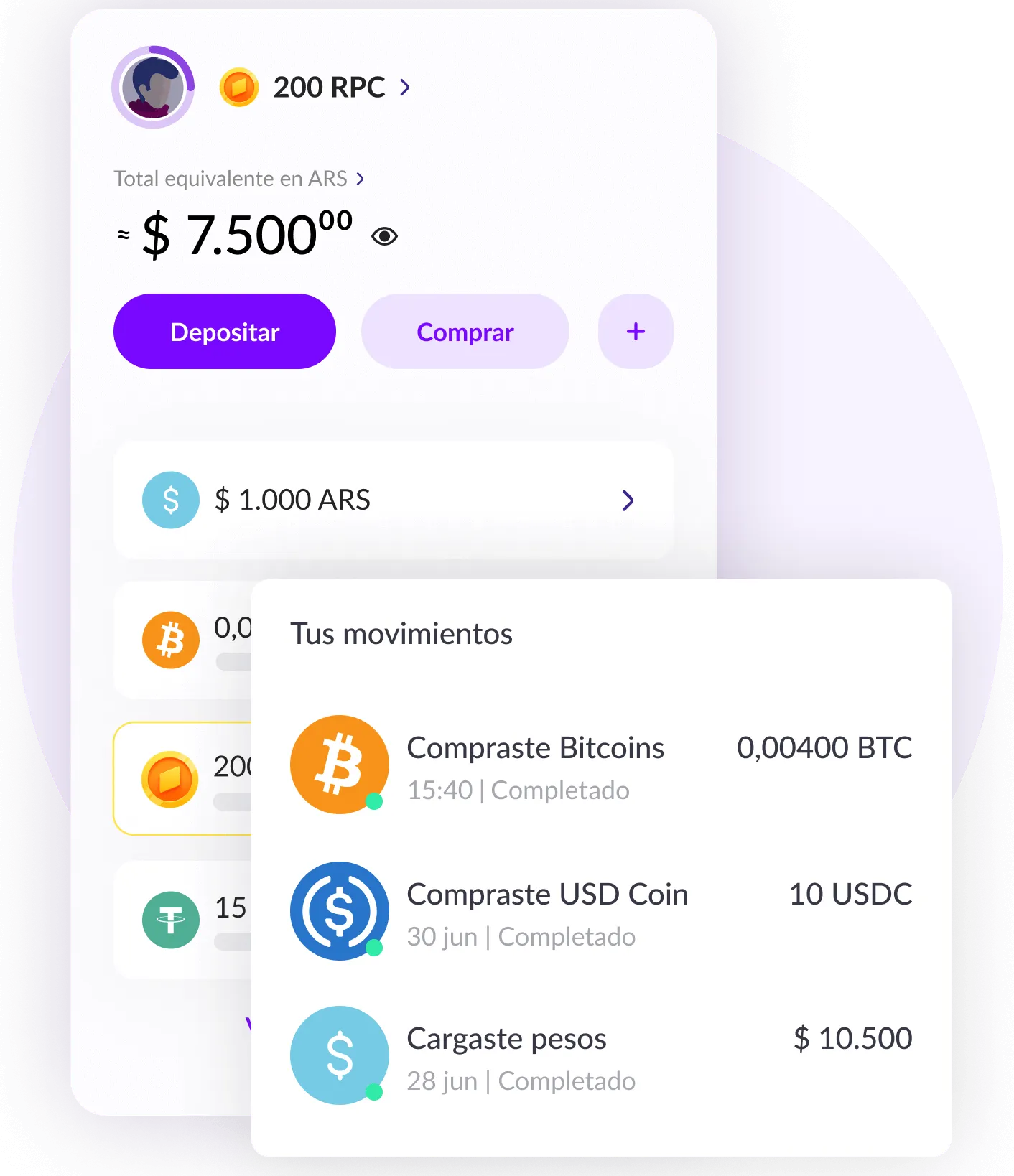
The Ripio app is available for iOS and Android and brings together buying, selling, prices, a wallet, payments, a card, and returns. Its design prioritizes direct actions and displays prices in local currency, making it easy to use for users who don't want to work with an order book.
The company reports approximate ratings of 4.3 on the App Store and 4.7 on Google Play, with tens of thousands of reviews. These figures should be updated on the day of publication because they vary by country, store, and app version.
Product variety is an advantage, but it can also mean that the experience varies between Argentina, Brazil, Mexico, and Colombia. A feature shown on the corporate website may not appear in a specific user’s account due to regulations, a phased rollout, or additional requirements.
Final Verdict: Is Ripio Worth It in 2026?
Ripio is a good choice for Latin American users looking for a well-established platform that integrates with local currencies and payment methods and offers more than just buying and selling. With over 100 assets, commission-free BTC, a Visa card, QR/PIX payments, earnings, and regional stablecoins, it offers a particularly comprehensive package in Argentina and Brazil.
Its main limitations are the fragmentation of functions by country, centralized custody, and the lack of a confirmed MiCA license for the EEA. It is also not the right choice for futures, leverage, or professional trading, and DeFi returns involve risks that do not exist in a guaranteed bank account.
Overall, our assessment is positive among the app’s target audience: LATAM users who prioritize a simple app and financial services tailored to the region. Outside of its main markets, it’s best to choose a locally authorized platform and always verify the institution, fees, and available products before making a deposit.
This review is based on our actual experience using Ripio. We tested the platform by making deposits, purchases, sales, and withdrawals of cryptocurrencies, and we also evaluated its fees, security, and ease of use. The assessment you are reading reflects hands-on experience, not a first impression, and does not constitute financial advice. Cryptocurrencies are high-risk assets.
Is Ripio not for you? Explore other options

Veteran exchange focused on security and compliance. Allows buying, selling, and staking, with pro tools and solid support.

Derivatives and copy trading-focused exchange with a fast app. Includes futures, multiple pairs, and advanced features for agile trading.

Leading global platform by trading volume. It offers spot and futures trading, staking, and a broad ecosystem with reduced fees through BNB.

European exchange with a clean interface and competitive fees. Ideal for trading crypto with SEPA transfers and stable liquidity in the European market.

Social trading and derivatives-focused platform with a simple interface. It includes copy trading, futures, and fast purchase options using a card.

Popular exchange for derivatives and spot trading, with high liquidity, a fast interface, and advanced tools geared toward active and professional traders.

Spanish exchange focused on ease of use, local support in Spanish, and integrated options for buying, saving, and custodial asset management.

Comprehensive platform offering spot, futures, and earn products. Strong global liquidity, pro tools, and a built-in Web3 wallet for active traders.