
Before we dive into the detailed analysis, here's a summary of Binance's key metrics at a glance.

Binance Quick Overview
| Score | |
| Established in | 2017 |
| Headquarters | Malta |
| Regulator | Global |
| Cryptocurrencies | +708 |
| Maker/Taker | 0,10 % / 0,10 % |
| MiCA regulation | No |
| Minimum deposit | 15 € |
About Binance: Origins and Who It's Intended For
Binance is a cryptocurrency exchange founded in 2017 by Changpeng Zhao and Yi He. It has become the industry’s largest platform in terms of trading volume and users, with more than 320 million registered accounts and a global selection of over 600 cryptocurrencies.
Pros
Spot fees of 0.10 % and an additional discount with BNB
Greater global liquidity and a very broad range of markets
Ecosystem featuring Earn, bots, Launchpool, P2P, and a Web3 wallet
SAFU Reserve Fund and Emergency Fund Test
Cons
No MiCA license and no normal operations as of August 2026
Complex corporate structure and regulatory history
A complex platform that is difficult for beginners to master
Trustpilot removed its rating for violating its guidelines
Since its launch, it has grown to more than 320 million registered users in over 180 countries, according to the company itself. Its focus has been on building a large-scale global ecosystem featuring spot trading, margin trading, futures, options, Earn, payments, P2P, bots, and Web3 access.
Binance maintained national registrations in various European countries, including Spain. However, those registrations were not equivalent to a MiCA license. After withdrawing its application with the Greek regulator in June 2026, it reached the end of the European transition period without a valid authorization to operate throughout the Union.
Who is Binance for? Outside the EEA, for users seeking maximum liquidity, more than 600 cryptocurrencies, and a platform offering virtually any trading tool.
Binance was the exchange that popularized some of the industry’s most widely used products, such as Launchpool, Simple Earn, and paying fees with BNB. Its scale remains a global advantage, although it no longer compensates for the lack of regulation when viewed from a European user’s perspective.
Behind Binance lies an international structure that has evolved over the years and does not have a single global headquarters equivalent to that of a European bank. The company has strengthened its compliance teams, but its track record includes significant regulatory settlements and penalties, including the $4.3 billion settlement with U.S. authorities in 2023.
What level of security does Binance offer?
Technical security is one of the areas where Binance has the most resources. The platform uses cold storage, risk monitoring, withdrawal controls, Proof of Reserves, and the SAFU fund. However, for a Spanish user in August 2026, security must be analyzed in light of the platform’s lack of MiCA authorization and the process of an orderly exit from the EU.
Public ratings on Trustpilot also cannot be displayed in the same way as on other exchanges:

European Regulation and Lack of a MiCA License
Binance was registered as a virtual asset service provider in several European countries, including Spain. Those national registrations allowed it to operate during the transition period, but did not grant it the European “passport” status associated with a MiCA authorization.
The company applied for a MiCA license in Greece but withdrew its application on June 24, 2026, after it was reported that the regulator was prepared to reject it. The transition period ended on July 1, 2026, and ESMA made it clear that unlicensed firms must cease operations and implement an orderly exit plan.
This means that, as of August 5, 2026, Binance cannot accept new customers or provide cryptoasset services as usual in Spain. Existing users may have limited functionality to close positions, withdraw, or migrate assets, but they should not interpret this as a current European authorization. If you’re looking for a platform that operates in Spain, check out our comparison of the best MiCA-regulated exchanges in Europe.
Custody and protection of funds
Cryptocurrencies deposited on Binance are held using a combination of cold wallets and hot wallets. The company states that all customer balances are backed 1:1 and publishes on-chain addresses for the assets included in its Proof of Reserves.
Binance also maintains SAFU, an emergency fund established in 2018 and initially funded with a portion of trading fees. Its purpose is to provide resources to respond to exceptional incidents that affect users.
Key protection measures include:
- Most reserves are stored in cold wallets.
- Multi-signature systems and internal controls for sensitive transactions.
- Reserve proof verifiable using Merkle trees and zk-SNARKs.
- SAFU Emergency Fund.
- 2FA, passkeys, anti-phishing code, and device management.
- Whitelist of addresses and withdrawal blocks following critical changes.
Reserve Test and transparency
Binance publishes a Proof of Reserves that allows users to verify that certain customer assets are backed by on-chain reserves. The system includes Merkle trees and zk-SNARK proofs so that users can verify that their balances have been included without revealing private information.
In January 2026, Binance modified its methodology to better reflect net balances and prevent the platform’s own assets from inflating the reported ratios. The company states that it maintains a minimum 1:1 reserve ratio for covered assets.
Although a review of reserves is not a substitute for a full financial audit, it provides useful information about holdings as of a specific date. It does not necessarily reveal all corporate liabilities, legal risks, or obligations outside the scope of the review.
Account Security
At the user level, Binance includes tools to secure access and withdrawals. It allows users to enable app-based authentication, passkeys, hardware keys, anti-phishing codes, authorized devices, and address whitelists.
It also implements automated fraud controls, risk alerts, and lockout periods after a password or other sensitive information is changed. These checks can protect the account, but they also account for some of the complaints about temporarily frozen funds and slow customer support.
Pros
Reserve Proof and Cryptographic Verification of Balances
SAFU Emergency Fund
2FA, passkeys, anti-phishing code, and allowlist
Extensive technical resources and continuous monitoring
Cons
The Allowance Test is not a substitute for a full financial audit
SAFU is neither a bank guarantee nor a government guarantee
History of Security Breaches in 2019 and Other Incidents in the Ecosystem
No MiCA protection for Spanish users in August 2026
Where is Binance available?
Binance states that it operates globally in more than 180 countries, although availability varies significantly by jurisdiction. In markets such as Japan, France, Italy, the United States, and the United Arab Emirates, it uses entities or platforms with specific terms and conditions.
In the European Union, the situation changed on July 1, 2026. Since it had not obtained a MiCA license, Binance had to suspend new registrations and a significant portion of its regulated services for residents of Spain and other EU countries.
Existing European users may retain limited access to manage, withdraw, or transfer their funds during the exit process. The availability of each feature should be checked within the account, and users should not assume that spot trading, Earn, SEPA deposits, or futures trading are still operating normally.
Binance Fees: How Much Does Trading Really Cost?
One of Binance's major historical draws is its fee structure. On the global spot market, it charges a base fee of 0.10 % for makers and takers, with discounts based on trading volume, VIP tier, and fee payments made in BNB.
Trading commission: 0.10 % on spot trades
Binance charges a base fee of 0.10 % on every spot trade. This means that buying 1,000 € worth of Bitcoin using a taker order incurs a fee of 1 €, before taking into account the spread or slippage.
When you enable BNB fee payments, the discount can reach 25 % for spot and margin trading, theoretically reducing the base fee to 0.075 %. For futures, the BNB discount can reach 10 %. These conditions depend on the region and on the user maintaining a sufficient BNB balance.
| Platform | Maker | Taker |
|---|---|---|
 MEXC
MEXC
|
0,00% | 0,05% |
 OKX
OKX
|
0,08% | 0,10% |
 Bybit
Bybit
|
0,10% | 0,10% |
 Binance
|
0,10% | 0,10% |
 KuCoin
|
0,10% | 0,10% |
 Gemini
|
0,20% | 0,40% |
 Kraken
|
0,25% | 0,40% |
To give you an idea, Binance remains one of the most affordable global platforms for spot trading, especially when using BNB. However, that advantage does not apply as a practical recommendation for new Spanish accounts until it obtains a MiCA license.
Did you know? At the spot rate of 0.10 %, buying €1,000 worth of Bitcoin costs €1. If the full 25 % discount for paying with BNB is applied, the theoretical cost drops to €0.75.
Deposits and Withdrawals: Limited Availability in the EU
Binance has historically offered deposits and withdrawals in euros via SEPA and SEPA Instant. Before its launch in Europe, fees varied by provider, and there were temporary promotions offering free deposits.
In August 2026, Spanish users should not assume that they can deposit euros as usual. During the exit process, fiat payment methods may be limited to withdrawals or account transfers. Crypto withdrawals will continue to be subject to a variable fee based on the asset and the network.
Binance Earn and Advanced Products Committee
Simple Earn offers flexible and locked products with variable APYs. Launchpool allows users to earn new tokens by locking up compatible assets. Bots execute orders subject to the fees of the respective market, and futures involve funding rates, leverage, and liquidation risk.
In the EEA, many of these products were restricted after July 1, 2026. Binance’s global campaigns typically include an explicit warning stating that they are not available to European users.
Overall, Binance's global fees remain competitive, but the lack of a license means that comparing costs is a secondary consideration for a Spanish resident: legal access to the product must come first.
| Concept | Price on Binance |
|---|---|
| Spot Commission | 0.10 % maker / 0.10 % taker |
| Spot Trading with BNB | Up to a 25 % discount |
| Futures Traded with BNB | Up to a 10 % discount |
| Cryptocurrency Deposit | 0 € via Binance; the source network fee is paid |
| SEPA Deposit in Spain | Restricted/unavailable during the MiCA rollout |
| Custody / maintenance / inactivity | 0 € in the standard account |
| Withdrawal to an external wallet | Commission varies depending on the asset and network |
Step-by-Step Guide to Opening an Account on Binance
Opening an account on Binance requires a digital registration and verification process. However, as of July 2026, the platform cannot accept new standard sign-ups from Spanish residents until it obtains MiCA authorization.
Step 1: Initial registration
In an eligible country, the process begins on the Binance website or app and requires an email address or phone number, a password, and a confirmation code. When selecting Spain as your country of residence, the platform must inform you of the restrictions in effect.
A Spanish resident should not change their country of residence, use a VPN, or provide false information to circumvent the block. Doing so would violate the terms of service, could result in the account being suspended, and would complicate any subsequent claims.
Step 2: Identity Verification (KYC)
In markets where it allows high-volume trading, Binance requires identity verification, which includes:
- A photograph of a valid document, such as an ID card or passport.
- A selfie or "proof of life" to confirm that the user matches the ID.
It may also request your address, tax residence, occupation, and source of funds. Verification does not make the account a European account nor does it exempt it from MiCA-related restrictions.
Automated verifications are usually completed quickly. Cases that require manual review may take longer and require additional documentation.
Step 3: Link a bank account
In supported markets, Binance accepts bank accounts, cards, and third-party providers. For euros, use:
- SEPA or SEPA Instant.
- Debit or credit cards.
- Available payment providers by region.
Did you know? After July 1, 2026, Binance may only maintain within the EU the functions necessary for an orderly exit; it may not continue to acquire customers as if it still held its former national registration.
Step 4: First deposit and first trade
In an eligible country, the minimum amount depends on the method and the asset. Once the funds have been deposited, the user can trade using Convert or the spot order book.
For a Spanish resident, this option should not be available as part of the standard process in August 2026. If any such feature still appears, it is advisable to check whether it is intended solely for withdrawing, reducing positions, or transferring assets.
Summary of Requirements for Opening an Account on Binance
- Be older than 18.
- Reside in a jurisdiction where Binance accepts new sign-ups.
- Have a valid identification document.
- Complete the facial assessment and the required questionnaires.
- Use a bank account in the same name.
- Do not reside in Spain or any other restricted EU country as long as Binance does not comply with MiCA.
Important note: By August 2026, Spanish residents must choose an exchange with active MiCA authorization.
Available cryptocurrencies: more than 600 worldwide
Beyond Bitcoin and Ethereum, Binance offers one of the largest selections on the market. Its global platform lists more than 600 cryptocurrencies and numerous spot, futures, and margin trading pairs.
The catalog includes BTC, ETH, BNB, XRP, SOL, DOGE, ADA, AVAX, and hundreds of altcoins. Availability varies by region and product. The global figure does not reflect the assets accessible from Spain following the European suspension.
Launchpool: New tokens with just one click
Launchpool is one of Binance's most distinctive features. It allows users to lock up BNB, stablecoins, or other compatible assets to receive new tokens during a campaign, without having to buy them directly on the market.
| Format | Focus |
|---|---|
| Launchpool | Distribute new tokens by locking eligible assets |
| Megadrop | Combine staking and Web3 tasks to earn rewards |
| HODLer Airdrops | Distribute tokens to eligible users of BNB-based products |
| Simple Earn | Generate flexible or locked-in returns on eligible assets |
| Dual Investment | Structured product linked to a target price and date |
| Liquidity Farming | Provide liquidity and earn fees with the risk of impermanent loss |
Beyond the announced reward, it's important to understand how they work in practice:
- Returns depend on the value of the token received and the locked-up capital.
- Promotions are temporary and may have limits per user.
- The token's price may drop sharply after the listing.
- Many products will not be available to EEA users in August 2026.
Simple Earn: Earnings on Your Cryptocurrencies
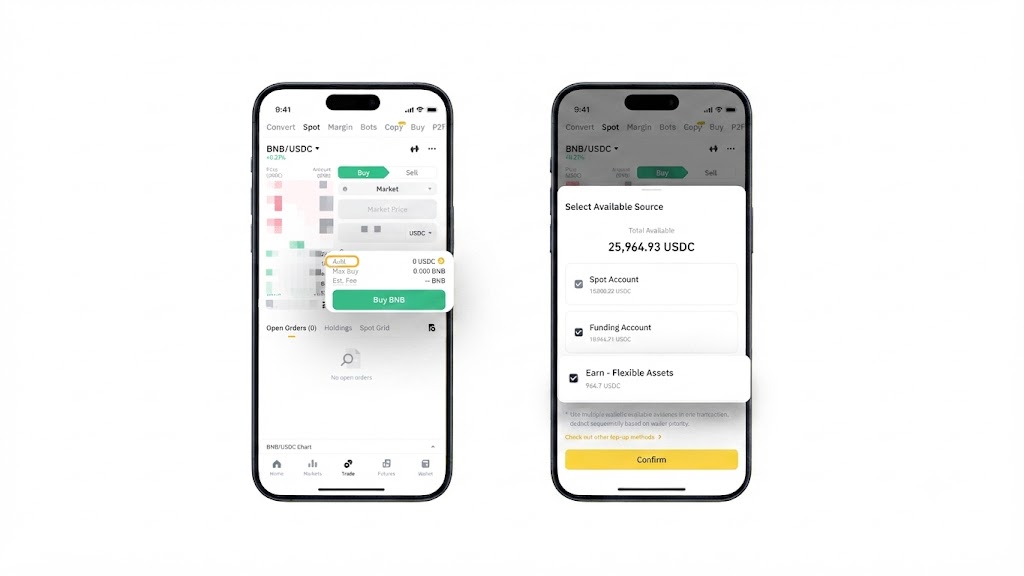
Binance Simple Earn offers flexible and locked options across more than 180 assets listed globally. Flexible products typically allow you to redeem your funds at any time; locked products require you to hold your funds for a specific term to earn the advertised APR.
The best features of Simple Earn:
- Flexible and locked products.
- Auto-Subscribe to automatically transfer eligible balances.
- Direct access from the app in supported regions.
Convert Recurring (DCA): Automate Your Purchases
Binance moved Auto-Invest to Convert Recurring. The feature allows users to schedule recurring cryptocurrency purchases at a set frequency, applying a DCA accumulation strategy without having to manually execute each trade.
Available order types
In addition to Binance Convert, the global platform offers:
- Market order: Buy or sell at the best available price.
- Limit order: Executed when the specified price is reached.
- Stop-limit and stop-market: These trigger an order when the specified level is reached.
- OCO: combines a limit order and a stop order.
- Trailing stop: tracks the price while maintaining a set distance.
- Iceberg, TWAP, and algorithmic orders for advanced users.
Binance vs. OKX
The most natural comparison for Binance pits the platform against OKX. Both are global exchanges offering spot trading, derivatives, Earn, bots, and a Web3 wallet, but their status in Europe as of August 2026 is completely different: OKX holds a MiCA license, while Binance does not.
| Characteristic | Binance | OKX |
|---|---|---|
| Foundation | 2017 | 2017 |
| European Regulation | No MiCA license; services suspended/restricted | MiCA via the MFSA starting in January 2025 |
| Spot Commission | 0.10% maker / 0.10% taker | 0.20 % / 0.35 % (standard EEE); 0.08 % / 0.10 % with X-Perps |
| Discounts | Up to 25 % on the spot market when paying with BNB | By volume, assets, and VIP level |
| SEPA deposits | Restricted in Spain after July 2026 | Yes, standard and instant |
| Cryptocurrencies | +708 | Approximately +408/td> |
| Security | Reserves Test and SAFU | Monthly Reserve Test and MiCA Segregation |
| Unique Product | Liquidity, BNB, Launchpool, and Catalog | Bots, European Regulation, and Web3 Wallets |
| Platform | Web, app, desktop, and Binance Wallet | Web, app, desktop, and OKX Wallet |
| Ideal for | Global users outside restricted regions | European users looking for regulation and advanced tools |
Binance maintains its lead in liquidity, selection, and overall cost. For users outside the EEA, it remains one of the most comprehensive exchanges on the market.
OKX is clearly the better choice for a Spanish resident in August 2026 because it has MiCA authorization, offers SEPA transfers, and provides operational services. In Europe, the license carries more weight than the difference in product offerings or the fees advertised by Binance.
Apps and Platform: How Do You Use Binance on a Daily Basis?
Binance offers an app for iOS and Android, a web platform, and a desktop client. The platform can be viewed in Lite mode for simple trading or Pro mode for spot trading, futures, bots, and advanced tools.
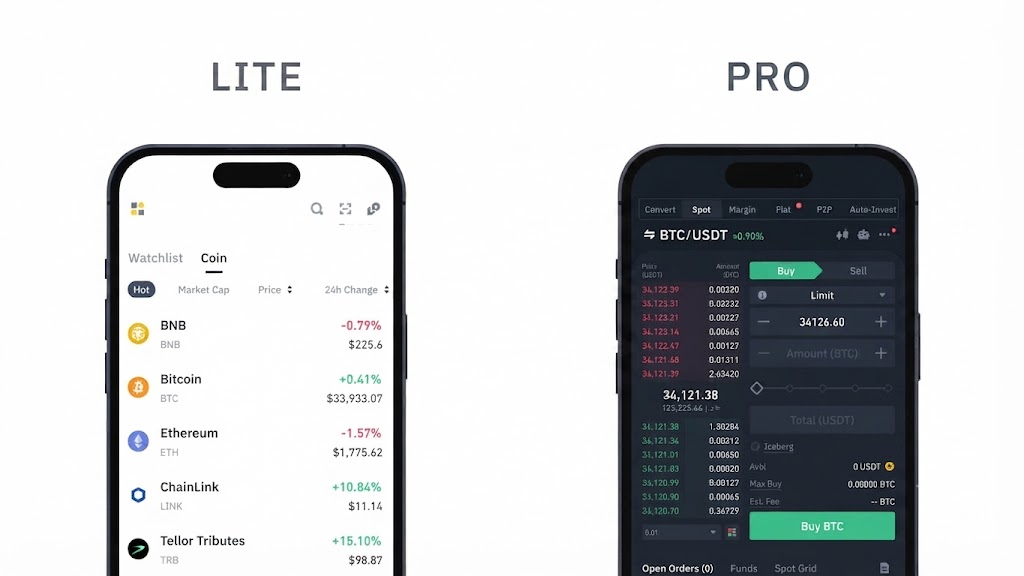
The navigation is organized into several sections:
- Markets: prices, currency pairs, new listings, and trends.
- Trading: Spot, margin, futures, and bots by region.
- Earn: Simple Earn, staking, Launchpool, and other products.
- Wallet: custodial balances, deposits, withdrawals, and Binance Wallet Web3.
Binance includes TradingView charts, an order book, order depth, indicators, an API, and portfolio analytics. It also offers watchlists, alerts, and automated tools.
In terms of order execution, it offers market, limit, stop, trailing stop, OCO, and algorithmic orders. However, for Spanish accounts, many of these features have been suspended or restricted since July 2026.
Pros
Lite and Pro modes within the same app
Maximum liquidity and professional tools
Charts, bots, APIs, and many types of orders
Separate Binance Wallet for Web3 access
Cons
An app packed with products, promotions, and notifications
Steep learning curve in Pro mode
Some global features are not available in all regions
In Spain, the lack of MiCA limits the platform's actual usefulness
Final Verdict: Is Binance Worth It in 2026?
Binance remains the world's largest exchange in terms of users and trading volume, with over 320 million accounts, more than 600 cryptocurrencies, fees of 0.10 %, and one of the most comprehensive ecosystems. Outside of Europe, its advantages in liquidity, variety, and tools remain hard to match.
However, for readers of Exchange Selector in Spain, there is one crucial limitation: Binance did not have a MiCA license as of August 2026. After withdrawing its application in Greece, it had to suspend new sign-ups and a significant portion of its European services as of July 1. This regulatory issue carries more weight than its fees or product offerings.
Given all of this, Binance is not a suitable recommendation for opening a new account from Spain in August 2026. Existing users should follow the official instructions to withdraw or transfer funds, while those looking for an operational exchange may want to consider OKX, Kraken, Bitvavo, Finst, or other platforms with active MiCA authorization.
This review is based on our actual experience using Binance. We tested the platform by making deposits, purchases, sales, and withdrawals of cryptocurrencies, and we also evaluated its fees, security, and ease of use. The rating you see here reflects our hands-on experience, not just a first impression.
Binance not for you? Explore other alternatives

Veteran exchange focused on security and compliance. Allows buying, selling, and staking, with pro tools and solid support.

Derivatives and copy trading-focused exchange with a fast app. Includes futures, multiple pairs, and advanced features for agile trading.
Leading global platform by trading volume. It offers spot and futures trading, staking, and a broad ecosystem with reduced fees through BNB.

European exchange with a clean interface and competitive fees. Ideal for trading crypto with SEPA transfers and stable liquidity in the European market.

Social trading and derivatives-focused platform with a simple interface. It includes copy trading, futures, and fast purchase options using a card.

Popular exchange for derivatives and spot trading, with high liquidity, a fast interface, and advanced tools geared toward active and professional traders.

Spanish exchange focused on ease of use, local support in Spanish, and integrated options for buying, saving, and custodial asset management.

Comprehensive platform offering spot, futures, and earn products. Strong global liquidity, pro tools, and a built-in Web3 wallet for active traders.
Frequently Asked Questions about Binance (Frequently Asked Questions)
Good platform, although I have many doubts about the drops with Bitcoin on Binance
Binance has been very useful and functional for making my transactions. Even when I sent a duplicate payment, customer support was quite friendly.
Everything's good. Great exchange for beginners. Simple and fast interface. Transfers and deposits are made normally and quickly. It has several options for staking. Highly recommended.
It has everything, perhaps too much. At first, I was constantly getting lost in menus and couldn't find what I was looking for. Once you get the hang of it, it's very powerful, but the learning curve is real.
I've had trouble adjusting the stop-loss and take-profit levels once the trade is open. It would be helpful if that feature were more flexible and easier to manage.
It's a shame that we can't use Binance from Spain due to MiCA restrictions. For an exchange with such high liquidity and an international presence, I think it should offer a more comprehensive solution for European users.