
Before we get into the details, here's a summary of the card's key features at a glance.

Quick Overview: Revolut Card
Background: What is Revolut, and where does its card come from?
Revolut was founded in London in 2015 by Nikolay Storonsky and Vlad Yatsenko with a very specific goal: to put an end to exorbitant fees when making payments or withdrawing money abroad. The first multi-currency prepaid card was, in fact, the product that put Revolut on the map before it became the all-in-one bank it is today, offering a checking account, cryptocurrency, stock trading, interest-bearing savings, and loans—all under a single IBAN.
Nearly ten years later, Revolut is one of the leading digital banks in Europe. The company claims to have over 75 million users across the continent and the rest of the world, and in Spain alone it says it has about 6 million customers. It operates through Revolut Bank UAB, an institution with a European banking license granted by the Bank of Lithuania and also supervised by the European Central Bank. In Spain, it provides its account and card services through a branch registered with the Bank of Spain under number 1583, which in practice means that it is not simply electronic money, but a fully-fledged bank account, with the card serving as the gateway to the rest of the ecosystem.
Did you know? Revolut's first card was prepaid and did not require a personal bank account. Today, the card is always linked to a Revolut account with a European IBAN, which allows users to have their paychecks deposited directly and, in Spain, to use Bizum directly from the card.
The five versions of the card
Revolut doesn't sell just one card, but rather a tiered lineup linked to the account's subscription plan. The more you pay per month, the higher the fee-free limits, the greater the travel benefits, and the more premium the card itself—up to stainless steel or platinum-plated versions at the highest tiers.
| Plan | Monthly payment | Focus |
|---|---|---|
| Standard | Free | Basic everyday use, free of charge, customizable card with a design or message |
| Plus | 3,99 € | A little more leeway for spending abroad |
| Premium | 9,99 € | Unlimited currency exchange and purchase protection, available in three exclusive colors |
| Metal | 15,99 € | Designed for frequent travelers, featuring stainless steel, cashback, and travel insurance |
| Ultra | 55 € | Unlimited VIP lounges, mobile data throughout Europe, and a platinum bathroom |
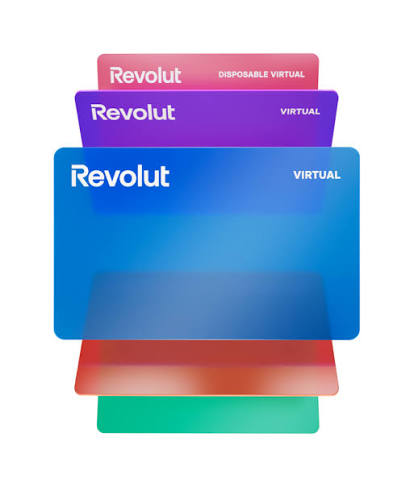
No matter which plan you choose, the physical card always comes with a virtual card that can be activated instantly through the app. This virtual version is especially useful for online purchases or for linking to Apple Pay and Google Pay even before the physical card arrives in the mail. In addition, Revolut lets you request one-time-use cards, whose details are regenerated after each purchase, designed for making payments on websites you don’t fully trust.
Currency Exchange and Cash Withdrawals in Europe
This is where the Revolut card continues to stand out from a traditional bank debit card, especially when traveling outside the eurozone within Europe. When making a payment or withdrawal in a currency other than the euro—such as the British pound, the Swiss franc, or the Swedish krona—Revolut applies the interbank exchange rate, without the markup that Visa or Mastercard typically add on their own. This free exchange rate, however, has a monthly limit that depends on your plan.
| Plan | Commission-free currency exchange | Weekend Surcharge | Free ATM Withdrawal |
|---|---|---|---|
| Standard | Up to €1,000 per month | 1 % on the amount | 200 €/month |
| Plus | Up to 3,000 €/month | 0.5 % of the amount | 200 €/month |
| Premium | No limit | No surcharge | 400 €/month |
| Metal | No limit | No surcharge | 800 €/month |
| Ultra | No limit | No surcharge | 2,000 €/month |
When you exceed the free ATM limit, the fee is no longer the standard flat rate of 2 % that Revolut charged until recently. Within Spain, the fee charged by the ATM itself applies—usually between 2 and 3 € if the ATM belongs to a bank other than the customer’s. In the rest of Europe, outside the eurozone, the fee remains 2 % with a minimum of 1 €. Here’s a practical tip for those traveling across the continent: if the ATM offers the option to withdraw directly in euros instead of the local currency—commonly known as DCC conversion—it’s best to always decline it, because it’s almost always more expensive than letting Revolut handle the exchange rate.
Did you know? Since 2026, Revolut has had its own branded ATMs in Madrid, Barcelona, and Valencia. Withdrawals at these ATMs are free and have no limit on the amount, and customers can also pick up a new card on the spot immediately if they are new customers or need a replacement card.
Bizum: How It Works with Your Card and Account
Revolut integrated Bizum in Spain in September 2024, and today it is one of the main selling points it highlights when compared to the country’s traditional banks. With the Standard account—which is completely free—you can link your phone number and start sending, receiving, and requesting money instantly, as well as paying at online stores that accept it as a payment method.
Activation is simple and is done right from the app itself—just accept Bizum’s terms and link your phone number. There’s one detail that often causes confusion: Bizum only allows you to have one phone number linked to a single account at a time, so if you’re already using it with another bank, you’ll need to unlink it there before activating it on Revolut. The actual transactions—sending, receiving, and paying at merchants—incur no additional fees from Revolut, and the limits on amounts and daily transactions are the same as those set by the Bizum system itself for any financial institution.
| Function | What it offers |
|---|---|
| Controls from the app | Instant blocking and unblocking, with the option to enable or disable online payments, contactless payments, or ATM withdrawals separately |
| RevPoints | Points earned with every purchase made using the debit card, redeemable for airline miles and other rewards |
| Credit Card | A product separate from the debit card, subject to a credit check, that earns more RevPoints |
| Security | Real-time notifications for every transaction, virtual card details that are regenerated after each purchase, and 24-hour support via chat |
Card Fees: Summary Table
Beyond its day-to-day features, the factor that truly determines whether the Revolut card is worth it is its fee structure, which varies depending on the plan and the type of transaction. The good news is that all the relevant details fit into a single table, with no additional fine print or hidden conditions outside of it.
| Concept | Cost |
|---|---|
| Standard Physical Card Issuance | Free, with possible shipping charges in some cases |
| Standard Maintenance Plan | 0 €/month |
| Currency exchange within the limit | 0 %, at the interbank rate |
| Currency exchange outside the limit in Standard and Plus | 1 % or 0.5 % on weekdays, with an additional surcharge on weekends |
| ATM withdrawal within the limit | 0 €, with no fees charged by Revolut |
| Withdrawal Outside the Limit in Spain | The fee charged by the ATM itself |
| Withdrawal outside the limit in the rest of Europe | 2 %, with a minimum of 1 € |
| Bizum: for sending, receiving, and paying at stores | Free |
| Card Customization | Free with the Plus plan; may incur a one-time charge with the Standard plan |
In which European countries is the Revolut card available?
It’s important to distinguish between two questions that are often confused. It’s one thing to ask where you can use the card—which, in practice, is virtually any country that accepts Visa or Mastercard. It’s quite another to ask where you can open an account and have the card issued to you as a resident. This second question is what truly determines the actual availability of the product for a European customer.
Within Europe, Revolut allows residents of the following countries to open a personal account—and thus apply for the card—from 32 countries: the 30 countries of the European Economic Area, plus the United Kingdom and Switzerland—two European markets where it operates under its own license outside the framework of the European Union.
Outside of these 32 European countries, Revolut also allows sign-ups in some markets on other continents, although under different conditions and without access to Bizum. For customers residing in Europe, this list is the definitive guide to card availability.
Revolut vs. N26 in Europe
The other fintech company the Revolut card is most often compared to is N26, a German digital bank with a very similar European presence in terms of the countries it covers. Both offer a free account, a European IBAN, and, in Spain, Bizum. Their approaches, however, differ. Revolut focuses on a broad ecosystem that includes cryptocurrency, stock trading, insurance, and travel products, all organized under a highly tiered pricing structure. N26 maintains a simpler offering, centered on the account and the card, with fewer subscription tiers and fewer additional features within the app.
In practice, for someone who’s just looking for a fee-free card for everyday use and Bizum, both options more than fulfill their purpose. Revolut is clearly the better choice if the customer travels frequently throughout Europe outside the eurozone, or if they’re interested in having investments, cryptocurrency, and interest-bearing savings all in one place. N26 may be more convenient for those looking for a minimalist option who don’t plan on upgrading their plan.
Pros
Free Standard Plan with no time limit, no payroll requirement, and no minimum balance required
Currency exchange at the interbank rate, with no markup
Bizum is integrated at no additional cost and can be activated from the app
Instant virtual card and full control from the app
Cons
The highest benefits require paying premiums of up to 55 €/month
Exceeding the ATM limit on weekends or outside the eurozone makes withdrawals more expensive
Bizum only works for residents of Spain, not in the other European countries where Revolut operates
With no physical offices, all support is handled through the app's chat feature
Final Verdict: Is the Revolut Card Worth It in 2026?
As a card for everyday use in Spain and the rest of Europe, the Standard plan already covers the essentials: fee-free payments, free cash withdrawals up to €200 per month, and Bizum—all with no fixed fee. In that sense, it’s hard not to recommend it, especially as a second card for traveling across the continent or for keeping everyday expenses separate from your traditional bank account.
The biggest question is whether it’s worth upgrading your plan. The Premium and Metal plans make sense for those who travel outside the Eurozone fairly often, or for those who feel that unlimited currency exchange and cashback justify the monthly fee. Ultra, at €55 per month, is only worth it if you’re actually going to take advantage of access to VIP lounges and the other high-end perks. For those who are just looking for a card with no fees and Bizum, the free plan is, quite simply, enough.
This review is based on our actual experience using the Revolut card. We tested the card by making payments, withdrawing cash from ATMs, exchanging currency, and activating Bizum, and we also evaluated its fees, security, and ease of use. The rating you see here reflects our hands-on experience, not just a first impression.