
Before we dive into the detailed analysis, here’s a ranked list of the 10 best cryptocurrency exchanges for Norway, with the key information you need to know about each one.


Investing in cryptocurrencies carries the risk of partial or total loss of capital. The content of this review is informative and does not constitute financial advice.
1. Kraken: The Most Comprehensive Platform for Making the Leap to Advanced Trading
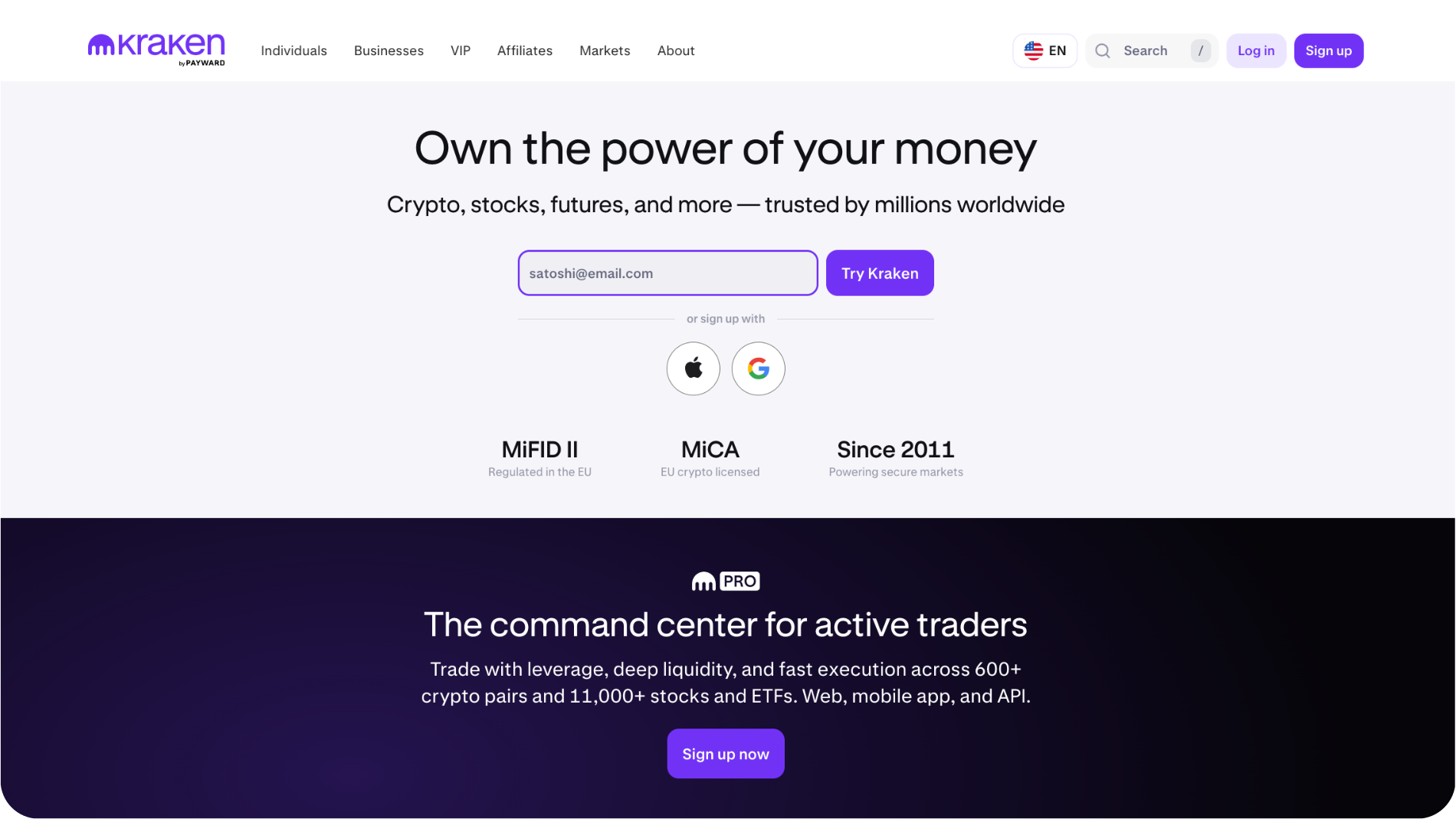
Kraken is one of the industry’s longest-standing exchanges, founded in 2011 and operational since 2013, with more than 600 cryptocurrencies and a presence in over 190 countries. It ranks first because it combines a long track record of security, quarterly Proof of Reserves audits with 1:1 backing, and a selection of cryptocurrencies that exceeds the top 10 average. In Europe, it operates through Payward Europe Solutions Limited, authorized as a CASP by the Central Bank of Ireland since June 2025; that license has been operating in Norway under an EEA passport since MiCA was incorporated into the EEA Agreement on February 6, 2026.
Su tarifa estándar es del 1% más spread, pero Kraken Pro reduce el coste hasta el 0,40% maker y 0,80% taker en el primer tramo, bajando con volumen. El depósito mínimo es de 10 USD. Para el usuario en Noruega, no admite coronas noruegas (NOK) de forma directa, por lo que conviene fondearlo con euros o stablecoins comprados previamente en un exchange con rampa local. View full Kraken review
Who is Kraken for? For users in Norway with intermediate or advanced profiles who already trade in euros or stablecoins and are looking for world-class security and liquidity.
Advantages:
- Wide variety of cryptocurrencies and markets available
- A strong track record of safety since its founding in 2011
- Access to margin trading and staking for dozens of cryptocurrencies
Disadvantages:
- No direct conversion from Norwegian kroner (NOK)
- High standard fee if you don't use Kraken Pro
- Learning curve to take full advantage of all its features
2. Bitvavo: The Cheapest Option in Europe for Trading in Euros
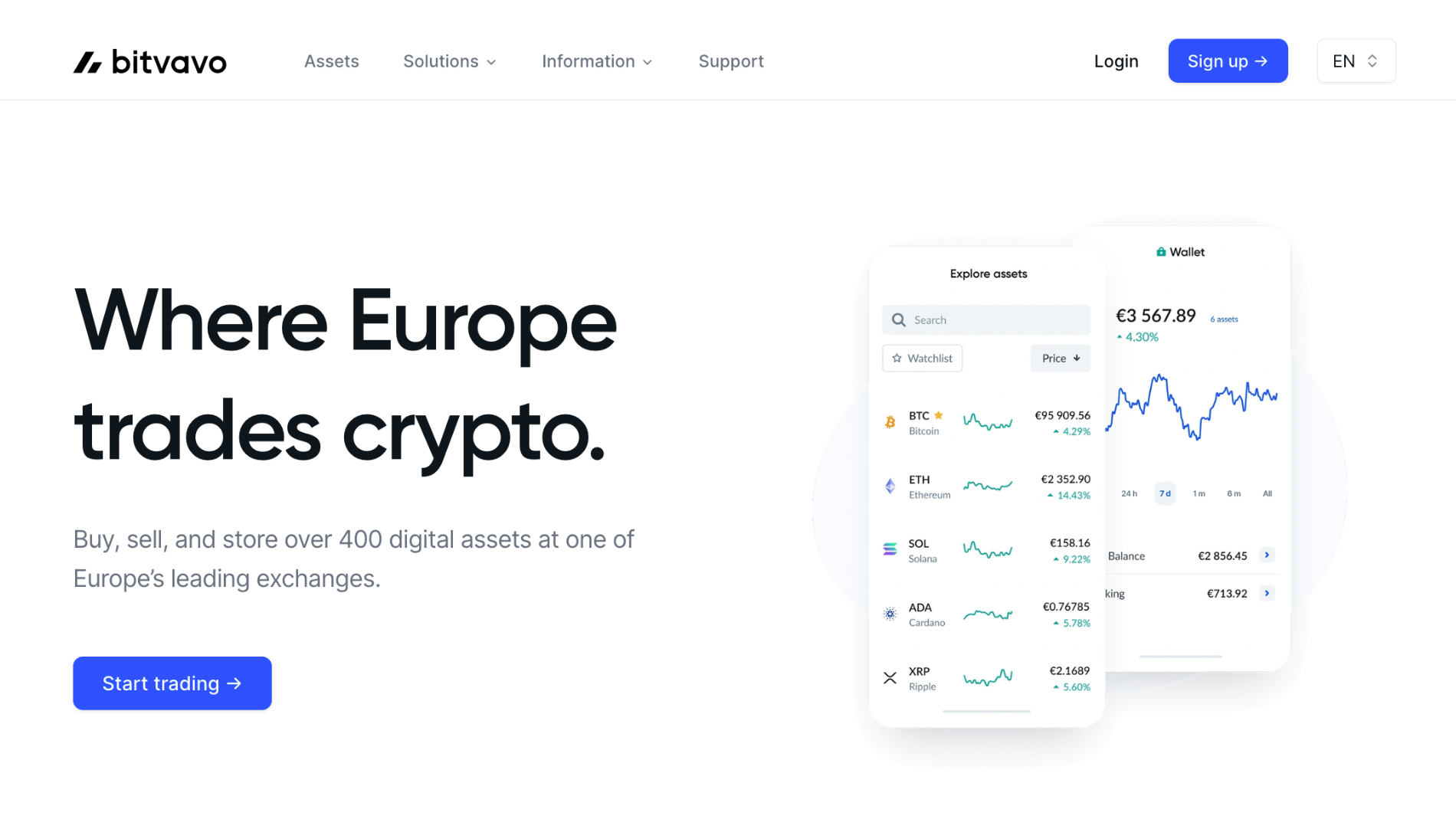
Bitvavo is Europe's largest exchange by volume in euros, headquartered in Amsterdam and with more than 2 million users in 27 countries. It ranks second because it combines some of the lowest fees among the top 10 exchanges, a selection of 428 cryptocurrencies, and an experience designed from the ground up for European users who trade in euros. It holds a MiCA (CASP) license granted by the Dutch AFM Starting in 2025, with a passport valid throughout the EEA, including Norway, starting in February 2026.
Its fees are 0.15% for makers and 0.25% for takers, with a minimum deposit of just 1 €. For users in Norway, transactions are processed in euros via SEPA without currency conversion, which means you’ll be subject to your bank’s EUR/NOK exchange rate when depositing or withdrawing funds. See the full review of Bitvavo
Who is Bitvavo for? For users in Norway who already trade in euros and want to buy, sell, and earn returns on cryptocurrencies with competitive fees and MiCA regulation.
Advantages:
- Fees among the lowest in all of Europe
- MiCA license with a passport valid throughout the EEA
- Minimum deposit of just 1 €
Disadvantages:
- No direct conversion from Norwegian kroner (NOK)
- A more limited selection of cryptocurrencies than other exchanges
- Customer service with more limited options
3. Firi: The first Norwegian exchange with its own CASP license
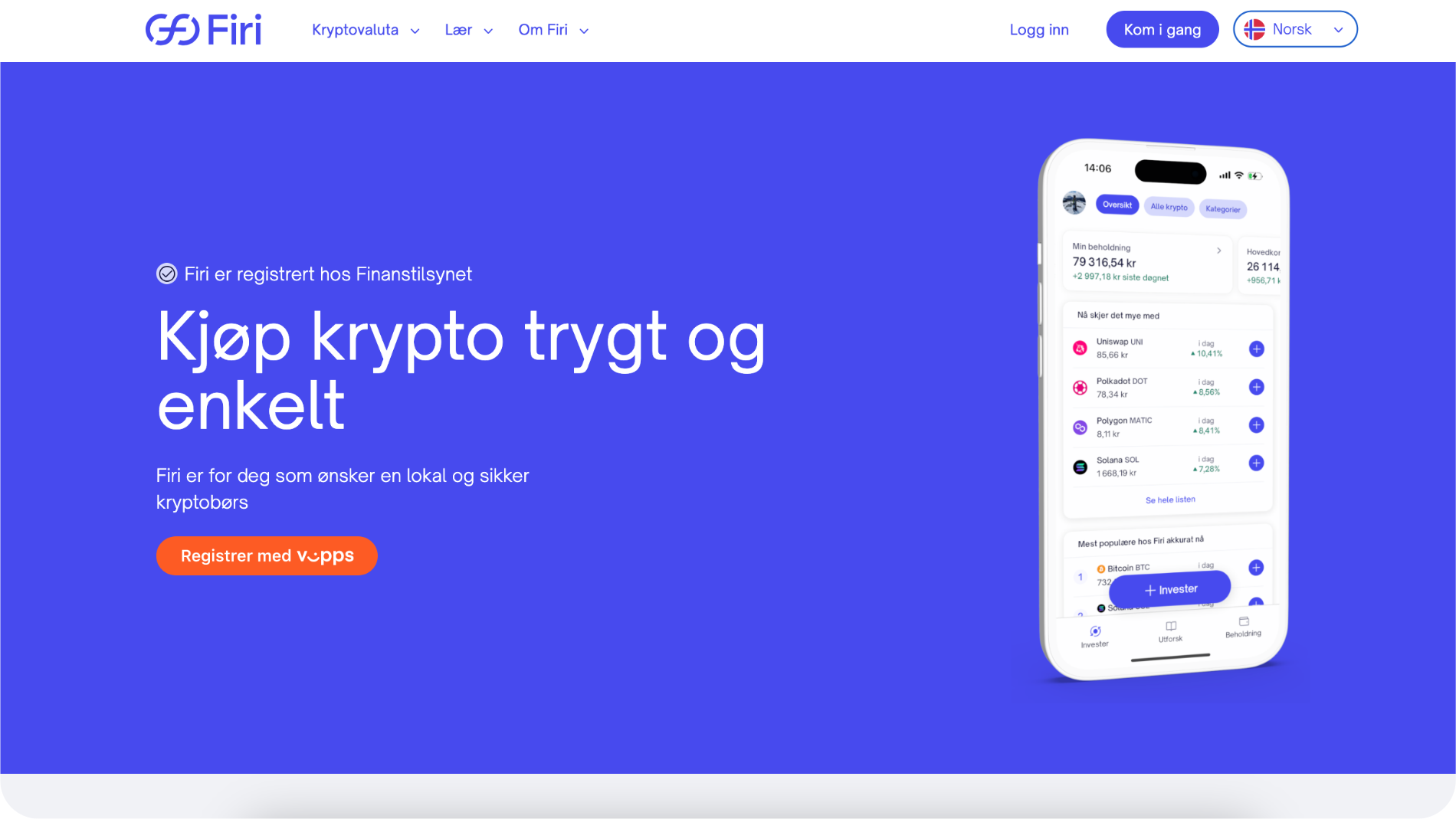
Firi is the Norwegian crypto platform founded in 2018 (formerly known as MiraiEx), the most widely used in the country thanks to its integration with BankID and Vipps. It ranks third for being the first entity to obtain the Financial Supervisory Authority the CASP license to operate a cryptoasset trading platform under Article 63 of MiCA, effective May 22, 2026, after years of operating under the previous anti-money laundering registration.
Its fees are competitive in the Norwegian market, with a tiered structure based on monthly trading volume. For users in Norway, Firi allows them to verify their identity and deposit Norwegian kroner directly using BankID or Vipps, without any intermediate steps or currency conversion.
Who is Firi for? For users in Norway who prioritize having their primary exchange regulated directly by Finanstilsynet, with immediate access via BankID and Vipps.
Advantages:
- First exchange with its own CASP license from the Finanstilsynet
- Verification and Direct Deposits with BankID and Vipps
- No currency conversion when trading in Norwegian kroner
Disadvantages:
- A smaller selection of cryptocurrencies than global exchanges
- Fewer advanced trading tools than international platforms
- Commissions that are less competitive than those offered by low-cost spot specialists
4. Bitpanda: Cryptocurrencies, stocks, and precious metals all in one app
Bitpanda is an Austrian platform founded in 2014 that combines cryptocurrencies, stocks, ETFs, and precious metals in a single account, with more than 6 million users in Europe. It ranks fourth for being the most comprehensive multi-asset offering in the top 10, in addition to being the first major crypto platform to obtain the MiCA license, granted by the Germany's BaFin in January 2025, with an EEA passport starting in February 2026.
Instant buying and selling incurs a 1.49% fee, while Bitpanda Fusion (its Pro version) charges as low as 0.02% for makers. Deposits via bank transfer are free, and a 1.5% fee applies for card deposits. For users in Norway, the platform operates in euros and does not offer direct conversion to Norwegian kroner; customer support is available only in English. See the full review of Bitpanda
Who is Bitpanda for? For users in Norway who want to invest in cryptocurrency, stocks, and precious metals all from a single app, with robust European regulation.
Advantages:
- Combine crypto, stocks, ETFs, and precious metals
- A pioneer in obtaining the MiCA license in Europe
- Deposits via wire transfer with no fees
Disadvantages:
- High commission on instant buy/sell transactions
- No direct conversion from Norwegian kroner (NOK)
- Customer service is available in English only

5. Coinbase: The Most Well-Known Option for Getting Started
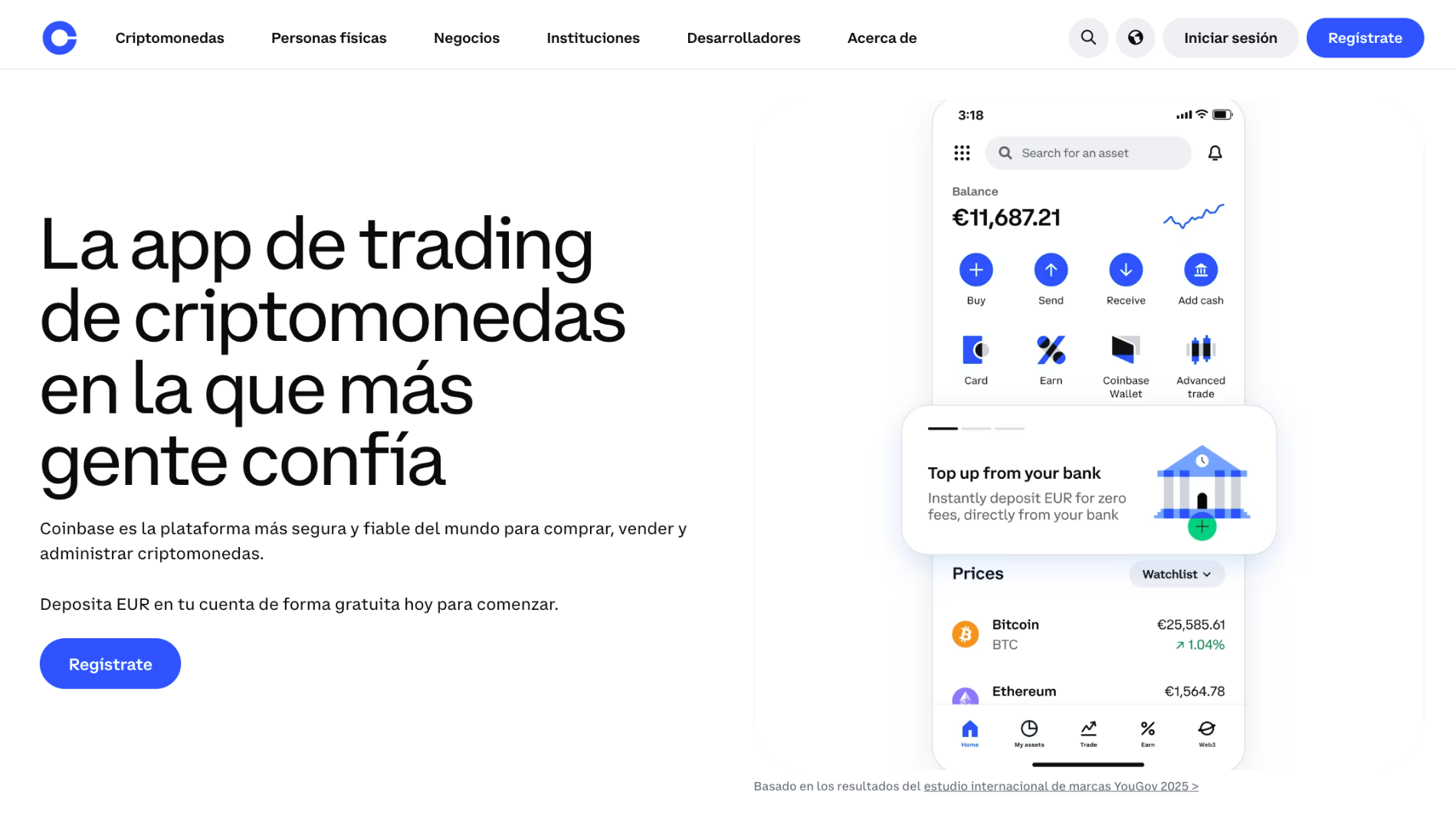
Coinbase is a publicly traded exchange (Nasdaq: COIN since 2021) and one of the most audited in the world, with more than 120 million users in over 100 countries. It ranks fifth because it combines the highest brand trust among the top 10 with an interface designed for those who have never bought cryptocurrency before. It holds a MiCA (CASP) license from the Luxembourg CSSF as of June 2025, with a passport valid in Norway as of February 2026.
The standard app charges fees of up to 3.99% for card transactions, but Coinbase Advanced reduces them to between 0.35% and 0.75%, depending on volume. For users in Norway, the app does not support deposits in kroner, so it’s best to fund it with euros or stablecoins previously purchased on an exchange with a NOK onramp. View full Coinbase review
Who is Coinbase for? For users in Norway who are just getting started with crypto and prefer the reliability of a well-known brand over lower fees.
Advantages:
- A well-known brand listed on the stock exchange
- Intuitive interface designed for beginners
- Large global user base
Disadvantages:
- High fees in the standard app
- No direct conversion from Norwegian kroner (NOK)
- You must upgrade to Advanced to get competitive rates
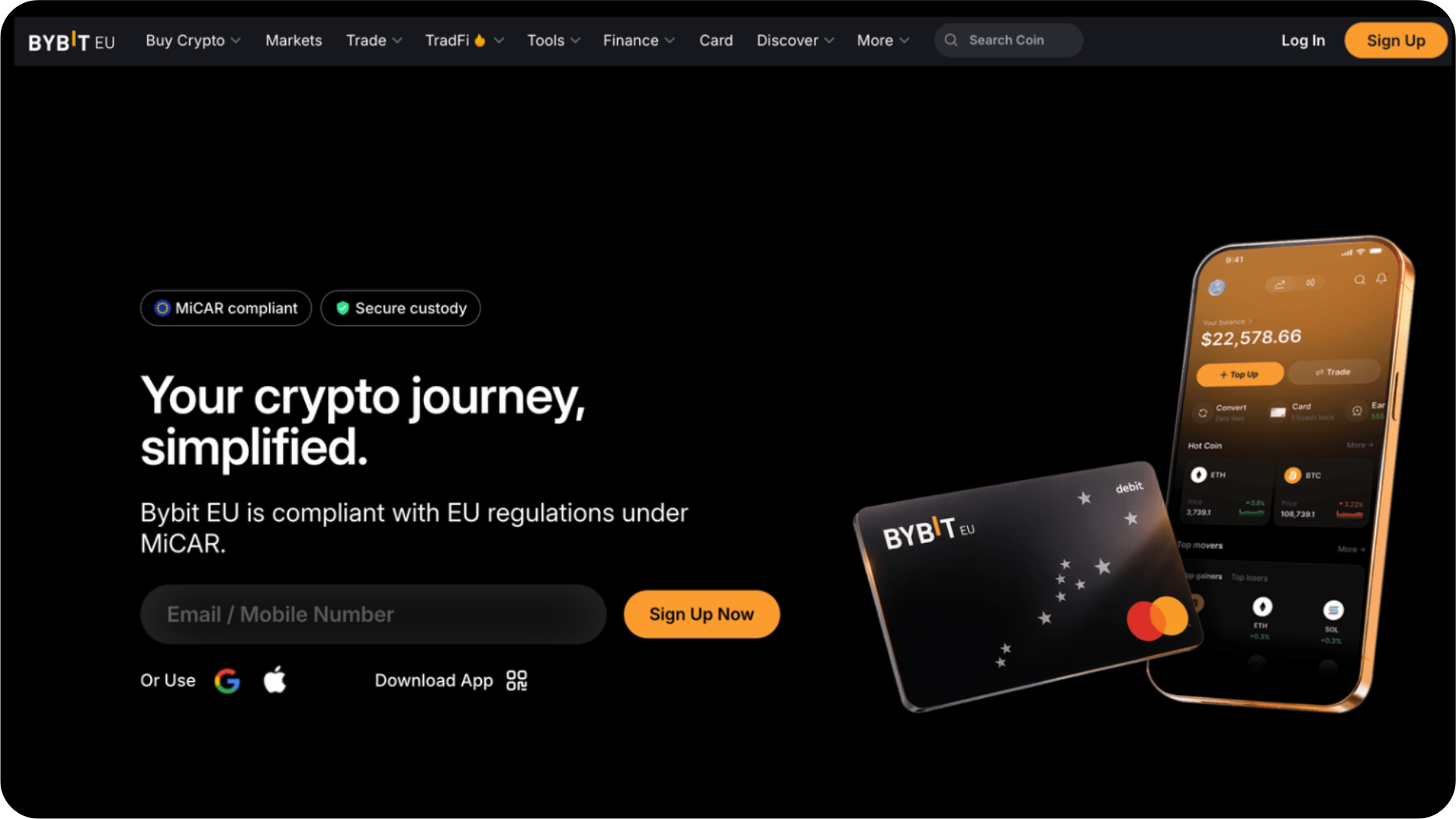
6. Bybit EU: Derivatives and Advanced Trading Under European Regulation
Bybit EU is the European arm of the world's second-largest exchange by volume, headquartered in Vienna after obtaining the MiCA (CASP) license from the Austrian FMA in May 2025, with EEA passport status starting in February 2026. It ranks sixth as the option in the top 10 most focused on derivatives and advanced trading, with up to 10x leverage on spot trading and a platform fully migrated to bybit.eu as of July 2026 for all EEA users.
Fees are competitive for advanced trading and decrease with volume, and the platform includes features such as the Bybit Card and spot margin trading. For users in Norway, all traffic now goes through the regulated entity bybit.eu; it’s worth noting that Bybit suffered a $1.5 billion hack in February 2025, although this did not affect the European entity. View the full review of Bybit EU
Who is Bybit EU for? For experienced users in Norway looking for derivatives and advanced trading within a framework regulated by the EEA.
Advantages:
- Entity regulated under a MiCA license with an EEA passport
- Strong focus on derivatives and advanced trading
- Up to 10x leverage available on spot trades
Disadvantages:
- Less suitable for beginners
- Background on a major theft on the global platform
- No direct conversion from Norwegian kroner (NOK)
7. NBX: the publicly traded Norwegian exchange, licensed by CASP, with a digital bank in the works
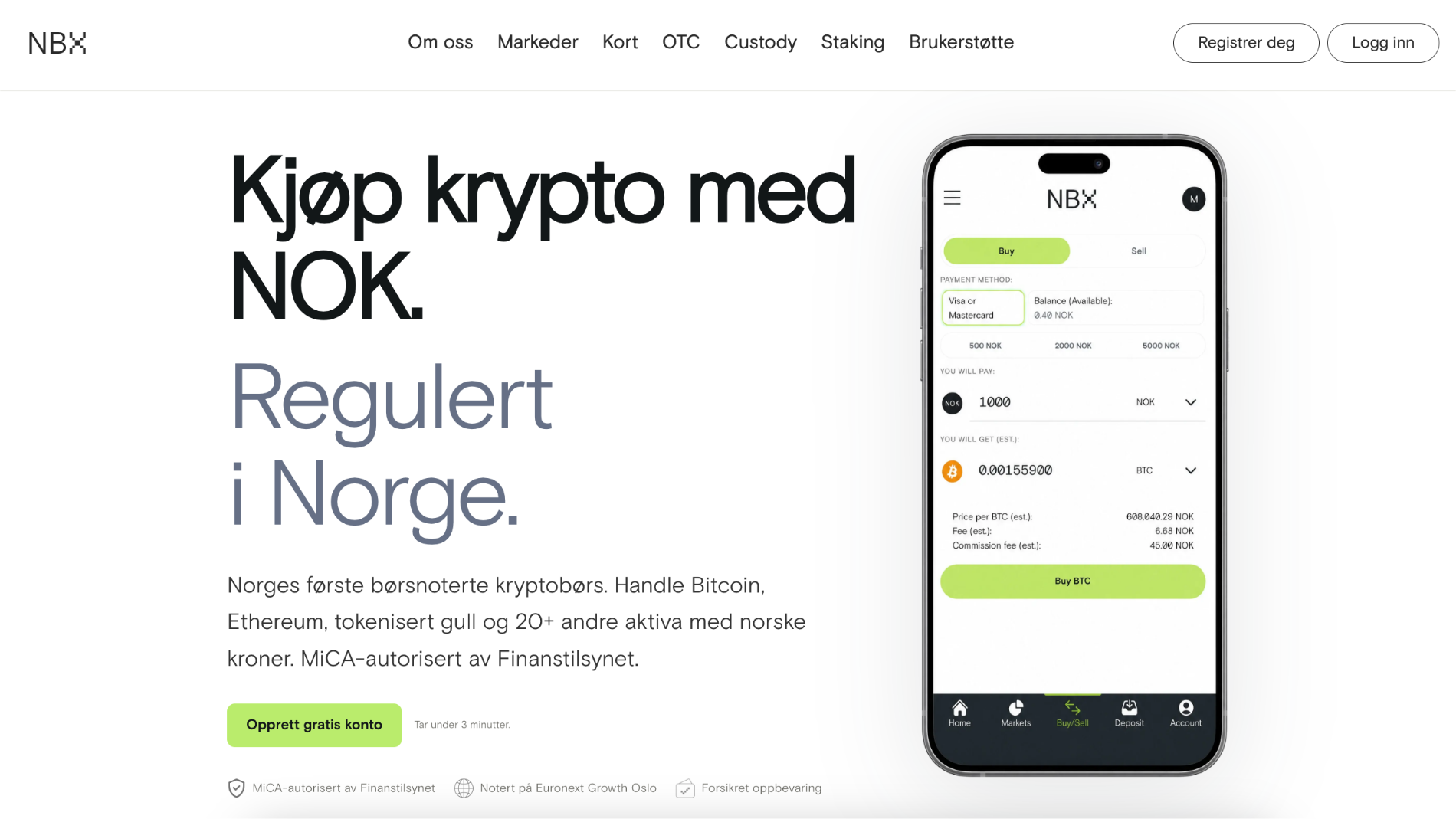
Norwegian Block Exchange (NBX) is a Norwegian platform founded in 2018, headquartered in Lysaker and listed on Euronext Growth Oslo, and a pioneer in issuing the world’s first credit card with Bitcoin cashback. It ranks seventh for having obtained the Financial Supervisory Authority its CASP license under MiCA on June 29, 2026, which grants it passport access to the 30 EEA countries, in addition to its previous license as an electronic money institution (EMI).
Its fees are competitive in the Norwegian market, with trading pairs in Norwegian kroner and euros, and a product offering that includes tokenized precious metals. For users in Norway, NBX is preparing to launch a multi-currency Visa card in the fourth quarter of 2026, as part of its strategy to become a fully licensed digital asset bank.
Who is NBX for? For users in Norway who are looking for a publicly traded, locally regulated exchange with a long-term vision for comprehensive digital banking services.
Advantages:
- CASP and EMI licenses, both issued by the Norwegian Financial Supervisory Authority (Finanstilsynet)
- Listed on Euronext Growth Oslo, with publicly disclosed financial information
- Pairs in Norwegian kroner and euros, plus tokenized precious metals
Disadvantages:
- A smaller selection of cryptocurrencies than global exchanges
- Multi-currency Visa card not yet available (scheduled for the fourth quarter of 2026)
- Fewer advanced trading tools than international platforms
8. OKX: Low fees and Web3 access for the most active users
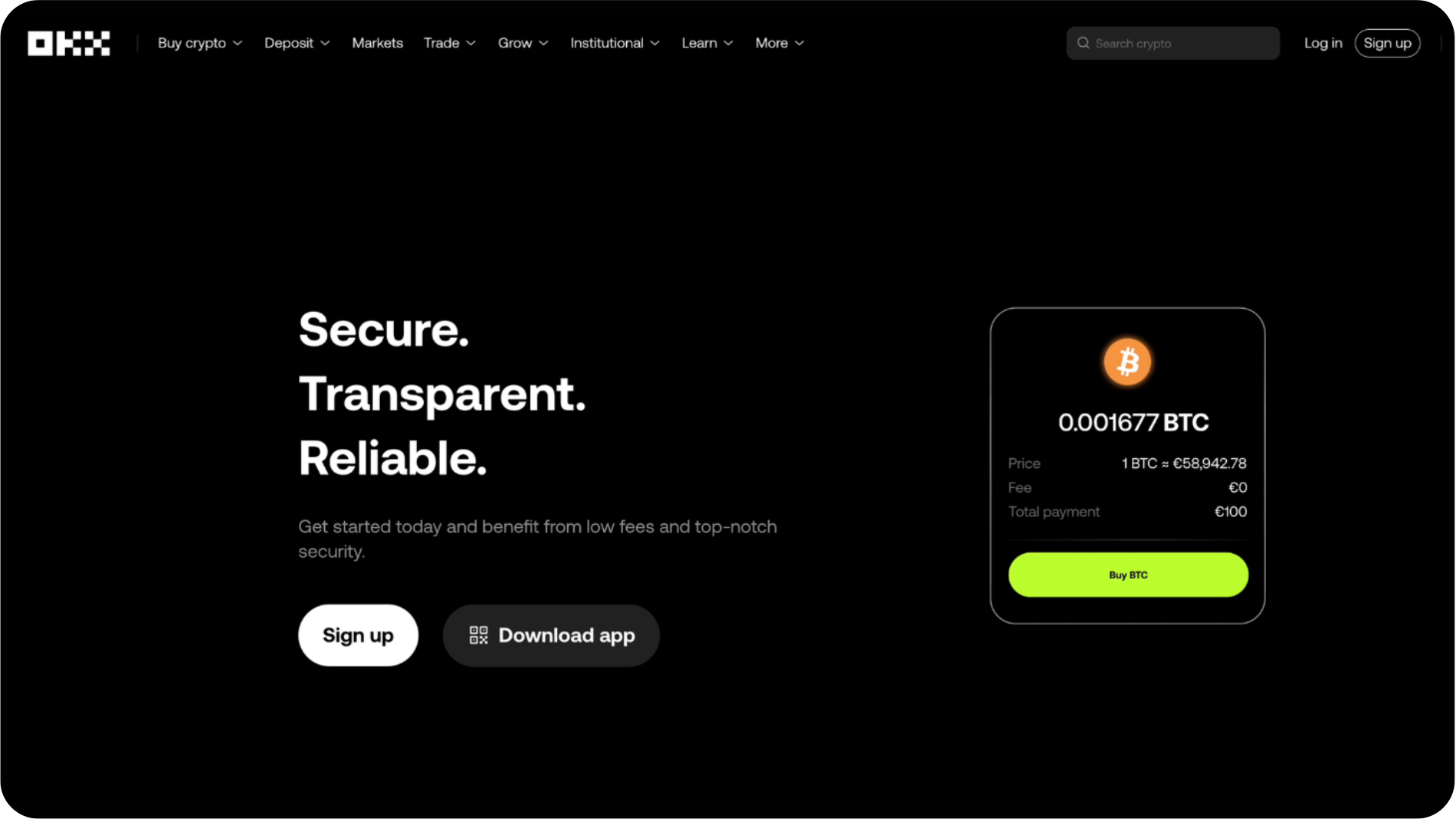
OKX is a global exchange that ranks as one of the most cost-effective options among the top 10 for frequent traders, while also providing access to Web3 features (such as its own wallet and DeFi) that are uncommon on centralized exchanges. It was among the first to obtain the MiCA (CASP) license in the EU, granted by the Maltese MFSA in January 2025, with an EEA passport starting in February 2026.
Its spot trading fees are among the lowest in the industry: 0.08% for makers and 0.1% for takers, with discounts up to levels with no minimum volume requirement. For users in Norway, it does not support direct deposits in kroner, but it does allow users to buy crypto with a credit card in euros and trade on its P2P marketplace. See the full OKX review
Who is OKX for? For users in Norway with a certain trading volume who are looking for low fees and want to start exploring Web3 without leaving the exchange.
Advantages:
- Spot commissions among the lowest in the industry
- Access to Web3 features such as a native wallet
- Reserve audits published quarterly
Disadvantages:
- It does not have its own guarantee fund
- No direct conversion from Norwegian kroner (NOK)
- Designed primarily for users with some experience
9. Bitstamp: Europe's longest-running regulated exchange
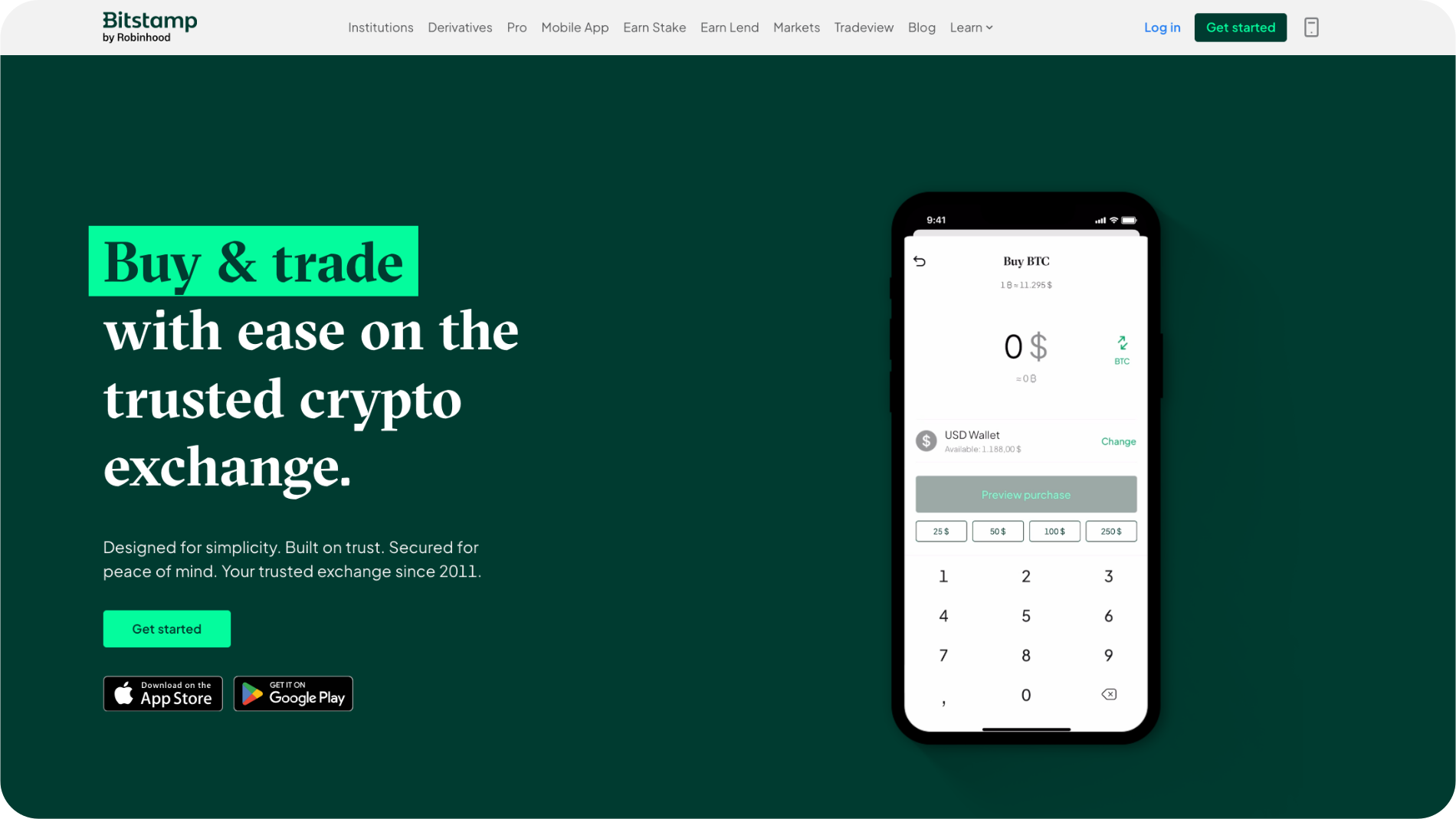
Bitstamp is the oldest active cryptocurrency exchange in Europe, founded in 2011 and owned by Robinhood (Nasdaq: HOOD) since 2025. It ranks eighth due to its track record of more than a decade without any serious security incidents, a feature that is particularly appealing to conservative users. Headquartered in Luxembourg, it was the first platform to obtain the MiCA (CASP) license from the CSSF in May 2025, with EEA passporting status starting in February 2026, in addition to already holding a MiFID license to operate as a multilateral trading facility.
Its fees are in line with the market average and decrease based on trading volume, with the advantage of operating under a doubly reinforced regulatory framework (MiCA and MiFID). For users in Norway, it is a platform that has been well-established in the European market for over a decade, although its selection of cryptocurrencies is more limited than that of newer exchanges. See the full review of Bitstamp
Who is Bitstamp for? For users in Norway who prioritize track record and regulatory stability over product variety or app design.
Advantages:
- A track record of more than a decade without serious incidents
- Dual regulation under MiCA and MiFID licenses
- Backed by the Nasdaq-listed Robinhood Group
Disadvantages:
- A smaller selection of cryptocurrencies than others
- No direct conversion from Norwegian kroner (NOK)
- Commissions are average; they are not among the lowest
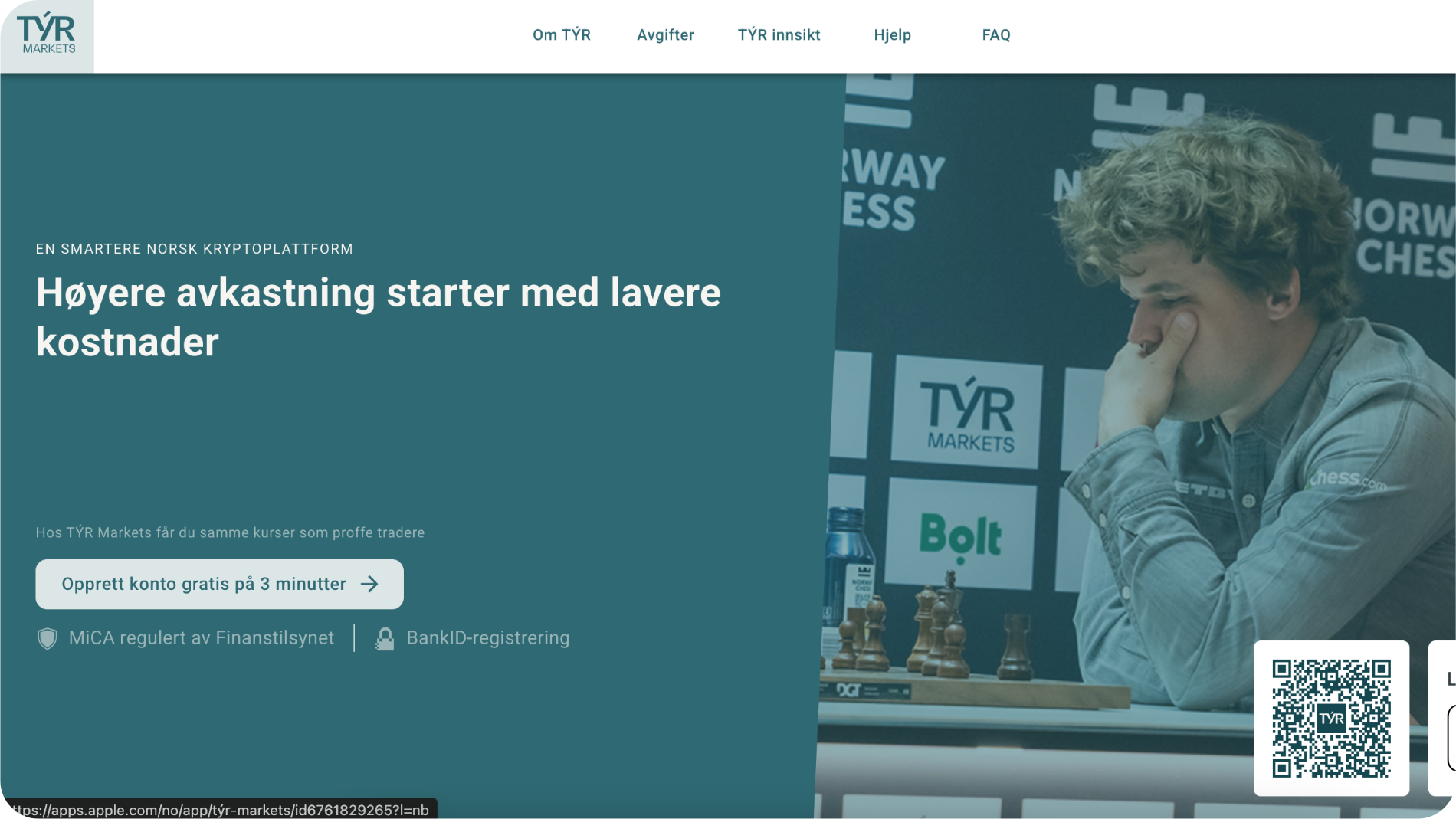
10. Týr Markets: Norway's second-largest exchange with a direct CASP license
Týr Markets is a Norwegian platform based on a fixed-commission model, with a simple and transparent business model. It rounds out the top 10 for having been, along with Firi, one of the first firms to obtain the Financial Supervisory Authority its CASP license under Article 63 of MiCA, effective May 18, 2026, covering custody, the exchange of cryptocurrencies for funds and other cryptocurrencies, and order execution.
It charges a flat commission of 0.35% on trades, with no tiers or complex structures—an approach that simplifies cost calculations for Norwegian users. For users in Norway, it allows for direct trading in kroner, with a selection focused on the most established cryptocurrencies rather than niche altcoins. See the full review of Týr Markets
Who is Týr Markets for? For users in Norway looking for a local platform, directly regulated by the Finanstilsynet, with a fixed commission that's easy to calculate.
Advantages:
- CASP license issued by the Norwegian Financial Supervisory Authority (Finanstilsynet)
- Fixed and transparent commission of 0.35%, with no tiers
- Direct trading in Norwegian kroner
Disadvantages:
- A smaller selection of cryptocurrencies than global exchanges
- Shorter history than other exchanges in the ranking
- Fewer advanced trading tools
Comparison Table of Exchanges for Norway
After reviewing the 10 exchanges, here is a comparison table that summarizes each one’s cryptocurrency offerings, maker/taker fees, and MiCA compliance for users in Europe.
| Platform | Cryptos | Maker / Taker | Regulation |
|---|---|---|---|
 Kraken |
600+ | 0,40% / 0,80% (Kraken Pro) | MiCA (Central Bank of Ireland), EEA passport |
 Bitvavo |
428+ | 0,15% / 0,25% | MiCA (AFM, Netherlands), EEA passport |
 Firi |
30+ | By tier based on volume | CASP (Norwegian Financial Supervisory Authority) |
 Bitpanda |
650+ | 0.02% (Fusion) / 1.49% (standard) | MiCA (BaFin, Germany), EEA passport |
 Coinbase |
400+ | 0.35% / 0.75% (Advanced) | MiCA (CSSF, Luxembourg), EEA passport |
 Bybit EU |
700+ | 0,25% / 0,25% | MiCA (FMA, Austria), EEA passport |
 NBX |
40+ | Competitive in the Norwegian market | CASP + EMI (Norwegian Financial Supervisory Authority) |
 OKX |
375+ | 0,08% / 0,10% | MiCA (MFSA, Malta), EEA passport |
 Bitstamp |
100+ | In line with the market average | MiCA + MiFID (CSSF, Luxembourg), EEA passport |
 Týr Markets |
25+ | 0.351 TP3T (fixed) | CASP (Norwegian Financial Supervisory Authority) |
Three exchanges on the list (Firi, NBX, and Týr Markets) hold a CASP license granted directly by the Norwegian Financial Supervisory Authority (Finanstilsynet), while the rest have been operating in Norway under a European passport since MiCA was incorporated into the EEA Agreement on February 6, 2026. The best option will depend on whether you prioritize direct trading in kroner, low fees, or a wide selection of assets.
How are cryptocurrencies taxed in Norway in 2026?
Norway does not have a specific tax on cryptocurrencies: Skatteetaten treats them as formuesobjekt (assets), subject to both capital gains tax and wealth tax (formuesskatt)—the latter being a rare feature in Europe. The key point is that you must report your crypto assets yourself on your skattemelding (tax return); only if you trade through a Norwegian institution will some of the information be pre-filled.
Depending on the type of transaction, the following rules apply:
- Capital Gains Tax: Gains from the sale or exchange of cryptocurrencies (including crypto-for-crypto transactions) are taxed at a flat rate of 22% in 2025 and 2026, with losses fully deductible at the same rate.
- Formuesskatt (wealth tax): Your crypto assets are valued at the closing price on January 1 of the following year and are added to the rest of your net worth; only the portion that exceeds the tax-exempt threshold—approximately 1.76 million NOK—is subject to tax.
- Recommended FIFO method: The Norwegian Tax Administration recommends calculating the purchase price using the FIFO (first-in, first-out) method, although the taxpayer may choose which units to sell if he or she does not liquidate the entire position.
- Third-party reporting starting in 2026: Starting this year, cryptocurrency exchange and custody service providers are required to report their customers' transactions directly to Skatteetaten, thereby strengthening the data-matching process that was already in place.
Data from Skatteetaten shows that Norwegians reported 40,000 million NOK in crypto assets during the 2024 tax filing season, with 5,500 million NOK in gains and 2,900 million in losses, although the agency itself estimates that only about 15% of cryptocurrency owners report them correctly. The most sensible approach is to keep your own record of purchases, sales, and market value as of January 1, and file your return with Norwegian Tax Administration by April 30.
How did we selected the exchanges in this ranking
This ranking was compiled based on a comparative analysis of the cryptocurrency exchanges available to customers in Norway, combining real-world testing with technical, regulatory, and user experience evaluations to identify those best suited for users residing in Norway in 2026.
To compile the ranking, we evaluated each platform based on the following criteria:
| Criteria | What We Evaluate | |
|---|---|---|
| 1 | License Regulation and Verification | We only include exchanges with full CASP authorization, verifying each operator in Finanstilsynet’s public records, including the services covered by their license and whether they operate under an EEA passport or are directly registered in Norway. |
| 2 | Norwegian Crown Ramp | Ease of depositing and withdrawing NOK, including integration with BankID and Vipps when offered by the platform. |
| 3 | Tax Adjustment | Clarity in operational reports for the purpose of the formuesskatt and capital gains tax, and compatibility with the new third-party reporting requirement to Skatteetaten starting in 2026. |
| 4 | History in the Norwegian Market | The platform's history and established presence in the local market, and whether it holds a direct CASP license from Finanstilsynet. |
| 5 | Actual Trading Costs | Actual trades on each platform, taking into account the combined cost of commissions, spreads, and withdrawal fees—not just the advertised rate. |
| 6 | Track Record and Transparency | Each exchange's security track record and transparency in the disclosure of reserves (Proof of Reserves). |
The testing was completed in September 2026, with a final verification of the licenses in effect in Finanstilsynet’s public records as of the publication date. You can review the complete data research and verification process on our methodology.
Important note: We review this ranking periodically based on new authorizations from Finanstilsynet, changes in the krone exchange rate, or tax changes. Rankings may vary.
Regulation of Exchanges and Cryptocurrencies in Norway
Norway is not a member of the European Union but of the European Economic Area (EEA), so MiCA did not automatically apply to it: it had to be incorporated into the EEA Agreement, which occurred on February 6, 2026. The Kryptoeiendelsloven (Norwegian Crypto-Asset Act), which transposes MiCA into national law, entered into force on July 1, 2025, and the Financial Supervisory Authority It is the authority that licenses and supervises cryptoasset service providers (CASP) in the country.
During the transition period, providers already registered under the former anti-money laundering law (hvitvaskingsloven) were able to continue operating while their CASP license applications were being processed. Faced with a higher-than-expected volume of applications, the regulator extended the transitional period from December 30, 2025, to June 30, 2026. That period definitively expired on July 1, 2026, coinciding with the end of the transitional regime in the rest of the EU and the EEA: since then, only platforms with their own CASP license or a passport from another EEA regulator have been allowed to operate in Norway. Firi (May 22, 2026) and Týr Markets (May 18, 2026) were the first to obtain their CASP licenses to operate a trading platform, followed by NBX (June 29, 2026).
Important note: Binance does not appear in this ranking because it does not have a MiCA license. As of July 1, 2026, it will not accept new users or deposits in any European Union country and will only allow withdrawals.
The information presented in this ranking is for informational and educational purposes only. It does not constitute financial or tax advice, nor is it a personalized investment recommendation. Using cryptocurrency exchanges involves risks, and each user is responsible for assessing which platform best suits their profile, as well as for complying with applicable regulations and their legal and tax obligations under current Spanish law. Some links in this ranking are affiliate links: if you open an account through them, Exchange Selector may receive a commission at no additional cost to you. This does not influence the criteria or the order of this ranking.
(FAQ) How to Choose a Cryptocurrency Exchange in Norway in 2026