
Before we dive into the detailed analysis, here's a summary of Bitvavo's most important data at a glance.
Quick overview

Coinbase
- Headquarters
- California, Estados Unidos
- Regulated by
- CSSF (MiCA) y SEC
- Cryptocurrencies
- More than 400
- Maker / taker fees
- 0,40 % / 0,60 %
- Minimum deposit
- 1 €
- Ideal for
- Your first crypto platform
Investing in cryptocurrencies carries the risk of partial or total loss of capital. The content of this review
is informative and does not constitute financial advice.
About Coinbase: a global-reach, listed platform
Coinbase was born in San Francisco in 2012 and is one of the world’s most recognized cryptocurrency platforms, as well as the only one of the big ones to be listed on the stock exchange (NASDAQ: COIN). It operates in more than 100 countries, holds some $246 billion in assets and, as a publicly traded company, publishes its results to the SEC, which is unusual for the industry.
In the European Union it operates under the MiCA framework, licensed by the CSSF of Luxembourg, which allows it to offer its services throughout the Community. In the United States, when listed on the NASDAQ, it is subject to oversight by the SEC and publishes its results periodically. Their proposal is supported by a simple interface, secure safekeeping of funds and a KYC-compliant compliance program.
Who is Coinbase for? For users who want a reliable and user-friendly platform to get started with cryptocurrencies, with the peace of mind of trading with a listed and regulated company.
Advantages:
- Publicly traded company with public financial reporting
- Simple interface, ideal for beginners
- More than 400 cryptocurrencies and a minimum deposit of €1
Disadvantages:
- Higher fees than other European exchanges
- Spread not always visible in quick purchases
- Limited customer support
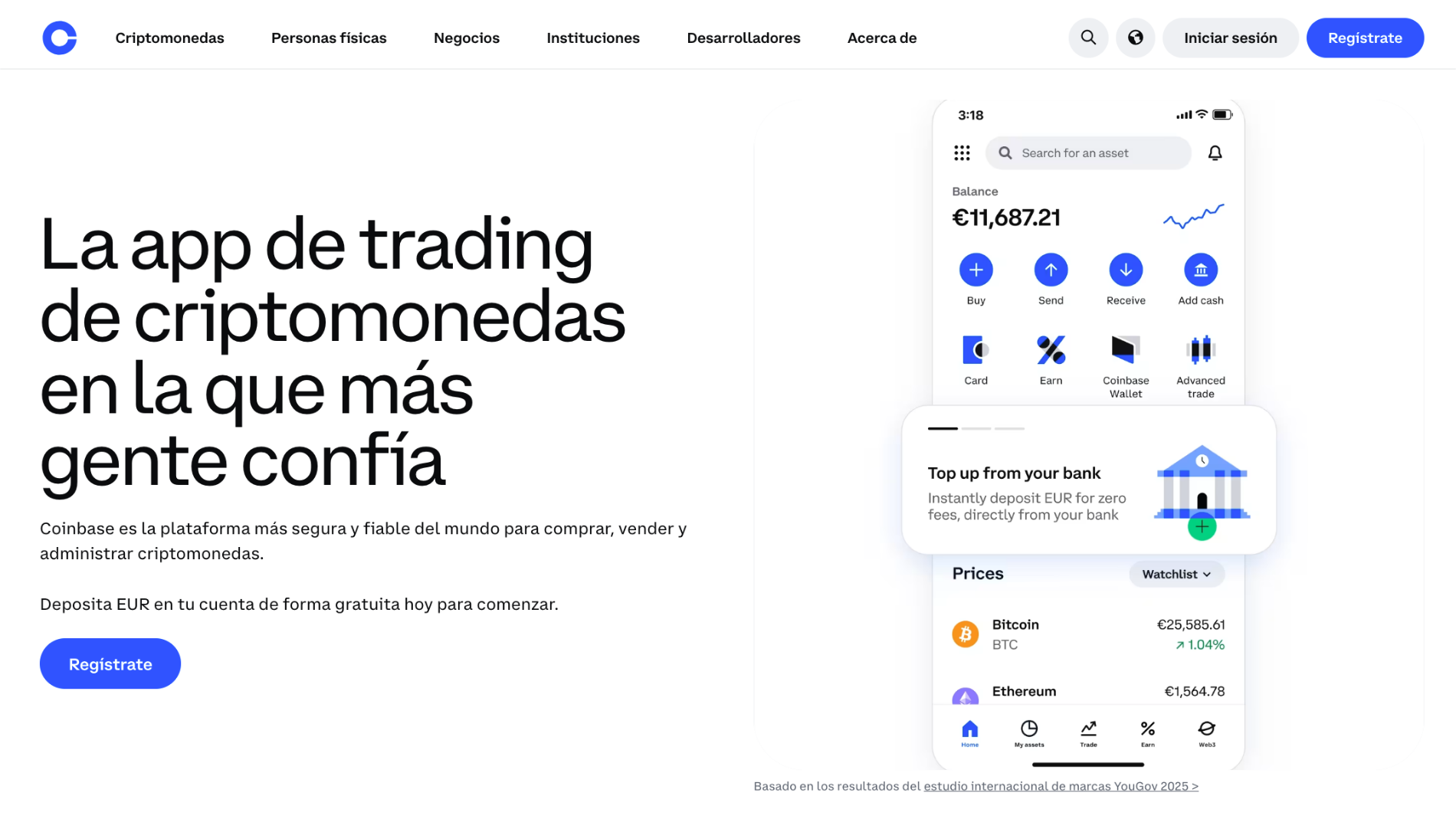
Where is Coinbase available? In over 100 countries
Coinbase serves more than 100 countries in Europe, the Americas, Asia, Africa and Oceania, including Spain, USA, UK, Japan, Singapore, UAE, Nigeria and India. In the European Union it operates under a MiCA license and in the US with state money transmission licenses. In all cases it is mandatory to verify identity to open an account.
Coinbase does not publish a list of blocked countries. Your restricted area policy only indicates that access is denied in US Treasury sanctioned territories. United States, that is, the total embargoes of OFAC: Cuba, Iran, North Korea, Syria and the occupied Ukrainian regions. May also be out of market due to lack of license, and available features vary by country.
KYC registration and verification at Coinbase: how to verify your account
To use Coinbase you have to verify your identity, a mandatory requirement by regulation. Until you do, your account has limited functionality. When you log in, select "Verify your information", upload a photo of your document and, if you live in the EU, take a live selfie. If your computer does not have a camera, you can complete the process from your mobile device by scanning the QR code. The result of the check arrives within 24 hours.
Passport, ID and EU or UK driving licence are accepted as long as they are valid. In some cases they may also ask you for a proof of address from the last 3 months. Make sure that the website where you upload your document ends at .coinbase.com and never send your ID via email.
Coinbase fees: how much does trading really cost?
Coinbase’s fees aren’t summarized in a single number, because it depends on where and how you operate. In the standard app you pay a variable fee and, in addition, the price already includes a spread. There is no spread at Coinbase Advanced: you pay a maker/taker commission that decreases based on your volume in the last 30 days.
The 0.40% / 0.60% figures shown in this review are the first tranche of Advanced, not a standard app flat rate.
Standard app fees
The cost consists of several layers. No single figure reflects what you pay, so the most reliable thing is to look at the preview screen before confirming each order.
| Concept | How It Works |
|---|---|
| Coinbase fee | Variable. Calculated when placing the order based on payment method, amount, asset and your location |
| Spread | Included in the price of purchases, sales and conversions, not appearing as a separate commission |
| Simple limit order | Independent commission of 1 % of the amount, both on purchases and sales |
| Payment method | Commission of up to 1,875 % may be added depending on the method chosen |
| DEX Trading | Additional service charge, plus possible slippage |
The spread is not a hidden commission at all, but it’s not presented as such. Coinbase includes it in the quoted price and is seen in the preview, clicking the dropdown next to the asset’s price. In addition, the platform itself indicates that it can keep the excess spread and that this varies between similar trades. Does not post a fixed percentage, so there is no figure we can give you.
The other trap is limit orders in the standard app. Even though they seem like the way to save, they charge an extra 1%, and not even Coinbase One removes it. If you want to set the purchase or sale price, it’s better to do it from Advanced.
Coinbase Advanced fees
In Advanced you operate directly against the order book, no spread. The orders that are executed at the moment pay the taker commission, and those left waiting in the book pay the maker. If an order is only partially executed, each party pays for its own. Your installment is updated every hour based on the 30-day volume.
| Volume (30 d) | Maker fee | Taker fee |
|---|---|---|
| 0 $ + | 0,40 % | 0,60 % |
| 10.000 $ + | 0,25 % | 0,40 % |
| 50.000 $ + | 0,15 % | 0,25 % |
| 100.000 $ + | 0,10 % | 0,20 % |
| 1.000.000 $ + | 0,08 % | 0,18 % |
| 15.000.000 $ + | 0,06 % | 0,16 % |
| 75.000.000 $ + | 0,03 % | 0,10 % |
| 250.000 $ + | 0,00 % | 0,06 % |
| 400.000.000 $ + | 0,00 % | 0,04 % |
Deposits and withdrawals on Coinbase: what you pay and when
Saving your money on Coinbase is free: there are no charges for holding cash or cryptocurrencies on the main balance, and moving cryptocurrencies to another Coinbase user also has no cost. The costs appear when entering or withdrawing money, and depend on the method chosen. Coinbase always shows the commission before you confirm, so there are no later surprises. SEPA bank transfer is often the cheapest option, while card and instant methods tend to cost more.
When sending cryptocurrencies out of Coinbase, what you see is an estimate of the network fee. The actual cost that Coinbase pays may be different, because it aggregates transactions and network congestion changes. There are no transaction fees with the Coinbase Card, although spread is included when converting crypto to expense and third-party ATMs can charge their own.
| Operation | What you pay |
|---|---|
| Save cash and crypto | Free |
| Transfer crypto to another Coinbase user | Free |
| SEPA deposit or withdrawal | Normally no Coinbase commission; takes 1-3 business days |
| Deposit or withdrawal with other methods (card, instant) | Variable according to the method, shown before confirming |
| Send crypto to an external wallet | Estimated network fee, which may differ from the actual |
| Spending on the Coinbase Card | No transaction fee, although spread applies and cashiers may charge |
| Recover an unsupported asset | Network fee, plus 5% on the amount exceeding $100 |
If you want to spend as little as possible, deposit and withdraw via SEPA, and always compare the preview before confirming.
Coinbase One: what is it and how much does it cost
Coinbase One is the Coinbase subscription to trade at lower costs and get more out of your cryptocurrencies. Includes trading without trading commission up to a monthly limit (the spread is still applied), an increase in staking rewards, member draws and tax and onchain offers. Available in more than 40 countries, including most of Europe, USA The US, Canada, Brazil, Australia and Singapore, although benefits may vary by region.
You can pay by debit card, fiat balance, PayPal, USDC, USDT or certain cryptocurrency balances. The subscription is personal and not shareable, and previous transaction fees are non-refundable.
| Characteristic | Basic | Favorite | Premium |
|---|---|---|---|
| Precio mensual | 4,99 € | 24,99 € | 249,99 € |
| Zero fees x transaction | Up to 500 €/month | Up to 10.000 €/month | Unlimited |
| Push rewards staking | +5 % | +10 % | +15 % |
| Member sweepstakes | Yes | Yes | Yes |
| 24/7 priority assistance | No | Yes | With advisor |
| Exclusive tax offers | Yes | Yes | Yes |
| Onchain partner offers | Yes | Yes | Yes |
Advantages:
- Zero trading fees up to the limit of each plan
- Increased rewards for staking (+5% to +15%)
- Member extras: tax offers, sweepstakes and onchain benefits
Disadvantages:
- The spread still applies, so the cost does not disappear entirely
- Low plans have a monthly trading limit with no commission
- Only compensates if you operate frequently
Coinbase Advanced: more control and less fees to trade
Coinbase Advanced is Coinbase’s professional trading platform, designed for those who want more control than the standard app. Includes customizable charts, real-time order books, a modular workspace, different types of orders and APIs (REST and WebSocket) to automate strategies. Allows trading in more than 550 spot pairs and, depending on the region, derivatives with leverage of up to 10x. It was formerly known as Coinbase Pro, and has no subscription fee: fees depend on trading volume.
Maker’s commissions start at 0.0% and fall as your volume increases, with a VIP program for big traders offering special pricing and dedicated account management. To protect the account, account with two-step verification, mobile biometrics, support for Yubikey and a list of allowed addresses. Markets, products and fees may vary by country.
Advantages:
- Maker fees from 0.0% and no subscription fee
- More order types: market orders, limit, stop limit and auction mode.
- Professional tools: charts, order book, API and customizable workspace
Disadvantages:
- More complex interface and not recommended for beginners
- Leverage and derivatives carry high risk
- Derivatives and some markets are not available in all regions
Futures on Coinbase Advanced: trade with leverage of up to 10x
In addition to the trading spot, Coinbase Advanced offers futures on cryptocurrencies, and depending on the region also on commodities and indices, with a leverage of up to 10x. The "nano" contracts are small in size, for example 0.01 bitcoin, allowing trading with smaller positions and better risk management. Everything is operated from the same interface as the spot market, without changing products.
These are some of the most important contracts. Some are quoted 24/7, and the maximum leverage may vary depending on the contract and your region.
| Name | Active type | Contract size | Schedule | Max. leverage |
|---|---|---|---|---|
| Nano Bitcoin | Crypto | 0,01 BTC | 24/7 | 10x |
| Nano Bitcoin Perpetual | Crypto | 0,01 BTC | 24/7 | 10x |
| Nano Ether | Crypto | 0,1 ETH | 24/7 | 10x |
| Nano Solana | Crypto | 5 SOL | 24/7 | 5x |
| Nano XRP | Crypto | 500 XRP | 24/7 | 5x |
| Gold (oro) | Precious metals | 1 oz today | 24/7 | 20x |
| Nano Crude Oil (petróleo) | Energy | 10 WTI barrels | 24/5 | 8,33x |
| US500 Index Perp Style | Stock index | 1 stock unity | 24/5 | 20x |
Risk Warning: Leveraged futures and derivatives carry high risk and can result in
total loss of invested capital, and even greater in some cases.
Coinbase Card: spend crypto and earn rewards
The Coinbase Card is a Visa debit card linked to your Coinbase account, with which you can pay in fiat currency or cryptocurrencies at any store that accepts Visa. It has no annual commission or expense fees, and allows you to choose from a rotating list of crypto-compensation for each purchase, without the need to buy crypto separately. You can create a virtual card or order a physical one, no credit check or staking required, and security includes two-step verification, card freeze, and PIN change. Rewards are targeted at US users, and availability of the card depends on country.
Spending limits vary between clients, and transaction-based, daily, and monthly restrictions may apply. To view them, open the Coinbase app, go to Card, then Support and select "See spending limits and cashier". Limits are usually lower until identity verification is completed. The figures in the table are indicative, for US users.
| Characteristic | Coinbase Card |
|---|---|
| Card Type | Visa debit, virtual or physical |
| Annual fee | No annual fee |
| Expense fee | No expense fees |
| daily expense | Up to 2.500 $ (EE. UU.) |
| Weekly / monthly expense | 10.000 $ / 25.000 $ (EE. UU.) |
| ATM Withdrawal | Up to 1.000 $ daily (EE. UU.) |
| Rewards | Eligible crypto-compensation, for US users |
| Requirements | No credit check or mandatory staking |
| Support | Telephone and mail, 24 hours |
Staking on Coinbase: earn rewards with your cryptocurrencies
Coinbase allows staking from the app with just a few taps, without mounting a node or synchronizing the blockchain. You can start with just $1 and request cancellation at any time, though you won’t be able to sell or ship those assets until the network completes the process, which takes anywhere from a few minutes to several weeks depending on the asset. There is also the option to cancel instantly with a 1% commission.
Coinbase gets a commission on the rewards, so the performance you see already deducts it. Rates are estimates based on the last 90 days and are set by each network, so they change over time. Also, staking is only available in certain jurisdictions and networks, and Coinbase One members receive enhanced rewards.
| Cryptocurrency | Estimated Reward (APY) |
|---|---|
| Ethereum (ETH) | 1,69 % |
| Solana (SOL) | 3,27 % |
| Cardano (ADA) | 1,35 % |
| Avalanche (AVAX) | 3,36 % |
| Polkadot (DOT) | 2,01 % |
| Cosmos (ATOM) | 12,89 % |
| Tezos (XTZ) | 2,82 % |
Coinbase Wallet: your self-custody wallet for onchain trading
Coinbase Wallet is a self-custody web3 wallet: you control your private keys and no one, not even Coinbase, can access your tokens or NFTs without your recovery phrase. It’s a different product than your Coinbase.com account and you don’t need to have one to use it. Works on several chains, such as Bitcoin, Ethereum and Solana, and allows you to explore the decentralized web from mobile or browser, in addition to being compatible with Ledger devices.
Beyond holding assets, it offers trading of cryptocurrencies, tokenized stocks and commodities, prediction markets, and leveraged perpetual contracts - all from the same app. To protect the user, includes token approval alerts, transaction preview, a malicious dapp block list, spam token hiding, and permission management. Of course, being self-custody, losing the recovery phrase means losing access to funds.
Coinbase customer service: support and contact channels
Coinbase’s support relies heavily on its help center, a self-service search engine with themed articles. According to the platform itself, 85% of users solve their problems with search. If you log in, the center identifies your account to help you faster and shows you personalized suggestions and important notifications, such as confirming your tax information. There is also a specific option for those who cannot access their account, and a section of active incidents and scheduled maintenance to check if the problem is platform.
If self-service is not enough, you can ask for help from the center itself once inside your account. Coinbase Card holders receive phone and mail assistance, and Coinbase One members receive 24/7 priority support on the Preferred and Premium plans. What we haven’t found in the help center is a general phone for all users, so for general inquiries it’s best to always start with search.
Coinbase security: how to protect your account and funds
Coinbase stores your cryptocurrencies in a hosted wallet and ensures that they remain yours: it does not lend or use them without your permission, and keeps them in a 1:1 ratio, without mixing client funds with those of the company. Much of the assets are stored offline in cold storage facilities, and to protect the keys it uses multiparty computing (MPC), which prevents a complete key from existing in one place. Being a listed company, it also publishes its financial statements every quarter and passes annual third-party audits.
In your account, two-factor authentication is mandatory, and you can choose between security keys, authentication apps, app security warning or SMS, which is the least secure method. There are also options such as multi-approval withdrawals in Coinbase Vault, trusted device management and account blocking if you suspect improper access. Coinbase maintains a bug bounty program and guidelines for detecting phishing, SIM swapping, and fake technical media.
| Measure | What does Coinbase offer you |
|---|---|
| Custody 1:1 | Your assets are not loaned or used without your permission, and they are kept separate from the company’s |
| Cold storage | Most funds are stored offline in secure facilities |
| MPC tecnology | The keys are distributed among several parts and never meet in one place |
| Two-step authentication | Required on all accounts, with security keys, authentication apps, and other methods |
| Coinbase Vault | Withdrawals with multiple approvals to enhance protection |
| Transparency | Quarterly financial statements and annual third-party audits |
| Bug Bounty | Rewards for researchers who report vulnerabilities |
Coinbase vs Kraken, Binance and Bybit
Coinbase is the simplest of the four options, but it also charges more for trading. Kraken has the widest portfolio and advanced trading tools, while Binance and Bybit compete with lower commissions (0.10%) and plenty of liquidity. The key difference is regulation: Coinbase and Kraken are MiCA licensed, while Binance withdrew its application in Greece and suspended its services for EU users as of 1 July 2026.
| Exchange | maker / taker | Cryptocurrencies | Ideal for |
|---|---|---|---|
 Coinbase Coinbase |
0,40 % / 0,60 % | More than 400 | Beginners who prioritize simplicity |
 Kraken Kraken |
0,40 % / 0,80 % | More than 600 | Extensive catalog and advanced trading |
 Binance Binance |
0,10 % / 0,10 % | More than 400 | Low fees and big liquidity |
 Bybit Bybit |
0,10 % / 0,10 % | More than 500 | Low fees and derivatives |
If you’re looking for a regulated, user-friendly platform to start with, Coinbase is the safest option. If you prioritize the cost or a larger catalog, Kraken or Bybit may fit better, as long as they are available in your country.
Coinbase in 2026: is it worth it?
Coinbase is one of the most reliable gateways to the crypto world. Its interface is among the simplest on the market, you can start with just €1, it has over 400 cryptocurrencies and supports everything with the transparency of a listed company and the MiCA license to operate in the European Union. In addition, it covers several profiles in the same ecosystem: staking from the app, Coinbase One to reduce costs and Coinbase Advanced for those who want graphics, API and commissions maker from 0.0%.
Its weak point is the price. In the standard app, fees (0.40% / 0.60%) and spread make trading more expensive than other exchanges, and customer service is mostly dependent on the help center. Still, for those who start or prioritize trust and ease of use, that cost is reasonable, and those with the most volume can save with Coinbase Advanced. The balance between safety, simplicity and variety of products leads us to rate it 4.4 out of 5.
| Criteria | Weight | Score |
|---|---|---|
| Fees | 25 % | 3,5 / 5 |
| Security and regulation | 25 % | 4,9 / 5 |
| Ease of use | 15 % | 4,9 / 5 |
| Assests (Staking, One, Advanced) | 15 % | 4,7 / 5 |
| Available Cryptocurrencies | 10 % | 4,5 / 5 |
| Customer service | 10 % | 3,8 / 5 |
| Final score | 100 % | 4,4 / 5 |
This review is based on actual platform usage. We have verified an account and made deposits, purchases, sales and withdrawals, and we have checked fees, limits and conditions with the official information from Coinbase. The data was reviewed in October 2026 and we updated the review as conditions changed. If you find any outdated data, write to us and we will correct it.
(FAQ) Frequently Asked Questions About Coinbase

I've experienced that during times of high volatility, some cryptocurrency platforms can experience technical issues. This can make it difficult to close positions or withdraw funds, and sometimes even accessing Coinbase can become complicated when the market is particularly active.
It's one of the most user-friendly and easy-to-use crypto exchanges out there, as well as being secure and well-regulated. It's great for getting started with cryptocurrency trading.
Speed and solidity in management
It has only one downside… the exchange fees should be lower, even though the amounts are small
The platform is very easy to use and registration is hassle-free. The problem is that until you discover the Advanced mode, you're paying quite high fees without realizing it.
I've been using Coinbase on my computer for years, but now I can't send Bitcoin because it requires me to have a smartphone. If you don't have a cell phone, it's pretty inconvenient.
Very useful information, good job 👍🏼