Before we dive into the detailed analysis, here is a ranked list of the 10 best cryptocurrency exchanges for France, with the most important information about each one at a glance.


Investing in cryptocurrencies carries the risk of partial or total loss of capital. The content of this review is informative and does not constitute financial advice.
1. Bitvavo: The cheapest platform in Europe for trading in euros
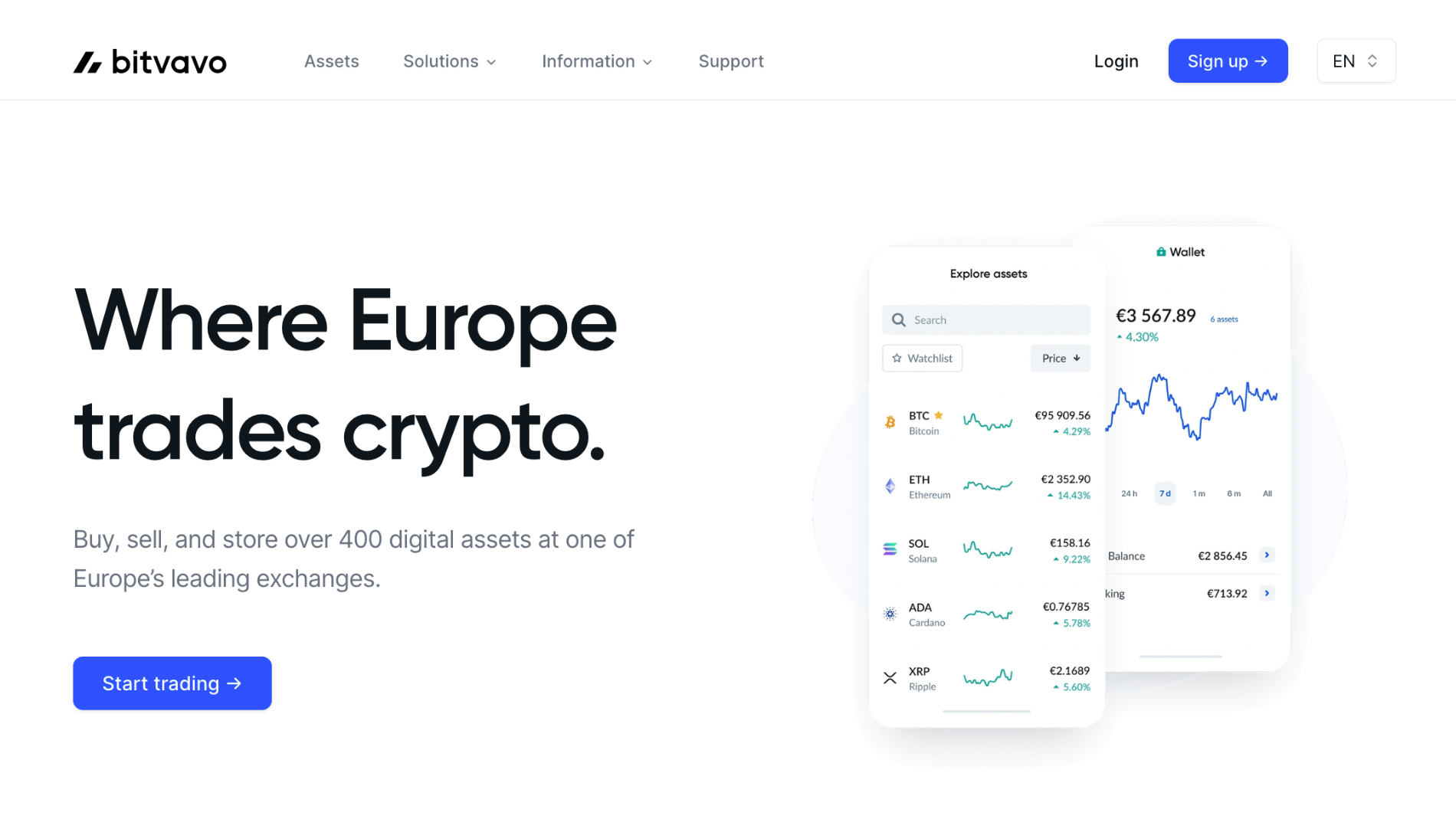
Bitvavo is Europe's largest exchange by volume in euros, headquartered in Amsterdam and with more than 2 million users in 27 countries. It ranks first because it combines some of the lowest fees among the top 10 exchanges, a selection of 428 cryptocurrencies, and an experience designed from the outset for European users trading in euros, without the need to use dollar-denominated stablecoins. It holds a MiCA (CASP) license granted by the Dutch AFM Starting in 2025, authorized to operate in all 27 EU countries under the European passport system, with joint supervision by the Dutch Central Bank (DNB).
Its fees are 0.15% for makers and 0.25% for takers, with a minimum deposit of just 1 €. For French users, it operates in euros via SEPA without currency conversion, and its exportable trading history makes it easy to calculate capital gains for Form 2086. See the full review of Bitvavo
Who is Bitvavo for? For French users who want to buy, sell, and earn returns on cryptocurrencies in euros, with competitive fees and MiCA regulation.
Advantages:
- Fees among the lowest in all of Europe
- MiCA license with a passport valid throughout the EU
- Designed for seamless SEPA transactions in euros
Disadvantages:
- A more limited selection of cryptocurrencies than other exchanges
- Few advanced trading features
- Customer service with more limited options
2. Crypto.com: Spend Your Cryptocurrency with the Everyday Visa Card
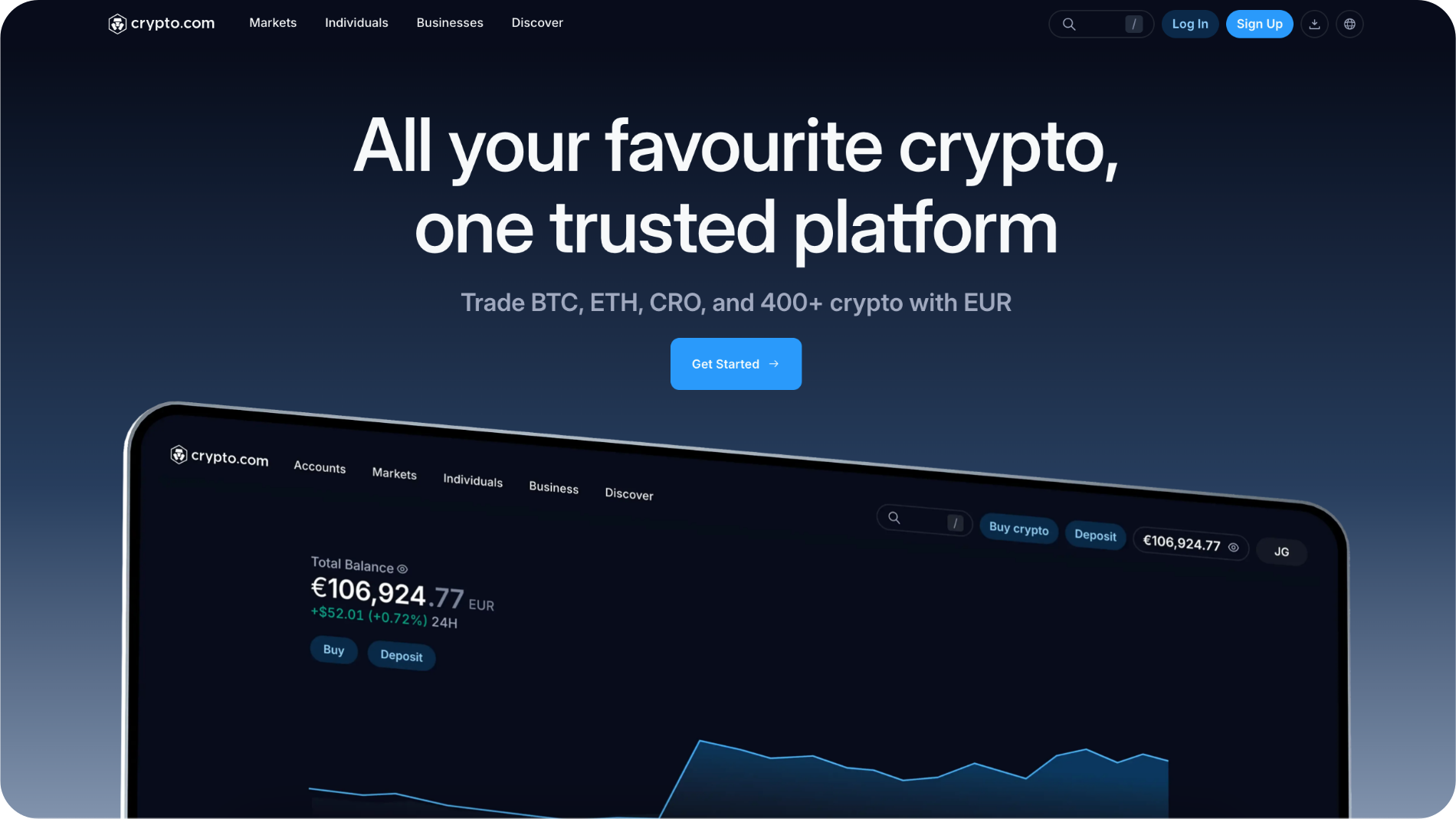
Crypto.com is one of the world’s largest crypto platforms, with more than 150 million users and a business model focused on everyday spending thanks to its Visa card linked to users’ crypto balances. It ranks second due to this combination of an exchange and a payment method—something no other platform in the top 10 offers with such strength. It holds a MiCA (CASP) license from the Maltese MFSA and insurance coverage of up to $750 million on the funds in custody.
Fees start at 0.075% for makers and takers at the base level, decreasing based on trading volume or CRO token staking; the Visa card offers cashback of up to 6%. For users in France, the minimum deposit is 1 €, and SEPA withdrawals also cost 1 €. See the full review of Crypto.com
Who is Crypto.com for? For French users who want to use their cryptocurrency for everyday purchases with a Visa card, in addition to trading on the exchange.
Advantages:
- Visa Card with Cashback of up to 6%
- Low fees at the basic level
- Comprehensive insurance coverage for funds in custody
Disadvantages:
- Better terms require holding the CRO token
- A somewhat complex ecosystem for new users
- Small fixed fees on deposits and withdrawals
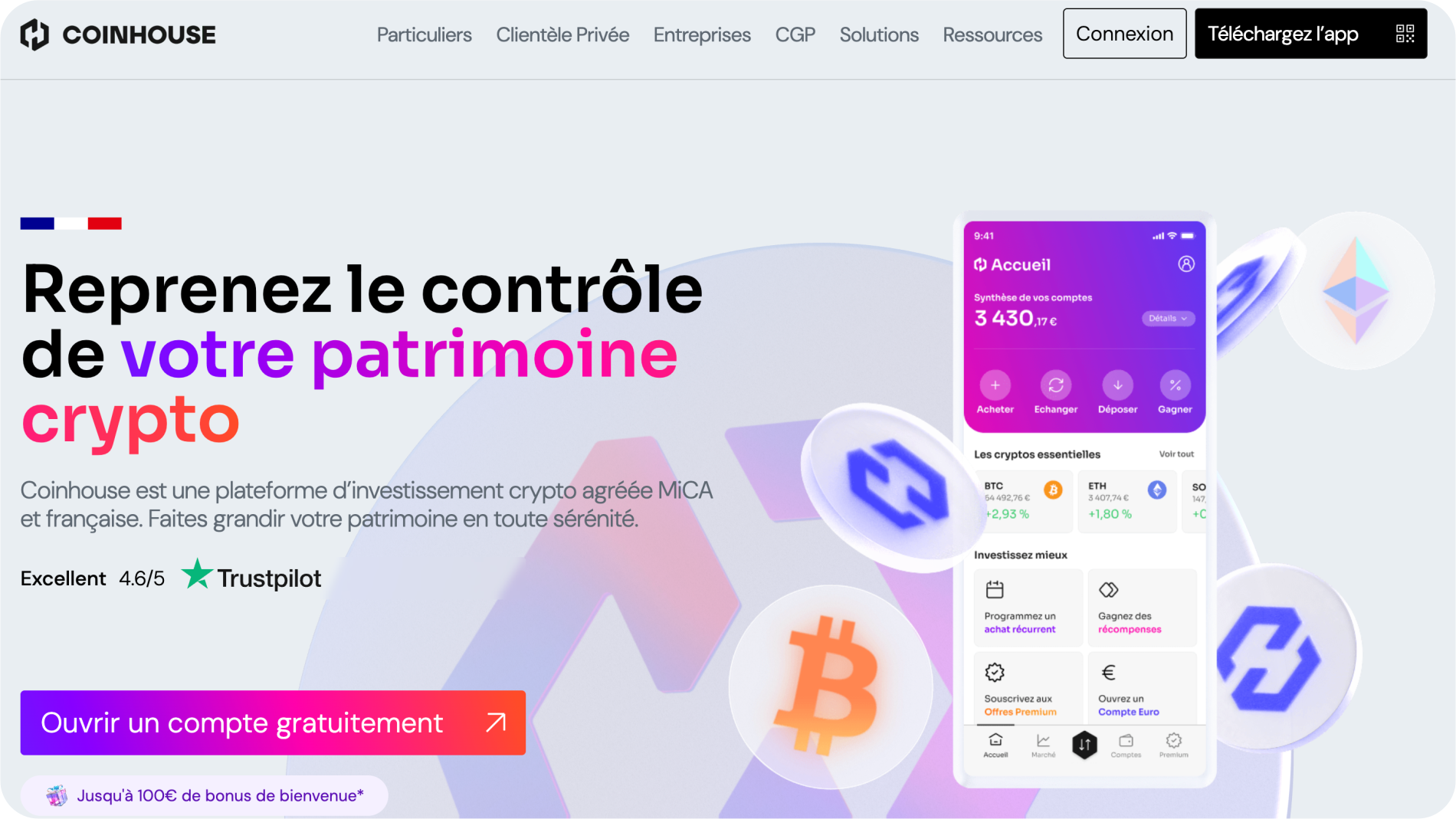
3. Coinhouse: the French exchange directly licensed by the AMF
Coinhouse is a French cryptocurrency platform founded in 2014 and headquartered in Paris. It ranks third because it is the only one in the top 10 that is headquartered in France and holds a MiCA (CASP) license granted directly by the French AMF, obtained on May 7, 2026, with approval number A2026-013, and covers 7 of the 10 services regulated by MiCA: custody, exchange of cryptocurrencies for funds or other cryptocurrencies, order execution, advisory services, portfolio management, and transfer services.
Its transaction fees start at 0% for certain trades, with a structure designed for users trading from France. For French users, this means that the entire KYC process, support, and custody are under the direct supervision of a national regulator, without relying on a European passport issued by another country.
Who is Coinhouse for? For French users who prioritize having their primary exchange regulated directly by the AMF over having the widest selection or the lowest fees on the market.
Advantages:
- MiCA license granted directly by the French AMF
- Transaction fees starting in 0% for certain transactions
- Support and KYC managed under direct national oversight
Disadvantages:
- European passport still limited to a few member states
- A smaller selection of cryptocurrencies than global exchanges
- Fewer advanced trading tools than international competitors
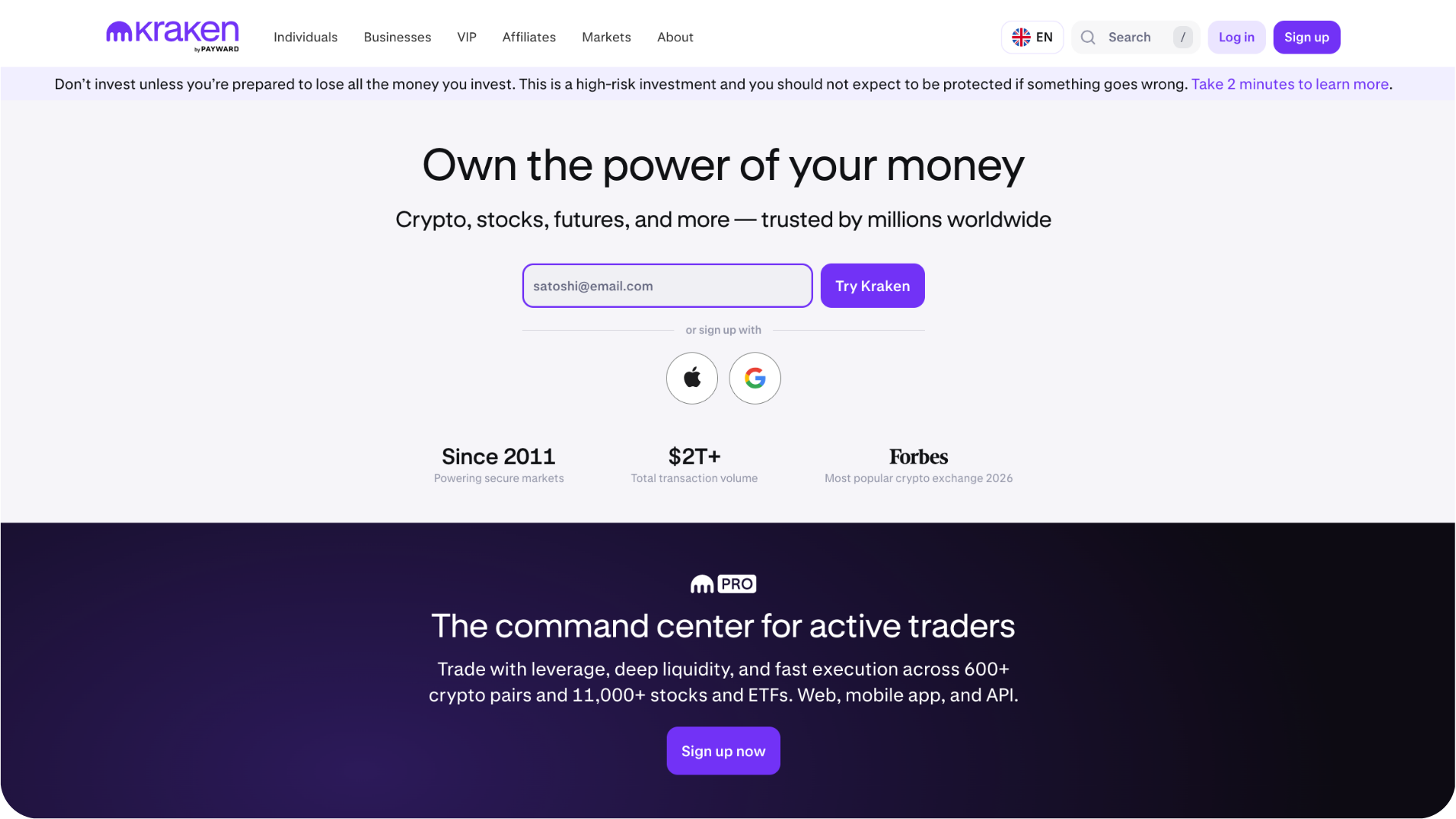
4. Kraken: The Most Well-Rounded Platform for Making the Leap to Advanced Trading
Kraken is one of the industry’s longest-standing exchanges, founded in 2011 and operational since 2013, offering more than 600 cryptocurrencies and operating in over 190 countries. It ranks fourth for combining a long track record of security, quarterly Proof of Reserves audits with 1:1 backing, and a selection of cryptocurrencies that exceeds the top 10 average. In Europe, it operates through Payward Europe Solutions Limited, authorized as a CASP by the Central Bank of Ireland Starting in June 2025, with a passport valid for all 30 EEA countries.
Its standard app charges around 1% plus the spread, but Kraken Pro reduces the cost to 0.40% for makers and 0.80% for takers in the first tier, with rates decreasing based on trading volume or the balance held on the platform. The minimum deposit is 10 €. For French users, SEPA transfers take between 0 and 3 days, and the platform offers staking for dozens of cryptocurrencies. View full Kraken review
Who is Kraken for? For French users looking for a long-established, highly secure exchange with room to grow into advanced trading.
Advantages:
- Wide variety of cryptocurrencies and markets available
- A strong track record of safety since its founding in 2011
- Staking is available for dozens of cryptocurrencies
Disadvantages:
- Higher standard app fees if you don't use Kraken Pro
- Higher minimum deposit than other exchanges
- Learning curve to take full advantage of all its features
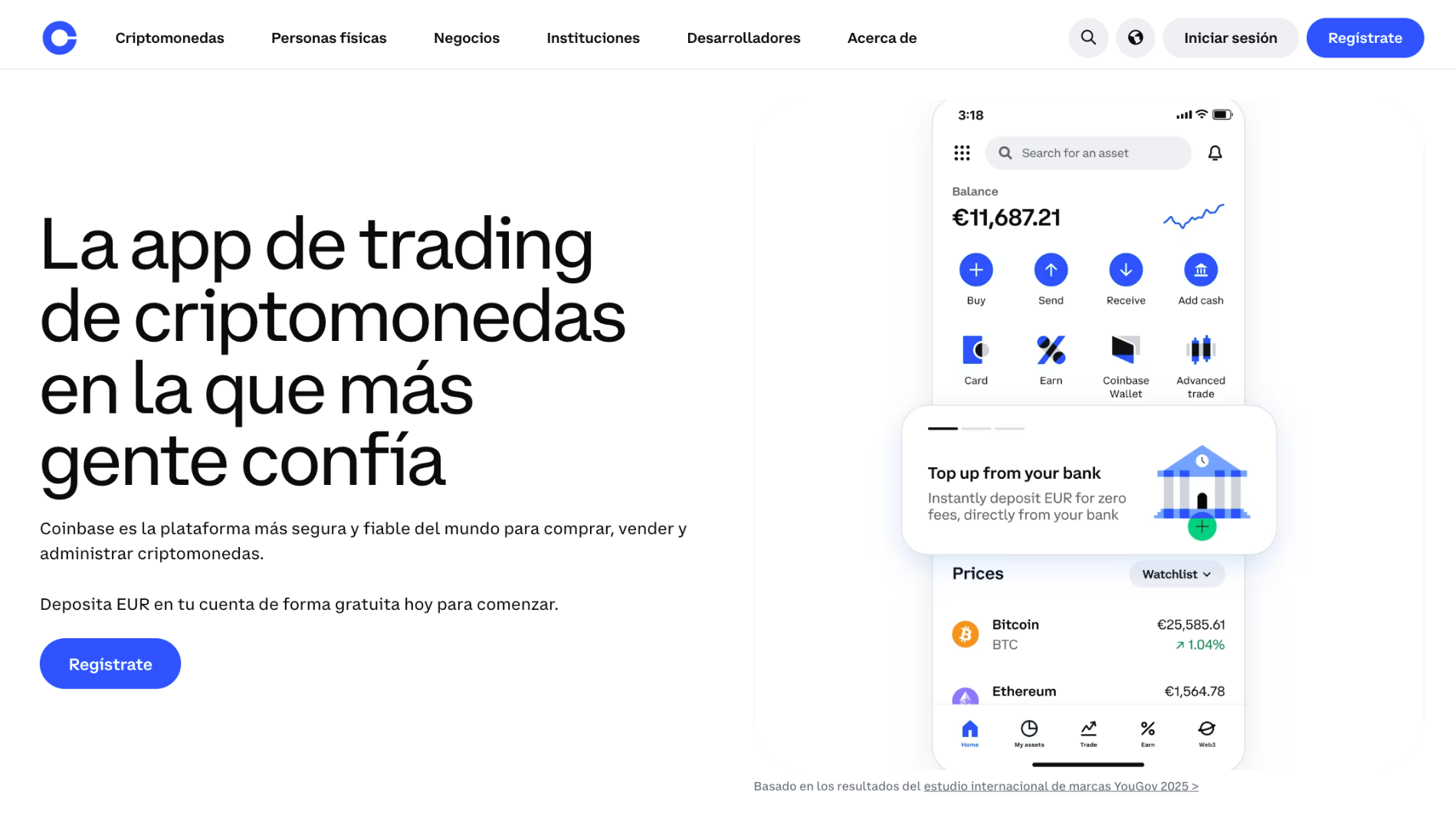
5. Coinbase: The Most Well-Known Option for Getting Started
Coinbase is a publicly traded exchange (Nasdaq: COIN since 2021) and one of the most audited in the world, with more than 120 million users in over 100 countries. It ranks fifth because it combines the highest brand trust among the top 10 with an interface designed for those who have never bought cryptocurrency before. It holds a MiCA (CASP) license from the Luxembourg CSSF Effective June 2025, valid in all 27 EU countries.
The standard app charges fees of up to 3.99% for card transactions, but Coinbase Advanced reduces them to between 0.40% and 0.60% depending on volume, and Coinbase One eliminates fees for up to 10,000 € per month with a subscription. For French users, the platform exports a transaction history that is useful for Form 2086 and for reporting foreign accounts. View full Coinbase review
Who is Coinbase for? For French users who are just getting started with crypto and prefer the reliability of a well-known brand over lower fees.
Advantages:
- A well-known brand listed on the stock exchange
- Intuitive interface designed for beginners
- Large global user base
Disadvantages:
- High fees in the standard app
- You must upgrade to Advanced to get competitive rates
- Less suitable for those who already have advanced experience
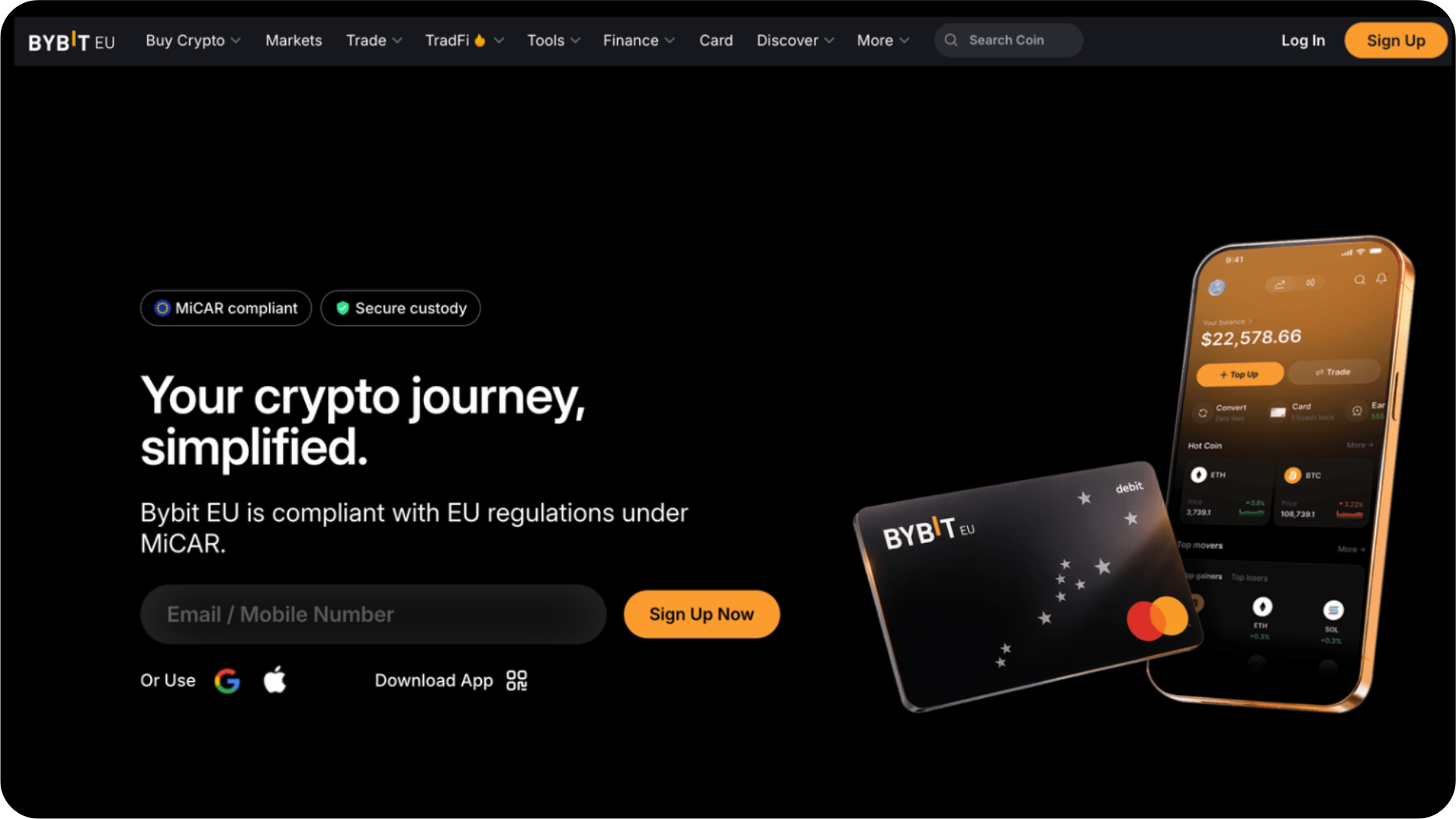
6. Bybit EU: Derivatives and Advanced Trading Under European Regulation
Bybit EU is the European arm of the world's second-largest exchange by volume, headquartered in Vienna after obtaining the MiCA (CASP) license from the Austrian FMA in May 2025. It ranks sixth as the most derivatives- and advanced trading-focused option among the top 10, with up to 10x leverage on spot trading and a platform that has been fully migrated to bybit.eu since July 2026 for all EEA users.
Fees are competitive for advanced trading and decrease with volume, and include features such as the Bybit Card and spot margin trading. For French users, all traffic now goes through the regulated entity bybit.eu, which is separate from the global platform; it’s worth noting that Bybit was on the AMF’s blacklist from May 2022 to February 2025, before obtaining its CASP license. View the full review of Bybit EU
Who is Bybit EU for? For experienced French users looking for derivatives and advanced trading within an EU-regulated framework.
Advantages:
- Entity regulated under a European MiCA license
- Strong focus on derivatives and advanced trading
- Up to 10x leverage available on spot trades
Disadvantages:
- Less suitable for beginners
- He was on the AMF's blacklist before his status was regularized
- Recent Migration to the New European Entity
7. OKX Europe: Low fees and Web3 access for the most active users
OKX Europe is the European arm of OKX, a global exchange that ranks among the top 10 most cost-effective options for frequent traders, while also offering access to Web3 features (such as its own wallet and DeFi) that are uncommon among centralized exchanges. It was among the first to obtain the MiCA (CASP) license in the EU, granted by the Maltese MFSA in January 2025.
Its spot trading fees are among the lowest in the industry: 0.08% for makers and 0.1% for takers, with discounts up to levels with no minimum volume requirement; the minimum deposit is just €1. For French users, it does not have its own guarantee fund, but it offers quarterly Proof of Reserves audits and customer support via chat in several European languages. View the full review of OKX Europe
Who is OKX Europe for? For French users with a certain volume of trading activity who are looking for low fees and want to start exploring Web3 without leaving the exchange.
Advantages:
- Spot commissions among the lowest in the industry
- Access to Web3 features such as a native wallet
- Reserve audits published quarterly
Disadvantages:
- It does not have its own guarantee fund
- Designed primarily for users with some experience
- Lower brand awareness in France
8. SwissBorg: Crypto Wealth Management with Guided Investing
SwissBorg is a platform focused on cryptocurrency wealth management, offering guided investment products, thematic portfolios, and automated returns—rather than simply serving as a trading exchange. It ranks eighth because, through its French subsidiary BlockNodes SAS, it obtained a MiCA (CASP) license from the French AMF On March 5, 2026, covering 6 of the 10 services regulated by MiCA: custody, exchange of cryptocurrencies for funds or other cryptocurrencies, order execution, portfolio management, and advisory services.
Its fee structure is based on variable spreads that depend on the product purchased, with higher spreads for automated management products than for simple buy-and-sell transactions. For French users, this license has already been registered in 29 of the 30 EEA countries, one of the broadest scopes of coverage in the ranking.
Who is SwissBorg for? For French users looking for a more guided and automated way to manage their crypto portfolio, rather than trading manually on an order book.
Advantages:
- MiCA license with notification in 29 of the 30 EEA countries
- Wealth Management and Guided Investment Products
- Directly regulated by the French AMF
Disadvantages:
- Spreads that are less transparent than a published maker/taker model
- It does not offer the advanced trading tools of a pure exchange
- License limited to 6 of the 10 MiCA services
9. Bitstamp: Europe's longest-running regulated exchange
Bitstamp is Europe's oldest active cryptocurrency exchange, founded in 2011 and owned by Robinhood (Nasdaq: HOOD) since 2025. It ranks ninth due to its track record of more than a decade without any serious security incidents, a feature that is particularly appealing to conservative users. Headquartered in Luxembourg, it was the first platform to obtain the MiCA (CASP) license from the CSSF In May 2025, in addition to already holding a MiFID license to operate as a multilateral trading facility.
Its tiered fee structure is commission-free for monthly volumes below 1,000 $, rising to 0.30% for makers and 0.40% for takers in the next tier, and gradually decreasing as volume increases. For French users, it is a platform that has been well-established in the European market for over a decade, although its selection of cryptocurrencies is more limited than that of newer exchanges. See the full review of Bitstamp
Who is Bitstamp for? For French users who prioritize track record and regulatory stability over product variety or app design.
Advantages:
- A track record of more than a decade without serious incidents
- Dual regulation under MiCA and MiFID licenses
- Commission-free trading for monthly trading volume below 1,000 $
Disadvantages:
- A smaller selection of cryptocurrencies than others
- Commissions of 0.30% and 0.40% in the intermediate volume bracket
- The app's design is less modern
10. Bitpanda: Cryptocurrencies, stocks, and precious metals all in one app
Bitpanda is the Austrian platform founded in 2014 that combines cryptocurrencies, stocks, ETFs, and precious metals in a single account, with more than 6 million users in Europe. It rounds out the top 10 as the most comprehensive multi-asset offering in the ranking, in addition to being the first major crypto platform to obtain the MiCA license, granted by the Germany's BaFin in January 2025.
The standard app charges a 0.99% fee for Bitcoin and stablecoins, and a 1.49% fee for all other cryptocurrencies, while Bitpanda Fusion (its Pro version) starts at 0.25% at the first tier. Deposits via bank transfer are free, and a 1.5% fee applies for card deposits. For French users, the interface is available in French, although customer support is provided only in English, with no live chat or phone support. See the full review of Bitpanda
Who is Bitpanda for? For French users who want to invest in cryptocurrency, stocks, and precious metals all from a single app, with robust European regulation.
Advantages:
- Combine crypto, stocks, ETFs, and precious metals
- A pioneer in obtaining the MiCA license in Europe
- Deposits via wire transfer with no fees
Disadvantages:
- High commission on the sale of the standard app
- Customer service is available in English only
- No live chat or phone support

Comparison Table of Exchanges in France
After reviewing the 10 exchanges, here is a comparison table that summarizes each one’s cryptocurrency offerings, maker/taker fees, and MiCA compliance for users in France.
| Platform | Cryptos | Maker / Taker | Regulation |
|---|---|---|---|
 Bitvavo |
428+ | 0,15% / 0,25% | MiCA (AFM, Netherlands) |
 Crypto.com |
250+ | 0,075% / 0,075% | MiCA (MFSA, Malta) |
 Coinhouse |
100+ | From 0% | MiCA (AMF, France) |
 Kraken (Kraken Pro) |
600+ | 0,40% / 0,80% | MiCA (Central Bank of Ireland) |
 Coinbase (Advanced) |
400+ | 0,40% / 0,60% | MiCA (CSSF, Luxembourg) |
 Bybit EU |
700+ | 0,25% / 0,25% | MiCA (FMA, Austria) |
 OKX Europe |
375+ | 0,08% / 0,10% | MiCA (MFSA, Malta) |
 SwissBorg |
100+ | Spread variable | MiCA (AMF, France) |
 Bitstamp |
100+ | 0,30% / 0,40% | MiCA + MiFID (CSSF, Luxembourg) |
 Bitpanda |
650+ | 0,99% / 1,49% | MiCA (BaFin, Germany) |
All the exchanges in the ranking are already MiCA-licensed, which ensures consistent oversight across the EU. Coinhouse and SwissBorg are the only ones with a license granted directly by the French AMF. The best option will depend on whether you prioritize low fees, a wide selection, or a national regulator like the AMF.
How are cryptocurrencies taxed in France in 2026?
France taxes capital gains on cryptocurrencies under a specific tax regime, as set forth in Article 150 VH bis of the General Tax Code. The key is to know which transaction triggers the taxable event: converting cryptocurrency to euros or paying with cryptocurrency is taxable, while exchanging one cryptocurrency for another does not generate tax liability at the time of the exchange, although it must be recorded for the subsequent calculation of the capital gain. Purchasing with euros or transferring funds between your own wallets is also not subject to taxation.
Depending on the source of your cryptocurrency, different rules apply:
- Flat tax (PFU) of 31.4%: Effective January 1, 2026, the Prélèvement Forfaitaire Unique increased from 30% to 31.4% (12.8% in income tax plus 18.6% in social security contributions), following the passage of the 2026 Social Security Financing Act (PLFSS).
- Opting for the progressive scale: Instead of the PFU, you can choose to pay taxes on your crypto capital gains according to the progressive income tax scale plus social security contributions of 18.6%; this is particularly beneficial for those with a low or zero marginal tax rate.
- €305 deductible: If the total value of your transactions (sales and payments in cryptocurrency) for the year does not exceed €305, the gain is entirely tax-exempt.
- Professional Activity (BIC/BNC): If you trade regularly and professionally, or mine in an organized manner, you are taxed under the Industrial and Commercial Income (BIC) or Non-Commercial Income (BNC) tax regimes, not under the capital gains tax regime for individuals.
Capital gains are calculated using the Weighted Average Acquisition Price (WAAP) method, not FIFO or LIFO, and capital losses for the year can only be offset against capital gains from the same fiscal year; they cannot be carried forward to subsequent years. Starting in January 2026, the European DAC8 directive will also take effect, requiring exchanges to share their clients’ data with EU tax authorities beginning in 2027. The most sensible approach is to keep your own record of purchases, sales, and acquisition dates, report capital gains on Form 2086, report accounts on foreign platforms on Form 3916-bis, and include the final result on Form 2042-C when filing with the Directorate General of Public Finance (DGFiP).
How did we selected the exchanges in this ranking
This ranking was compiled based on a comparative analysis of MiCA-authorized cryptocurrency exchanges available to customers in France, combining real-world usage tests with technical, regulatory, and user experience evaluations to identify those best suited for users residing in France in 2026.
To compile the ranking, we evaluated each platform based on the following criteria:
| Criteria | What We Evaluate | |
|---|---|---|
| 1 | License Regulation and Verification | We only include exchanges with full MiCA authorization, verifying each operator in the public records of the AMF and the ESMA, including the services covered by their license and whether they operate under a European passport or a direct authorization in France. |
| 2 | French Support and Localization | Availability of customer service in French, quality of the interface, and educational resources in the local language. |
| 3 | Tax Adjustment | Clarity of operational reports for Form 2086, Form 3916-bis, and the calculation of capital gains using the PAMP method. |
| 4 | Transactions in euros and SEPA funds | Smooth deposits and withdrawals via SEPA and SEPA Instant from French accounts, settlement times, and compatibility with cards and mobile wallets. |
| 5 | Actual Trading Costs | Actual trades on each platform, taking into account the combined cost of commissions, spreads, and withdrawal fees—not just the advertised rate. |
| 6 | Track Record and Transparency | Each exchange's security track record and transparency in the disclosure of reserves (Proof of Reserves). |
The testing was completed in September 2026, with a final verification of the licenses in force in the public registries of the AMF and ESMA as of the date of publication. You can review the complete data research and verification process on our methodology.
Important note: We review this ranking periodically based on new authorizations from the AMF, improvements in French support, or tax changes. Rankings are subject to change.
Regulation of Exchanges and Cryptocurrencies in France
Platforms offering cryptocurrency services in France operate under the European MiCA regulation, which applies to service providers as of December 30, 2024, and replaced the former national PSAN registry. The Autorité des Marchés Financiers (AMF) It authorizes and supervises crypto-asset service providers established in France, in coordination with the Autorité de Contrôle Prudentiel et de Résolution (ACPR) for prudential matters. Coinhouse and SwissBorg (through its entity BlockNodes SAS) are the two exchanges in this ranking that hold a MiCA license granted directly by the AMF.
The transition period ended on July 1, 2026, and since then, only platforms authorized by the AMF or by another European authority with a MiCA passport and listed in the registry of the ESMA. Binance, which withdrew its license application in Greece, has restricted its services for French users: it only allows them to close positions and withdraw funds, and assures them that it will not freeze their assets. Before depositing money on an exchange, check that the service provider is listed in the ESMA registry.
Important note: Binance does not appear in this ranking because it does not have a MiCA license. As of July 1, 2026, it is not accepting new users or deposits in France and only allows withdrawals.
The information presented in this ranking is for informational and educational purposes only. It does not constitute financial or tax advice, nor is it a personalized investment recommendation. Using cryptocurrency exchanges involves risks, and each user is responsible for assessing which platform best suits their profile, as well as for complying with applicable regulations and their legal and tax obligations under current Spanish law. Some links in this ranking are affiliate links: if you open an account through them, Exchange Selector may receive a commission at no additional cost to you. This does not influence the criteria or the order of this ranking.
(FAQ) How to Choose a Cryptocurrency Exchange in France in 2026