
Before we enter into a detailed analysis, here is the ordered ranking of the top 10 crypto exchanges for Poland with the most important data about each at a glance.


Investing in cryptocurrencies carries the risk of partial or total loss of capital. The content of this review is informative and does not constitute financial advice.
1. Bybit EU: BLIK and pairs in PLN for the Polish user
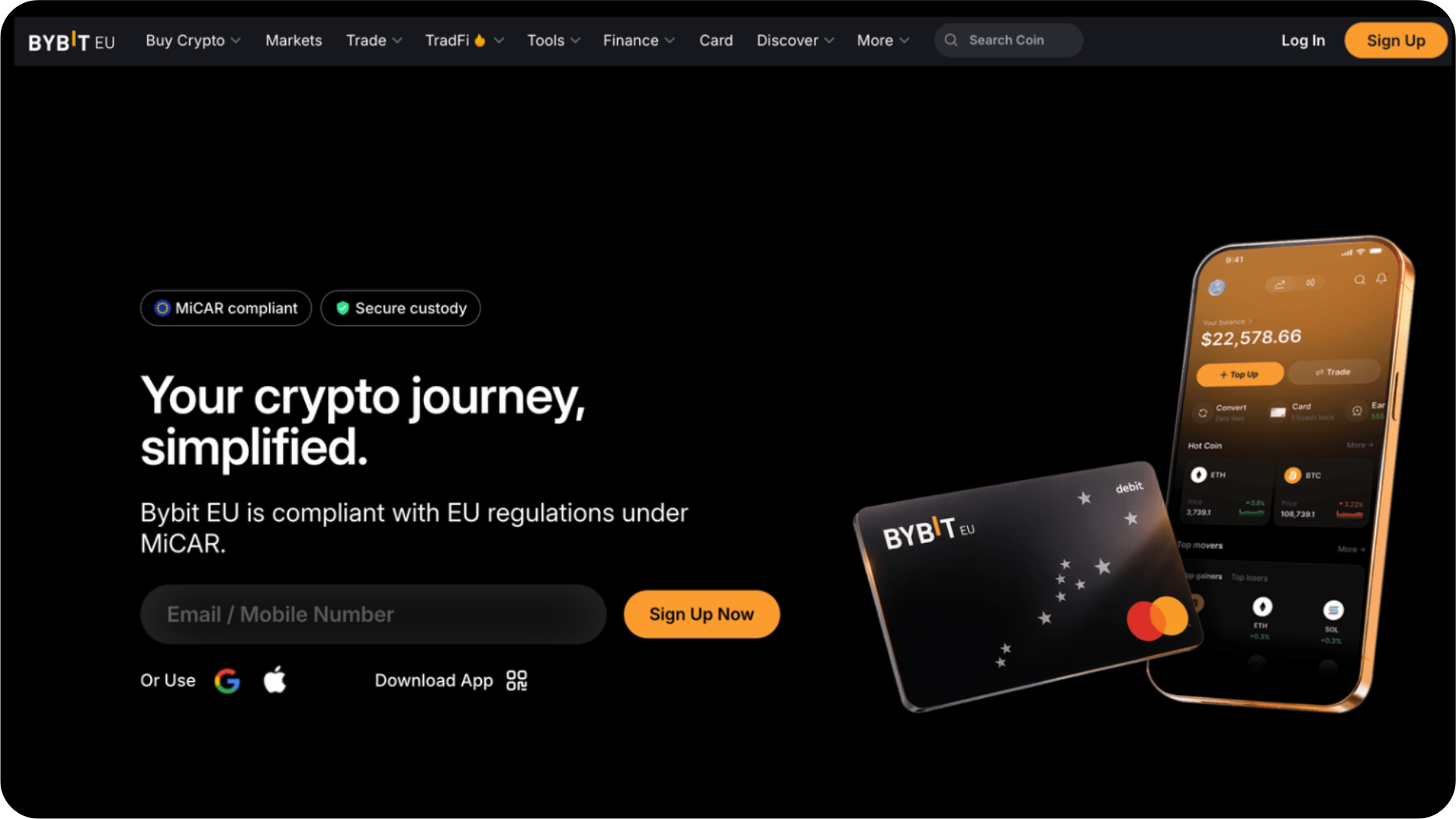
Bybit EU is the European entity of the world’s second largest volume exchange, based in Vienna and licensed by MiCA (CASP) under the FMA Austrian since May 2025, valid for the EEA with a European passport. Ranked first because it is the platform that has best adapted its operation to the Polish user: direct pairs in zlotys (PLN) since April 2026 and deposits with BLIK, without currency conversions or transfers in euros. In addition, since July 2026 all its activity in the EEA has passed through bybit.eu.
Its spot commissions are 0.10% maker and 0.10% taker, and it offers a margin of up to 10x on spot and the Bybit Card. For the Polish user, the deposit with BLIK is made by copying the six-digit code from the bank’s app and, under current conditions, does not add any commission from the platform. It is worth noting that Bybit suffered a $1.5 billion theft in February 2025, although it did not affect the European entity. See full review of Bybit EU
Who is Bybit EU for? For Polish users who want to buy and trade directly in PLN with BLIK, with room to grow into advanced trading under European regulation.
Advantages:
- Deposits with BLIK and direct pairs in PLN
- 0.10% flat spot commission maker and taker
- Entity regulated by the FMA under license MiCA
Disadvantages:
- Less suitable for beginners
- Background on a major theft on the global platform
- Recent Migration to the New European Entity
2. Bitvavo: The Cheapest Option in Europe for Trading in Euros
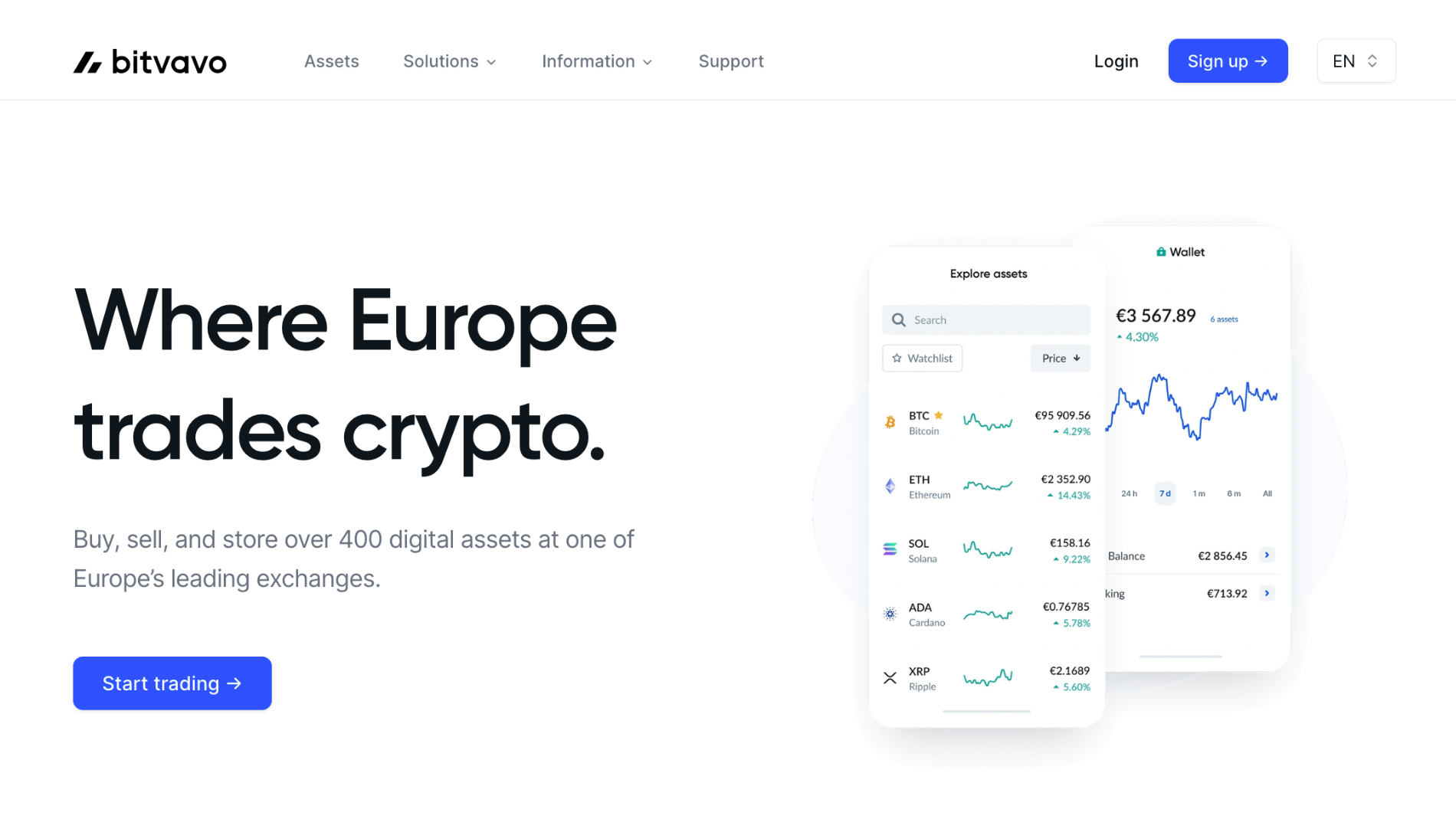
Bitvavo is the largest European exchange by volume in euros, based in Amsterdam and with more than 2 million users in 27 countries. It ranks second because it combines fees among the lowest in the top 10, a catalog of 428 cryptocurrencies and an operation in euros designed for the European user, without passing through stablecoins in dollars. Holds a MiCA (CASP) license granted by the AFM Netherlands, with joint supervision of the Dutch Central Bank (DNB).
Its fees are 0.15% maker and 0.25% taker, with a minimum deposit of just €1. For the Polish user, the platform is focused on the euro market: it does not offer PLN balance or BLIK deposits, so bank transfer deposits are made in euros via SEPA. See full Bitvavo review
Who is Bitvavo for? For Polish users who trade in euros and prioritize low fees and liquidity in EUR pairs over the convenience of the zloty.
Advantages:
- Very high liquidity in EUR pairs
- Top 10 lowest commissions
- SEPA deposits and withdrawals
Disadvantages:
- No balance in PLN or deposits with BLIK
- Few advanced trading features
- Customer service with more limited options
3. Bitpanda: Cryptocurrencies, stocks, and precious metals all in one app
Bitpanda es la plataforma austriaca fundada en 2014 que combina criptomonedas, acciones, ETFs y metales preciosos en una misma cuenta, con más de 6 millones de usuarios en Europa. Ocupa el tercer puesto por ser la propuesta multiactivo más completa del top 10, además de haber sido la primera gran plataforma cripto en obtener la licencia MiCA, concedida por la BaFin alemana en enero de 2025.
La compraventa instantánea cobra un 1,49%, mientras que Bitpanda Exchange (su versión Pro) baja hasta el 0,05% maker y 0,15% taker. Los depósitos por transferencia son gratuitos y con tarjeta se aplica un 1,5%. Para el usuario polaco, es una de las pocas plataformas del ranking que permite mantener saldo en zlotys en la cuenta y depositar con BLIK, aunque sus comisiones generales de compra son elevadas y su atención al cliente funciona únicamente en inglés, sin chat en vivo ni teléfono. See the full review of Bitpanda
Who is Bitpanda for? Para usuarios polacos que quieren invertir en cripto, acciones y metales preciosos desde una misma app, con saldo en PLN, BLIK y regulación europea sólida.
Advantages:
- Saldo en PLN y depósitos con BLIK
- Combine crypto, stocks, ETFs, and precious metals
- A pioneer in obtaining the MiCA license in Europe
Disadvantages:
- High commission on instant buy/sell transactions
- Customer service is available in English only
- No live chat or phone support

4. Crypto.com: spend your cryptocurrencies with the day-to-day Visa card
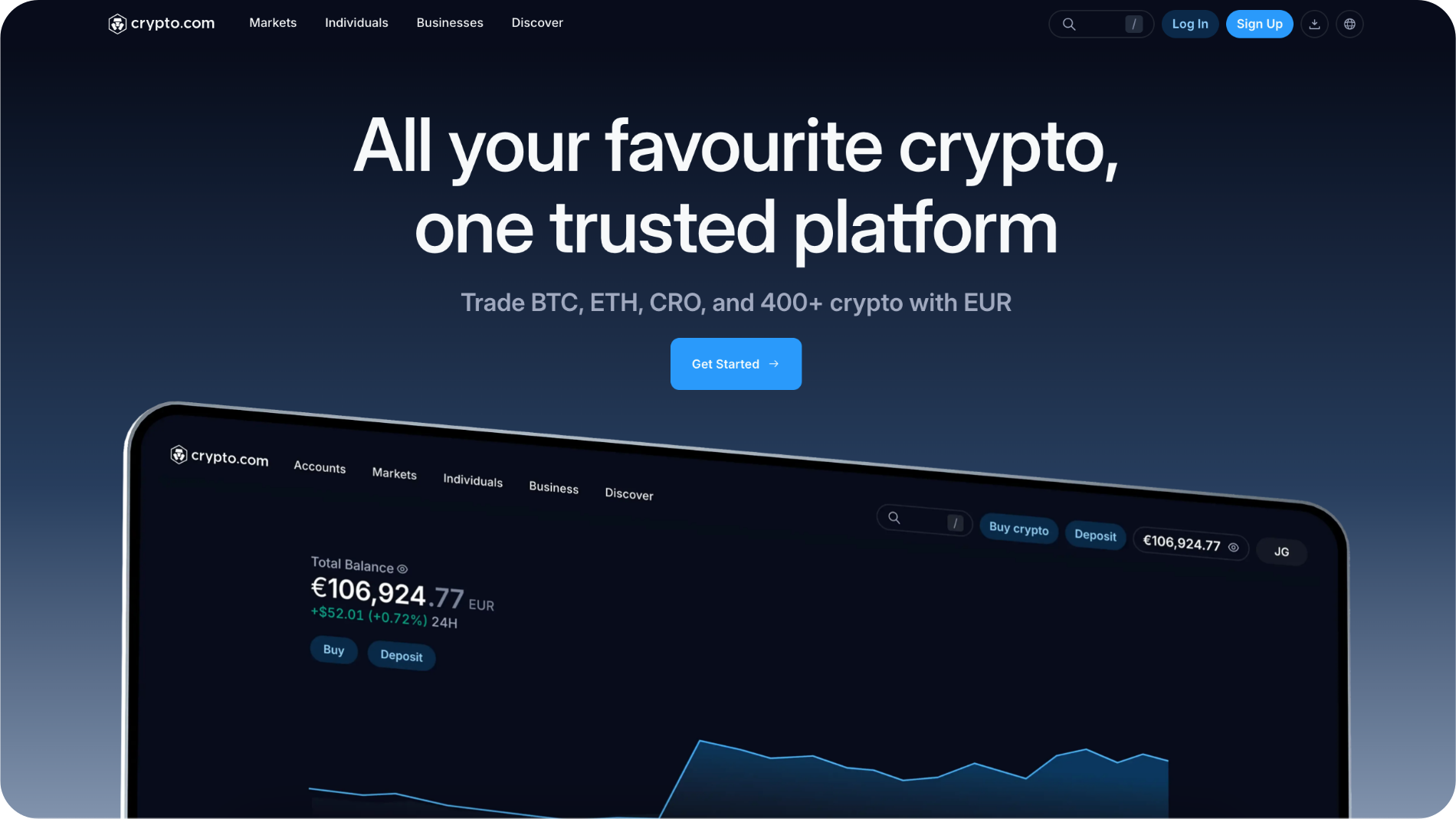
Crypto.com is one of the world’s largest crypto platforms, with more than 150 million users and a proposal focused on everyday spending thanks to its Visa card linked to the crypto balance. It ranks fourth for that combination of exchange and payment medium. Has a MiCA (CASP) license from the MFSA Maltese and an insurance of up to $750 million on the funds in custody.
Commissions start from 0.075% maker and taker on the exchange, while the simple app charges more (0.40% maker and 0.60% taker); they drop with the volume or staking of your CRO token, and the Visa card offers cashback up to 6%. For the Polish user, the minimum deposit is €1 and SEPA withdrawals also cost €1, so it makes sense to group withdrawals together to dilute the fixed cost. See full review of Crypto.com
Who is Crypto.com for? For Polish users who want to spend their cryptocurrencies on a daily basis with a Visa card, in addition to trading at the exchange.
Advantages:
- Visa Card with Cashback of up to 6%
- Low fees at the exchange's basic level
- Comprehensive insurance coverage for funds in custody
Disadvantages:
- Better terms require holding the CRO token
- A somewhat complex ecosystem for new users
- Small fixed fees on deposits and withdrawals
5. Coinbase: The Most Well-Known Option for Getting Started
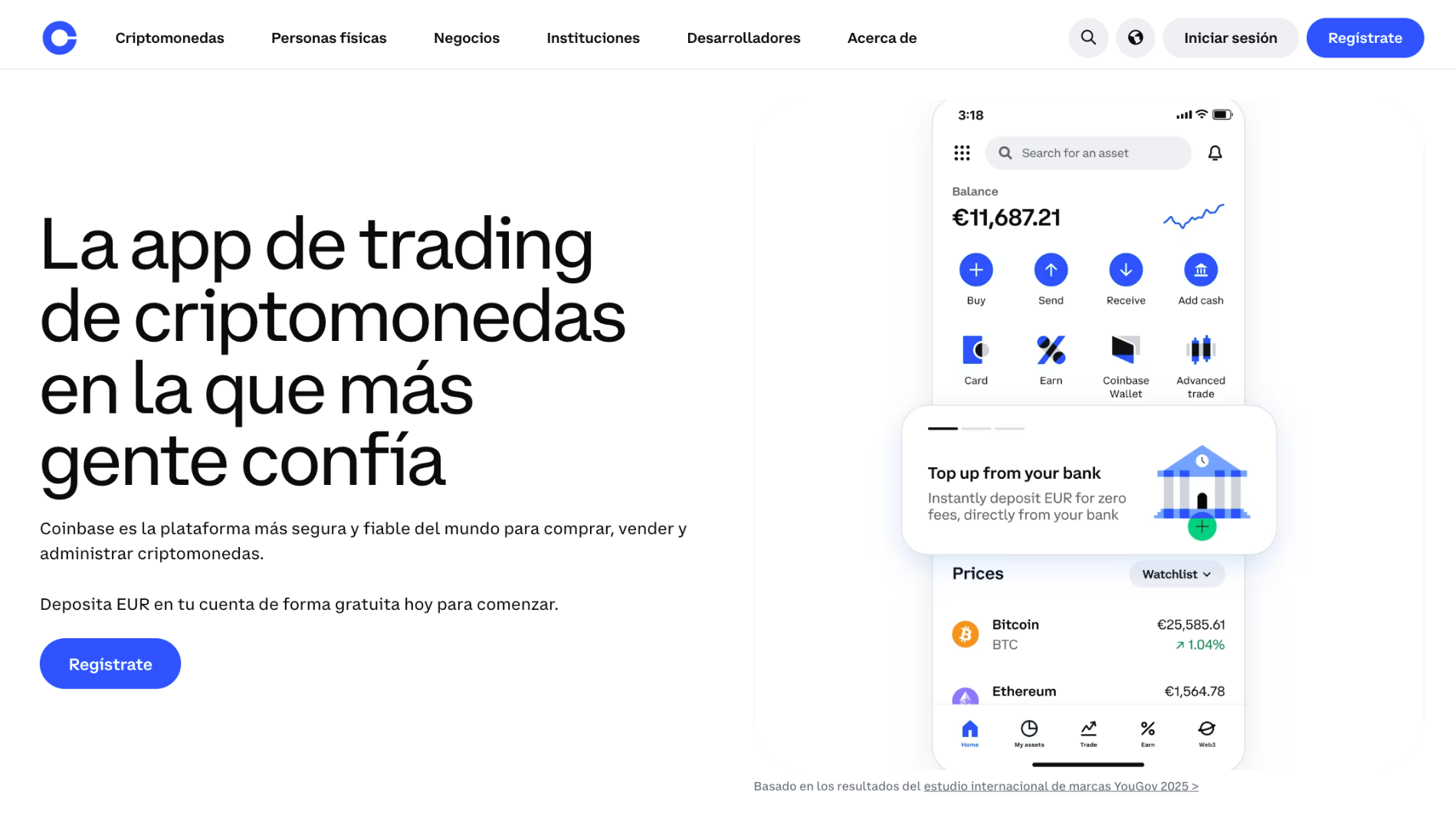
Coinbase is a publicly traded exchange (Nasdaq: COIN since 2021) and one of the most audited in the world, with more than 120 million users in over 100 countries. It ranks fifth because it combines the highest brand trust among the top 10 with an interface designed for those who have never bought cryptocurrency before. It holds a MiCA (CASP) license from the CSSF luxemburguesa desde junio de 2025, válida en los países del EEE.
The standard app charges up to 3.99% card fees, but Coinbase Advanced reduces them to between 0.35% and 0.75% depending on volume, and Coinbase One eliminates fees up to €10,000 per month by subscription. For the Polish user, the platform integrated BLIK via PPRO, which allows to buy crypto with zlotys without going through a transfer in euros. See full review for Coinbase
Who is Coinbase for? For Polish users taking their first steps in crypto, want to pay with BLIK and prefer the trust of a recognized brand over lower fees.
Advantages:
- A well-known brand listed on the stock exchange
- Buy in PLN via BLIK
- Intuitive interface designed for beginners
Disadvantages:
- High fees in the standard app
- You must upgrade to Advanced to get competitive rates
- Less suitable for those who already have advanced experience
6. Kraken: the most complete veteran to take the leap to advanced trading
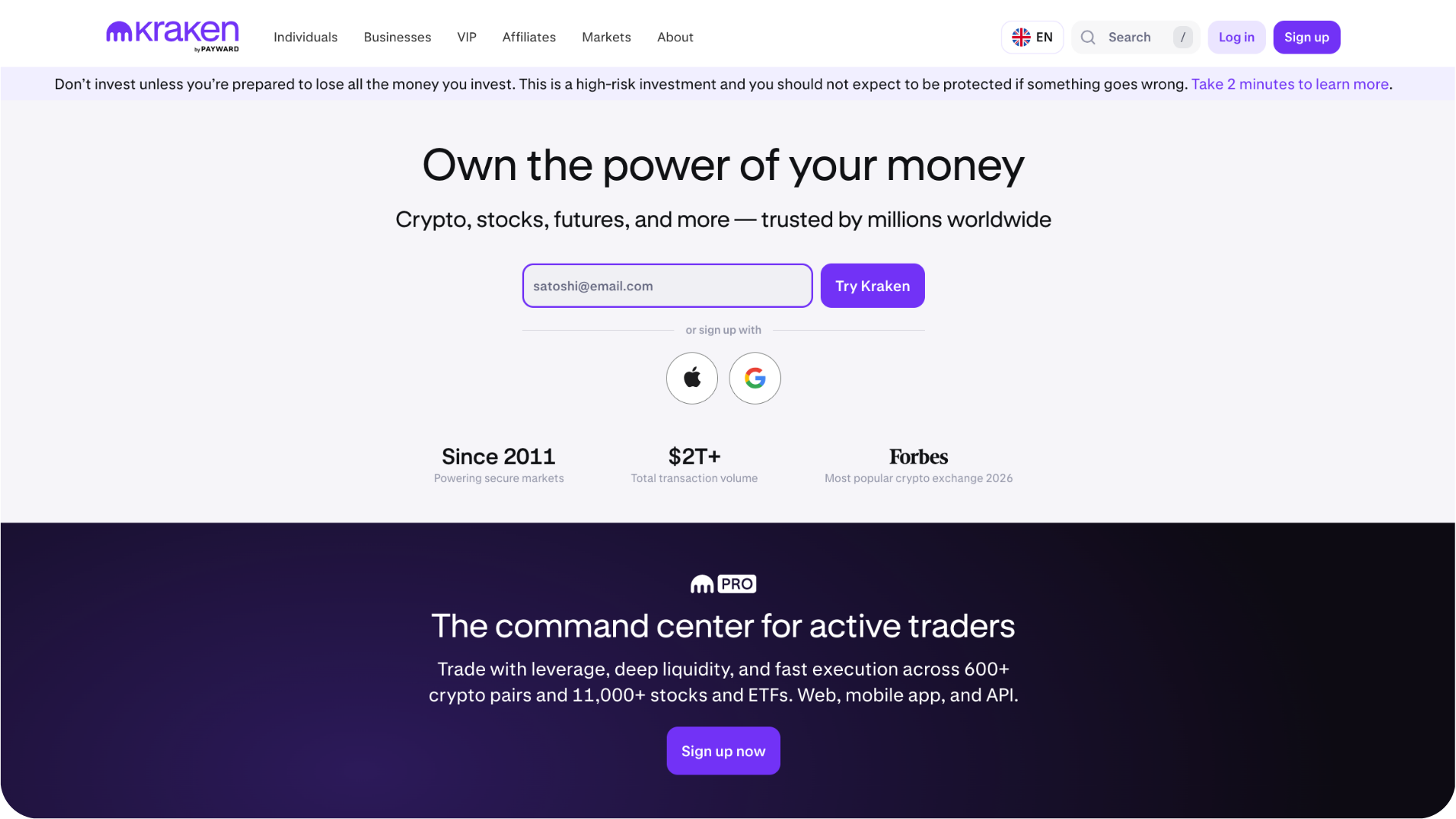
Kraken is one of the industry’s oldest exchanges, founded in 2011 and operational since 2013, with over 600 cryptocurrencies and presence in more than 190 countries. Ranked sixth for combining a broad security track record, quarterly Proof of Reserves audits with 1:1 support and a catalog above the top 10 average. In Europe it operates through Payward Europe Solutions Limited, authorized as CASP by the Central Bank of Ireland since June 2025, with passport for all 30 EEA countries.
Its standard rate is 1% plus spread, but Kraken Pro reduces the cost to 0.40% maker and 0.80% taker in the first tranche, decreasing with volume. The minimum deposit is €10. For the Polish user, there is no balance in PLN and BLIK is only available on instant purchase: payment is processed in zlotys but converted to EUR/USD within the platform. The platform also offers access to more than 60 tokenized S&P 500 stocks from €1. See full Kraken review
Who is Kraken for? For Polish users looking for a veteran and maximum security exchange, with room to grow towards advanced trading and products such as tokenized stocks.
Advantages:
- Wide variety of cryptocurrencies and markets available
- A strong track record of safety since its founding in 2011
- Instant purchase with BLIK and tokenized shares from €1
Disadvantages:
- High base fees of 0.40%-0.80% in Kraken Pro
- No balance in PLN: payment with BLIK is converted to EUR/USD
- Learning curve to take full advantage of all its features
7. WhiteBit: wide catalogue and low fees with new European license
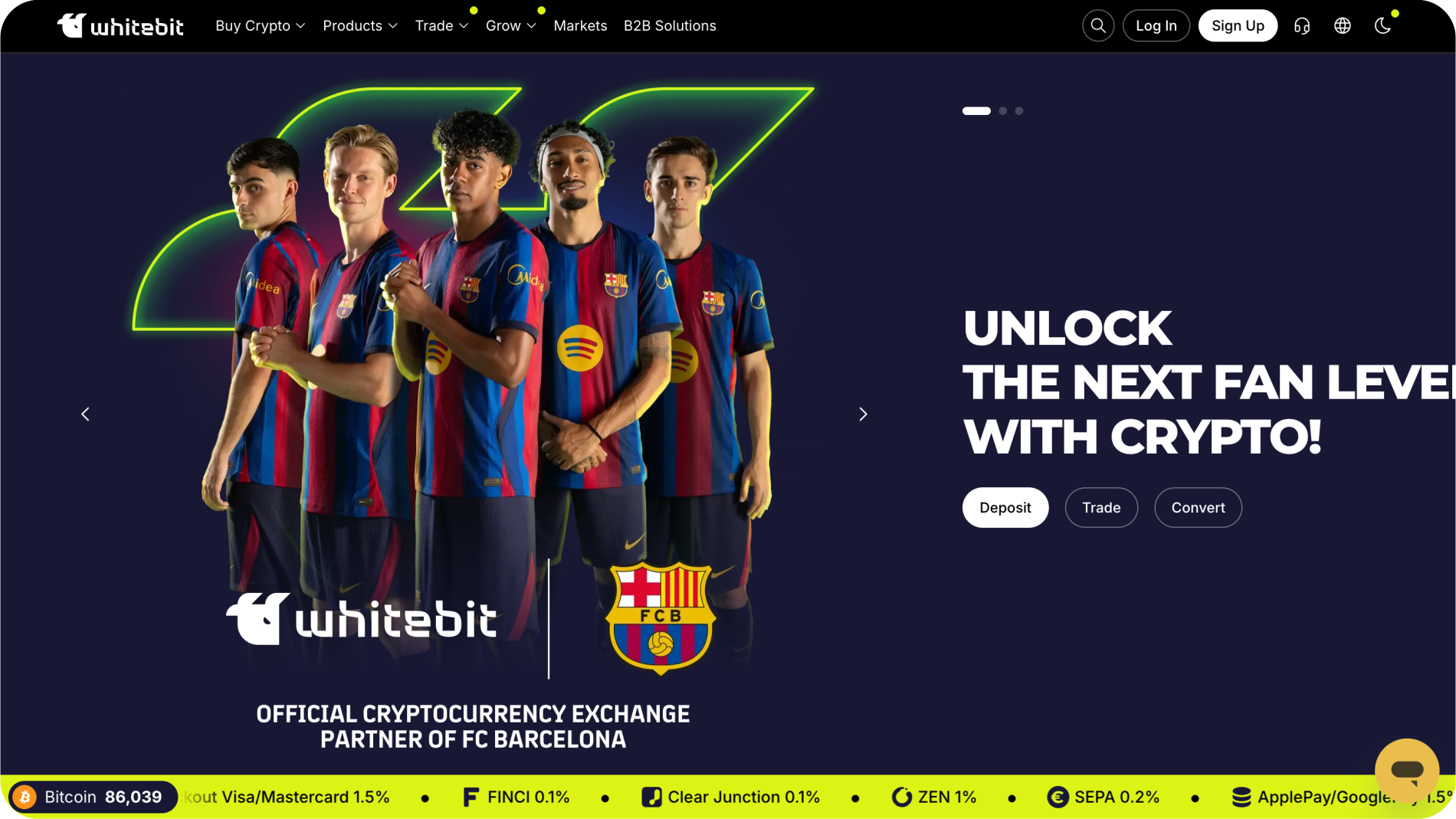
WhiteBit is one of the largest European exchanges by traffic, with more than 340 assets and over 900 trading pairs. Its European entity, WB-Shields Innovations GmbH, obtained the MiCA (CASP) license from the FMA Austrian in June 2026 and operates under the whitebit.eu platform with a European passport. It ranks seventh because it combines a wide catalogue and competitive commissions with a recent license that already allows it to serve the Polish user under MiCA framework.
Its spot fees are 0.10% maker and 0.10% taker, and the platform supports several fiat currencies. For the Polish user, it does not support deposits with BLIK, but allows direct purchases in PLN via card, Apple Pay or Google Pay through its purchase gateway, although without a balance in zlotys as such on the account.
Who is WhiteBit for? For Polish users who are looking for low fees and a large catalog, and prefer to pay by card or mobile instead of BLIK.
Advantages:
- More than 340 assets and over 900 pairs
- Direct purchase in PLN by card, Apple Pay or Google Pay
- Spot commission of 0.10% maker and taker
Disadvantages:
- No BLIK or PLN balance in the account
- Very recent European license (June 2026)
- Lower brand recognition in Poland than other exchanges
8. OKX: Low fees and Web3 access for the most active users
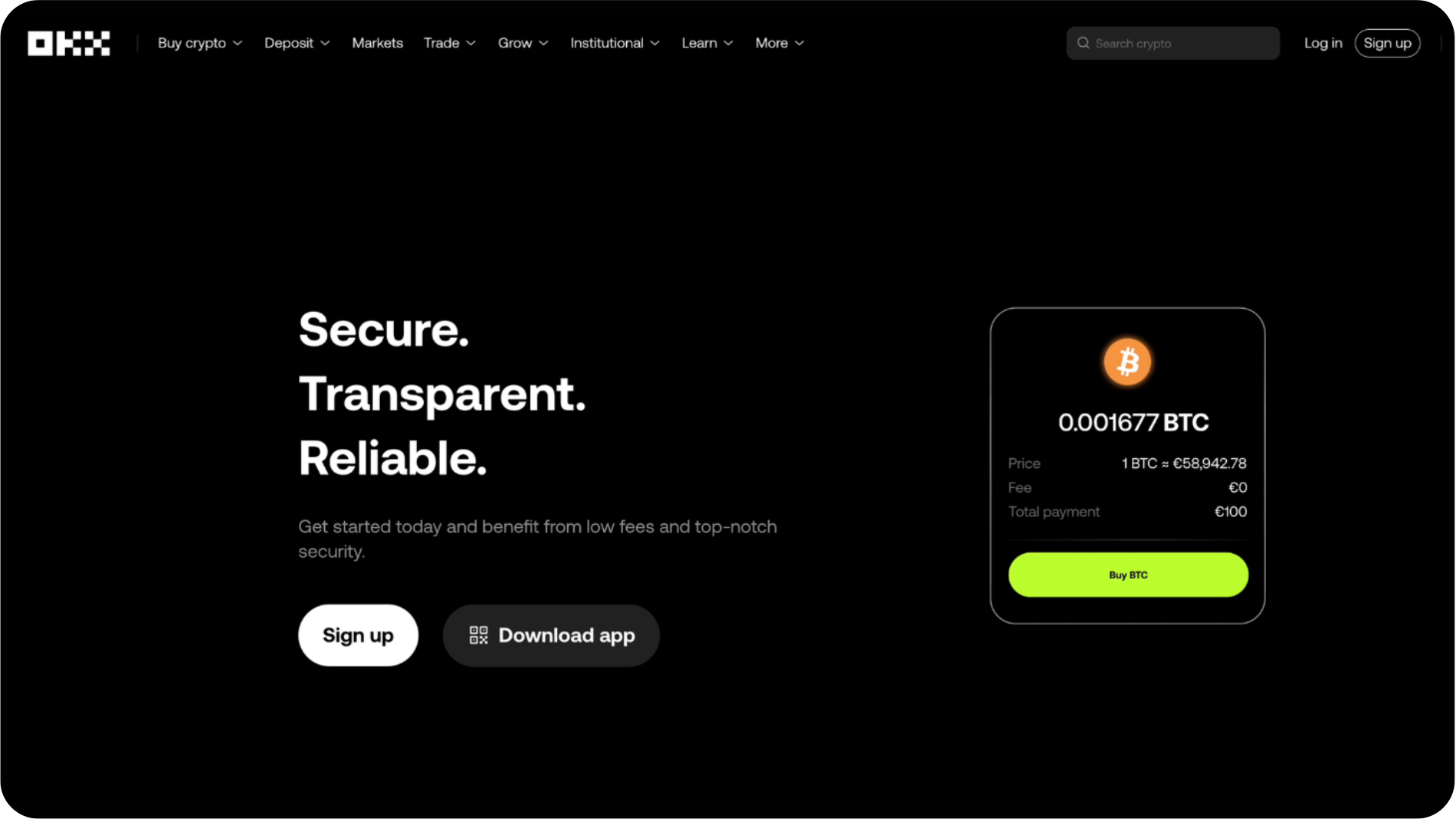
OKX is a global exchange that ranks as one of the most cost-effective options among the top 10 for frequent traders, while also providing access to Web3 features (such as its own wallet and DeFi) that are uncommon on centralized exchanges. It was among the first to obtain the MiCA (CASP) license in the EU, granted by the MFSA maltesa en enero de 2025, y cuenta además con una licencia de entidad de pago en Malta para OKX Pay y la tarjeta OKX.
Its spot fees are among the lowest in the industry: 0.08% maker and 0.10% taker, with volume discounts; minimum deposit is only €1. For the Polish user, funding is done via SEPA in euros or by card. It does not have its own guarantee fund, but offers chat support in several European languages and quarterly Proof of Reserves audits. See full review of OKX
Who is OKX for? For Polish users with a certain volume of operations looking for low fees and want to start exploring Web3 without leaving the exchange.
Advantages:
- Spot commissions among the lowest in the industry
- Access to Web3 features such as a native wallet
- Reserve audits published quarterly
Disadvantages:
- It does not have its own guarantee fund
- Designed primarily for users with some experience
- Lower brand recognition in Poland
9. Gate: extensive altcoin catalog under Maltese license
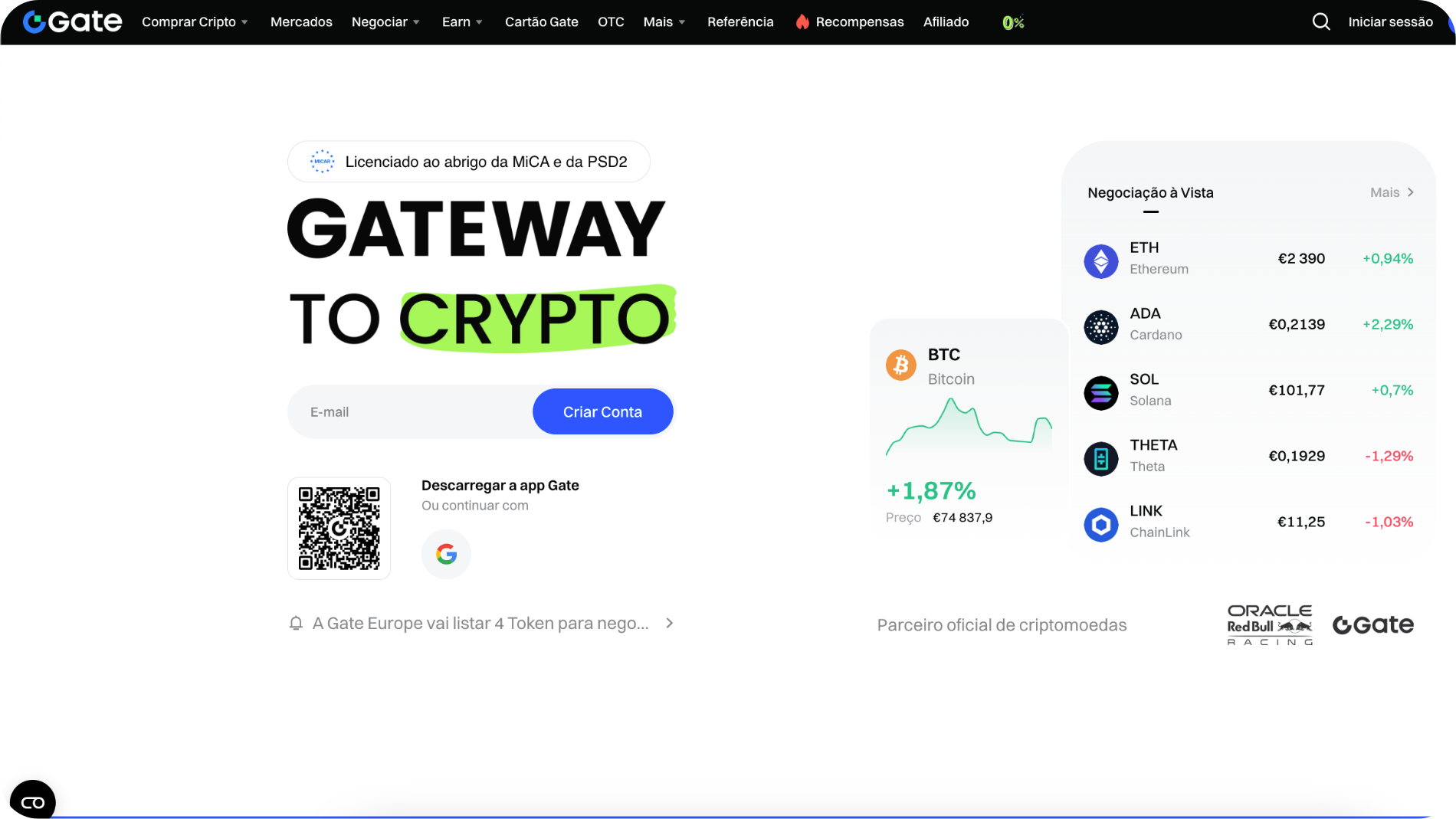
Gate is one of the oldest exchanges in the industry, founded in 2013 and with more than 60 million users according to its September 2026 communication. Ranked 9th for offering low commissions and a catalog of altcoins superior to many competitors, with one European entity, Gate Technology Ltd, obtaining the MiCA (CASP) license from MFSA Maltese in September 2025 and since February 2026 also has a PSD2 payment institution license.
Your base spot commission is 0.10% maker and 0.10% taker, with additional discount when paying with your GT token. For the Polish user, the European version of the platform gives access to more than 200 cryptocurrencies on spot, a catalog considerably lower than that of the global platform, and publishes its reserve ratio (127% in its last report of August 2026). See full review of Gate
Who is Gate for? For experienced Polish users seeking low fees and access to altcoins from a MFSA regulated entity.
Advantages:
- Spot commission of 0.10% maker and taker
- MFSA MiCA license and PSD2 payment institution license
- Disclosure of reserve ratio
Disadvantages:
- European catalogue far below the global platform
- Designed primarily for users with some experience
- Lower brand recognition in Poland
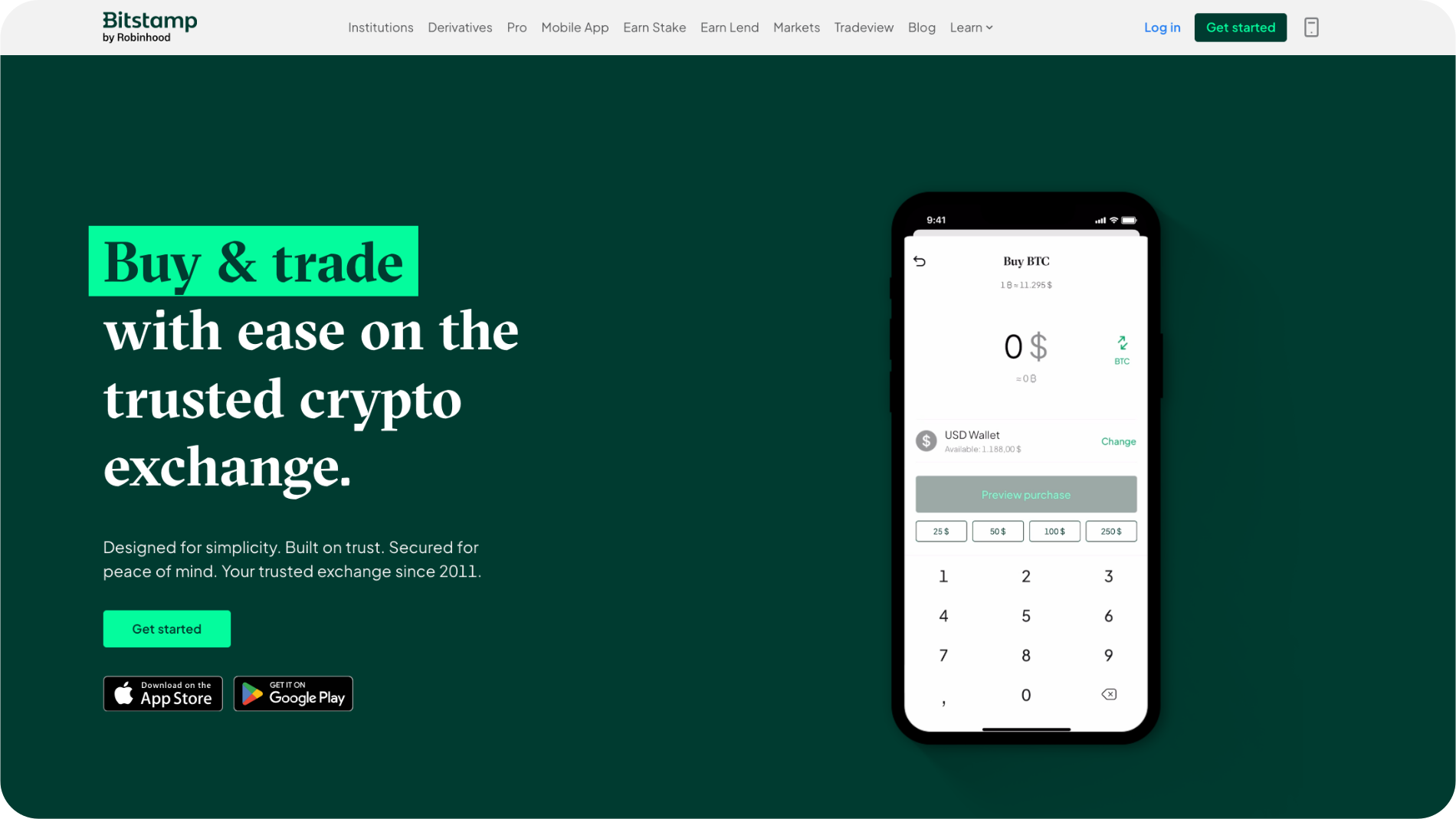
10. Bitstamp: Europe's longest-running regulated exchange
Bitstamp is the oldest active crypto exchange in Europe, founded in 2011 and owned by Robinhood (Nasdaq: HOOD) since 2024. Closes the top 10 for its track record of more than a decade without serious security incidents, a particularly attractive profile for the conservative user, further after the custody issues that have affected the Polish market in 2026. Headquartered in Luxembourg, it has a MiCA (CASP) license from the CSSF since May 2025, plus a MiFID license to operate as a multilateral trading venue.
Its commissions are in the market average (0.30% maker and 0.40% taker in the first tranche) and lower by trading volume, with the advantage of operating under a doubly strengthened regulatory framework (MiCA and MiFID). For the Polish user, it has been a well-established platform for more than a decade, although it does not offer local options such as PLN balance or BLIK and its cryptocurrency catalog is smaller than that of more recent exchanges. See full review of Bitstamp
Who is Bitstamp for? For Polish users who prioritize track record and regulatory robustness over product variety, local convenience or app design.
Advantages:
- A track record of more than a decade without serious incidents
- Dual regulation under MiCA and MiFID licenses
- Backed by the Nasdaq-listed Robinhood Group
Disadvantages:
- No local options for the Polish market (PLN, BLIK)
- A smaller selection of cryptocurrencies than others
- Commissions are average; they are not among the lowest
Comparison table of exchanges for Poland
Looking at the 10 exchanges, here is a comparison table that summarizes the crypto catalog, maker/taker commissions and MiCA regulation of each for the user in Poland.
| Platform | Cryptos | Maker / Taker | Regulation |
|---|---|---|---|
 Bybit EU |
700+ | 0,10% / 0,10% | MiCA (FMA, Austria) |
 Bitvavo |
428+ | 0,15% / 0,25% | MiCA (AFM, Netherlands) |
 Bitpanda (Exchange) |
500+ | 0,05% / 0,15% | MiCA (BaFin, Germany) |
 Crypto.com (Exchange) |
250+ | 0,075% / 0,075% | MiCA (MFSA, Malta) |
 Coinbase (Advanced) |
400+ | 0,40% / 0,60% | MiCA (CSSF, Luxembourg) |
 Kraken (Kraken Pro) |
734+ | 0,40% / 0,80% | MiCA (Central Bank of Ireland) |
 WhiteBit |
340+ | 0,10% / 0,10% | MiCA (FMA, Austria) |
 OKX |
375+ | 0,08% / 0,10% | MiCA (MFSA, Malta) |
 Gate |
200+ | 0,10% / 0,10% | MiCA (MFSA, Malta) |
 Bitstamp |
100+ | 0,30% / 0,40% | MiCA + MiFID (CSSF, Luxembourg) |
All exchanges in the ranking already have a MiCA license, ensuring consistent monitoring across the EU. The best option will depend on whether you prioritize depositing in zlotys with BLIK, low fees, or a wide catalog.
How are cryptocurrencies taxed in Poland in 2026?
Poland does not have its own tax on cryptocurrencies: earnings are taxed in the PIT as capital income, at a fixed rate of 19%, regardless of holding time. The key is what is considered a taxable sale: only the onerous disposal, that is, selling for zlotys or euros, paying goods or services with crypto. Exchanging one crypto for another (e.g., bitcoin for ether) is fiscally neutral, and buying with fiat or moving funds between your own wallets is not taxed.
Here are the rules you should know:
- PIT-38 at 19% (crypto purchases and payments): earnings from selling crypto in fiat currency or using it as a means of payment are taxed at a flat rate of 19% on the difference between income and costs, with no minimum exemptions. Are declared in the virtual currency section of PIT-38.
- Acquisition costs: unlike the FIFO method in other countries, in Poland costs are deducted in the year they are incurred (not associated with each specific sale). If you buy more than you sell in one year, those costs are also reported on the PIT-38 and the surplus is carried over to subsequent years to reduce future income, so it’s wise to report them even if you haven’t sold.
- Economic Activity: Even though you operate through a business, crypto sales revenue is still reported separately in PIT-38 at 19%. If you charge for a job in cryptocurrencies, the income is valued in its corresponding category and the subsequent sale of those crypto generates a new taxable fact.
- No Wealth Tax: Poland does not tax overall wealth nor require a specific crypto disclosure statement abroad equivalent to the Spanish Model 721.
Since January 2026, the European DAC8 directive has been in force: exchanges are already collecting their clients' data and will send their first reports in 2027, with the 2026 operations, so that the tax administration can cross-check them with your declaration. The wisest is to keep your own record of purchases, sales, commissions and procurement documents, and submit PIT-38 before April 30 of the following year (2026, before April 30, 2027).
How did we selected the exchanges in this ranking
This ranking has been drawn up from a comparative analysis of the MiCA-licensed crypto exchanges available to customers in Poland, combining actual usage evidence with technical, regulatory and user experience assessment, to identify those that best fit the user residing in Poland in 2026.
To compile the ranking, we evaluated each platform based on the following criteria:
| Criteria | What We Evaluate | |
|---|---|---|
| 1 | Regulation and licensing | We only include exchanges with full MiCA authorization, verifying each operator in the public records of the ESMA y de su autoridad de origen, incluidos los servicios cubiertos por su licencia y su pasaporte europeo hacia Polonia. |
| 2 | PLN, BLIK and location | Availability of deposits in zlotys, BLIK and other local methods, interface quality and customer support in Polish or English. |
| 3 | Tax Adjustment | Clarity of operations reports for PIT-38 and ease of rebuilding revenue and procurement costs. |
| 4 | Transactions in euros and SEPA funds | Seamless SEPA deposits and withdrawals from Polish accounts, settlement times and compatibility with cards and mobile wallets. |
| 5 | Actual Trading Costs | Actual trades on each platform, calculating the combined cost of commission, spread, PLN/EUR conversion and withdrawal fee, not just the published rate. |
| 6 | Track Record and Transparency | Each exchange's security track record and transparency in the disclosure of reserves (Proof of Reserves). |
Testing was completed in September 2026, with a final check of the licenses in force in ESMA’s public registers as of publication date. You can review the full process of data research and verification in our methodology.
Important note: We regularly review this ranking according to new authorizations, improvements in PLN and BLIK integration or tax and regulatory changes in Poland. Positions may vary.
Regulation of exchanges and cryptocurrencies in Poland
Platforms offering services with cryptocurrencies in Poland operate under the European regulation MiCA, applicable to service providers since 30 December 2024. Poland is a special case: President Karol Nawrocki has on three occasions (December 2025, February and June 2026) vetoed the national law that should have designated the KNF as market supervisor, and the Sejm has failed to muster a three-fifths majority to overturn the veto. As a result, Poland still lacks a comprehensive national framework for implementing MiCA.
On 1 July 2026 the transitional period ended, and since then only platforms authorized as CASP by a European authority with MiCA passport, like those in the ranking, can offer services in Poland. The lack of a local supervisor has left Polish users more exposed, something that became evident with the fraud investigation opened in 2026 against Zondacrypto, the country’s largest exchange. Binance, which withdrew its license application in Greece, has restricted its services in the EU: it only allows positions to be reduced and funds withdrawn, and it assures that it will not freeze assets. Before depositing money on an exchange, check that the entity providing the service is registered with ESMA.
Important note: Binance does not appear in this ranking because it has no MiCA license. Since 1 July 2026, it does not allow new users or deposits in Poland and only allows withdrawal of funds.
The information presented in this ranking is for informational and educational purposes only. It does not constitute financial or tax advice, nor is it a personalized investment recommendation. Using cryptocurrency exchanges involves risks, and each user is responsible for assessing which platform best suits their profile, as well as for complying with applicable regulations and their legal and tax obligations under current Spanish law. Some links in this ranking are affiliate links: if you open an account through them, Exchange Selector may receive a commission at no additional cost to you. This does not influence the criteria or the order of this ranking.
(FAQ) How to choose crypto exchange in Poland in 2026