
Before we dive into the detailed analysis, here's a summary of Bitpanda's key metrics at a glance.

Bitpanda Quick Overview
| Score | |
| Established in | 2014 |
| Headquarters | Vienna, Austria |
| Regulator | BaFin, FMA, MFSA |
| Cryptocurrencies | 500+ |
| Maker/Taker (Bitpanda Pro) | 0,10 % / 0,15 % |
| Standard App Commission | Up to 1.49 % (included in the price) |
| MiCA regulation | Yes, starting in January 2025 |
| Minimum deposit | 1 € |
About Bitpanda: Origins and Who It's For
Bitpanda is an Austrian platform founded in 2014 in Vienna by Eric Demuth, Paul Klanschek, and Christian Trummer, designed to allow users to invest in cryptocurrencies, precious metals, fractional shares, ETFs, and crypto indices all from a single account. It has grown to over 7 million users across Europe, with a clear focus from the start: to offer a simple gateway to the world of digital investing, without the need to open separate accounts for each type of asset.
Pros
Valid MiCA License in the EU
Cryptocurrencies, stocks, ETFs, and metals—all in one app
Bitpanda Pro: 0.10 % / 0.15 %
Staking in up to 23 cryptocurrencies
Cons
App commission of up to 1.49 %
A €70,000 fine from the FMA in 2026
Fewer cryptocurrencies than Binance or OKX
Lack of transparency regarding costs in the app
This exchange was founded with the goal of making it easier for users without technical expertise to invest in cryptoassets, and over time it expanded its offerings to become one of the most comprehensive investment platforms in Europe: crypto, precious metals, fractionalized stocks and ETFs, thematic indices, and savings products, all within the same account and under a single European regulatory framework.
Bitpanda GmbH obtained its MiCA license from the German financial regulator BaFin in January 2025, followed by a second authorization from the Austrian FMA in April 2025 and a third from the Maltese MFSA shortly thereafter. This BaFin-FMA-MFSA licensing structure allows it to operate under the European passport in all 27 member states of the European Union, as well as in the other EEA countries.
Who is Bitpanda for? For European retail investors looking to consolidate their crypto, metals, stocks, and ETFs into a single app, with the peace of mind that comes from a fully valid MiCA license.
In August 2026, the Austrian Financial Market Authority (FMA) imposed a €70,000 fine on Bitpanda for failing to submit its crypto-asset white paper on time and for compliance violations, marking the first definitive penalty under MiCA in the country. The penalty does not affect the validity of the license, but it serves as a reminder that European oversight of the sector is beginning to be enforced with real consequences.
What level of security does Bitpanda offer?
Security is one of the areas where Bitpanda positions itself as a European leader, backed by three concurrent MiCA licenses, predominantly cold storage, and external audits. Bitpanda has also been a pioneer in offering a regulatory framework that goes beyond the minimum requirements of any single member state.
That confidence is also reflected in how those who already use the platform value it:
European regulation under the MiCA framework
Bitpanda is headquartered in Vienna and was one of the first European platforms to obtain a full MiCA license, granted by the German financial regulator BaFin in January 2025. This was followed by a second authorization from the Austrian FMA in April 2025, granted to Bitpanda GmbH to provide custody, exchange, and order execution services, and a third license from the Maltese MFSA shortly thereafter.
Important note: Bitpanda is one of the most heavily regulated cryptocurrency platforms in Europe and holds a MiCA license.
This combination of licenses across three different jurisdictions is unusual among European exchanges and reinforces the company’s claim to be one of the most heavily regulated platforms on the continent. However, in August 2026, the Austrian FMA fined Bitpanda €70,000 for failing to submit the MiCA-required crypto-asset white paper on time and for errors in its content—the first final sanction of its kind in Austria. If you’d like to see which other platforms are subject to this same regulation, you can check out our comparison of the best MiCA-regulated exchanges in Europe.
Custody and protection of funds
Bitpanda keeps most of its customers' crypto assets in cold storage, separate from systems connected to the internet. The company combines this custody with asset segregation from the company’s balance sheet, a requirement reinforced by the MiCA framework for all authorized crypto-asset service providers.
In addition to technical custody, Bitpanda offers products with varying levels of regulatory protection: while the trading and custody of cryptocurrencies are covered by the MiCA license, products such as Bitpanda Stocks (fractionalized stocks and ETFs via derivatives) or certain Earn features involving stablecoins are governed by different frameworks, some of which are unregulated.
Key protection measures include:
- Most crypto assets are held in cold storage.
- Segregation of client assets from the company's balance sheet, as required by MiCA.
- Three concurrent MiCA licenses (BaFin, FMA, MFSA), with active supervision.
- Audits and internal controls for regulatory compliance.
- Explicit risk warning regarding unregulated products such as Earn in stablecoins.
Reserve Test and transparency
Bitpanda does not publish a public Proof of Reserves verified via a Merkle tree, equivalent to those of other exchanges such as Binance or Kraken. Instead, its claim to transparency is based on direct oversight by three European regulators under MiCA, which entails audits, capital requirements, and periodic compliance checks by the relevant authorities.
The €70,000 fine imposed by the FMA in August 2026, related to the failure to submit the cryptoasset white paper on time, is an example of how this oversight already results in penalties when noncompliance is detected, which, in a way, provides greater practical transparency than a voluntary Proof of Reserves without a legal obligation behind it.
Even so, the lack of a verifiable, publicly available proof of reserves is an area where Bitpanda lags behind other major international exchanges that do publish such information on a regular basis.
Important note: A Proof of Reserves is not the same as a financial audit, nor does it offer the same protection as a regulated guarantee fund.
Account Security
At the user level, Bitpanda offers two-factor authentication (2FA), facial or biometric recognition in the mobile app, instant activity notifications, and withdrawal controls. The platform also allows users to set custom withdrawal limits and review their complete transaction history from the app.
Registration and identity verification (KYC) are required from the very beginning in order to make deposits and trade, in accordance with the requirements of MiCA and European anti-money laundering regulations.
Pros
MiCA License in 3 Jurisdictions
Cold storage and segregated assets
2FA, biometrics, and real-time alerts
Cryptocurrencies, metals, stocks, and ETFs combined
Cons
No publicly verifiable Proof of Reserves
FMA fine of €70,000 in 2026
Earn in stablecoins is not regulated
App commission of up to 1.49 %
Where is Bitpanda available?
Bitpanda currently operates in all 27 member states of the European Union thanks to its MiCA license granted by BaFin, which allows it to operate under a European passport throughout the bloc. The platform also provides services in other countries within the European Economic Area and, for certain products such as Bitpanda Stocks, in additional markets outside the EU.
The Bitpanda platform is available to residents of the European Economic Area (EEA). This includes users from the following countries: Germany, Austria, Belgium, Bulgaria, Croatia, Cyprus, Czech Republic, Denmark, Estonia, Finland, France, Greece, Hungary, Ireland, Italy, Latvia, Lithuania, Luxembourg, Malta, the Netherlands, Poland, Portugal, Romania, Slovakia, Slovenia, Spain, and Sweden, as well as Norway, Iceland, and Liechtenstein.
Bitpanda Fees: How Much Does Trading Actually Cost?
Bitpanda’s fee structure is one of the aspects that causes the most confusion among new users, because two very different models coexist within the same brand: the standard app, designed for occasional users, and Bitpanda Pro, aimed at those who trade more frequently and want fees similar to those of a traditional exchange.
Standard app fee: up to 1.49 % included in the price
In the standard Bitpanda app, the cryptocurrency trading fee is included directly in the displayed price (it is not charged as a separate line item), and can be as high as 1.49 % depending on the asset and the transaction, although in practice the visible cost can range from 0 % to 2.49 % depending on the crypto asset. This means that buying 1,000 € worth of Bitcoin can cost up to 14.90 €, well above what crypto-specialized exchanges like Bitvavo or Finst charge.
| Platform | Maker | Taker |
|---|---|---|
 Bitget
|
0,10% | 0,10% |
 Bitpanda
Pro
Bitpanda
Pro
|
0,10% | 0,15% |
 Bitvavo
|
0,15% | 0,25% |
 Kraken
|
0,25% | 0,45% |
|
Bitpanda
App
|
Up to 1,49% | — |
 eToro
eToro
|
1% | 1% |
Bitpanda Pro Fees: 0.10 % maker / 0.15 % taker
To give you an idea of how it compares to other platforms: Bitpanda’s standard app is significantly more expensive than Bitvavo, Finst, or Kraken for the same type of trade, while Bitpanda Pro ranks the platform among the most competitive options in Europe for those willing to use the advanced interface.
Did you know? Buying €1,000 worth of Bitcoin on the standard Bitpanda app can cost you up to €14.90. If you make the same purchase on Bitpanda Pro with a taker fee of 0.15 %, the cost drops to €1.50.
No fixed account opening or maintenance fees
Opening and maintaining an account on Bitpanda is free—there are no custody, inactivity, or maintenance fees. Deposits in euros via SEPA are free of charge on Bitpanda’s end, although the issuing bank may charge its own fees. Cryptocurrency withdrawals do incur network fees, which vary depending on the asset and the congestion of the source blockchain.
Staking Fees, Cash Plus, and Other Products
For staking, Bitpanda retains 20 % of the APY generated by each cryptocurrency as a service fee, paying the remaining 80 % to the user. In Cash Plus, the interest-bearing fiat balance product, Bitpanda offers an APY of 1.99% in EUR, 4.08% in USD, and 4.04% in GBP. For stocks and ETFs, the platform charges a flat fee of 1 € per trade, in addition to the applicable spread.
Overall, Bitpanda's fee policy requires you to carefully consider which interface you're using: the standard app prioritizes convenience over price, while Bitpanda Pro competes head-to-head with the cheapest exchanges in Europe.
| Concept | Cost on Bitpanda |
|---|---|
| Standard app fee (crypto buying/selling) | Up to 1.49 %, included in the price |
| Bitpanda Pro Fees | 0.10 % maker / 0.15 % taker |
| SEPA Deposit | Free from Bitpanda |
| Withdrawal in euro | Free from Bitpanda |
| Custody / maintenance / inactivity | 0 € |
| Staking Fee | 20 % of the generated APY |
| Stocks and ETFs | 1 € per trade + spread |
| Cryptocurrency withdrawal | Network fee, variable depending on the asset |
Step-by-Step Guide to Opening an Account on Bitpanda
Opening an account on Bitpanda is a process designed to take just a few minutes on your phone, with no additional paperwork required thanks to digital identity verification.
Step 1: Initial registration
The process begins by downloading the Bitpanda app (available for iOS and Android) or accessing the site through a web browser. Registration requires an email address, creating a password, and confirming your country of residence.
Step 2: Identity Verification (KYC)
Bitpanda operates under MiCA regulations and must comply with European anti-money laundering regulations; therefore, identity verification is required from the outset. The process includes:
A photo of a valid ID (national ID card or passport, depending on nationality). A proof-of-life photo or selfie taken with a cell phone to confirm that the user matches the ID. Important note: Bitpanda may request additional information regarding the source of funds or the user’s tax status in certain cases, in line with the enhanced requirements of the MiCA framework.
Most verifications are completed in just a few minutes thanks to the automated system. Cases that require manual review may take a little longer.
Step 3: Link a bank account
To deposit and withdraw funds, Bitpanda supports SEPA transfers, credit cards, and—depending on the country—other local payment methods. SEPA deposits typically take anywhere from a few minutes to one business day, depending on the issuing bank.
Did you know? Bitpanda offers deposits in several fiat currencies in addition to the euro, including USD, GBP, CHF, and other European currencies—something that is uncommon among exchanges focused solely on the euro market.
Step 4: First deposit and first trade
The minimum practical deposit is around €1, although the minimum trade size per asset may vary. Once funds are available, users can buy cryptocurrencies, precious metals, fractional shares, or ETFs directly from the standard app, or access Bitpanda Pro to trade with lower commissions.
Summary of requirements for opening an account with Finst
- Be older than 18.
- Reside in one of the countries where Bitpanda currently operates: the 27 member states of the European Union, as well as Norway, Iceland, and Liechtenstein.
- Valid identification: National ID card or passport, depending on your nationality. A bank account or compatible payment method in an accepted currency. A phone or device with a camera to complete the selfie verification.
Important note: Bitpanda distinguishes between the standard app, which is geared toward casual users, and Bitpanda Pro, which has much lower fees but an interface more similar to that of a traditional exchange; it’s best to decide from the outset which one best fits each investor’s profile.
Available cryptocurrencies and assets: 500+ cryptocurrencies, stocks, ETFs, and metals
Beyond buying and selling Bitcoin or Ethereum, Bitpanda stands out from most European exchanges by allowing users to invest in various types of assets from the same account: more than 500 cryptocurrencies, precious metals such as gold and silver, more than 500 fractionalized stocks and ETFs via derivatives, and thematic crypto indices managed by the platform itself.
Bitpanda Stocks: Fractional Shares and ETFs
Bitpanda Stocks allows you to invest in stocks and ETFs from the world’s major stock exchanges through derivative contracts backed by the underlying asset, making it possible to invest in fractional shares starting with very small amounts. The commission is a flat fee of €1 per trade, plus the corresponding spread, as outlined in the platform’s cost transparency document.
| Product | Focus |
|---|---|
| Bitpanda Pro | Advanced exchange with fees of 0.10 % / 0.15 % |
| Bitpanda Stocks | Fractional shares and ETFs, starting at 1 € per trade |
| Staking | 23 cryptocurrencies, up to 25 % APY depending on the asset |
| Cash Plus | Return on balance in EUR, USD, and GBP |
| Crypto Indices | Themed baskets with automatic rebalancing |
| Bitpanda Card | Card for spending crypto and fiat from the account |
Trading on the standard app prioritizes simplicity over cost, with the commission included in the price. Bitpanda Pro requires you to activate an additional account within the same ecosystem to access lower commissions. Crypto indices are automatically rebalanced, similar to the Crypto Bundles offered by other exchanges. Staking: passive income from your cryptocurrencies
Bitpanda offers staking for 23 cryptocurrencies, with returns that vary significantly depending on the asset chosen. The more established networks offer a more conservative APY, while other networks achieve significantly higher returns, up to 25 % APY on certain assets and during specific promotional campaigns.
Bitpanda Staking with up to 25% APY on Cash Plus
Supports more than 20 cryptocurrencies, from Ethereum (ETH) and Cardano (ADA) to Solana (SOL), Polkadot (DOT), and Tron (TRX). Bitpanda retains 20 % of the generated APY as a service fee. Rewards are paid out weekly, with no lock-up periods for most assets. Available directly through the app, with no additional setup steps required.
For those who prefer to earn interest on their balance in euros, dollars, or pounds without buying cryptocurrency, Bitpanda offers Cash Plus, with an APY of 1.99 % in EUR, 4.08 % in USD, and 4.04 % in GBP, with no minimum holding periods. At the same time, Bitpanda has been rolling out Earn for stablecoins, an unregulated product that the platform itself explicitly identifies as such, with the APY, payment frequency, and refund rules displayed before users begin lending.
Available order types
In addition to instant purchases in the standard app, Bitpanda Pro offers:
- Market Order: buy instantly at the best price available.
- Limit Order: runs only when the price reaches the level set by the user.
- Stop Order: It protects the position against price declines or increases, depending on how it is configured.
- Bitpanda Swap: Direct exchange between cryptocurrencies within the same account.
Bitpanda vs. eToro
The most natural comparison for Bitpanda is with eToro, as both platforms share a multi-asset approach that is uncommon among cryptocurrency exchanges: crypto, stocks, ETFs, and indices all within the same account, aimed at European retail investors looking to centralize their portfolios in a single app.
| Characteristic | Bitpanda | eToro |
|---|---|---|
| Foundation | 2014 (Vienna) | 2007 (Tel Aviv / London) |
| Regulation | MiCA via BaFin, FMA, and MFSA | MiCA via CySEC and Other Local Licenses |
| Standard Crypto Commission | Up to 1.49 % (included in price) | Up to 1 % spread |
| Advance Commission | Bitpanda Pro: 0.10 % / 0.15 % | There is no equivalent Exchange Pro version available |
| Cryptocurrencies | 500+ | Approximately 100+ |
| Stocks and ETFs | 500+ via derivatives (Bitpanda Stocks) | Thousands, including actual stock purchases |
| Staking | Up to 25 % APY, 23 cryptocurrencies | Limited to a few assets |
| Copy trading | There is no equivalent product available | Yes, differential function |
| Platform | Website + mobile app (iOS/Android) | Website + mobile app (iOS/Android) |
| Ideal for | Centralize your crypto, metals, stocks, and ETFs with low fees when using Pro | Those who prioritize copy trading and actually buying international stocks |
Bitpanda stands out for its combination of MiCA licenses across three jurisdictions and for offering Bitpanda Pro as a low-cost alternative within the same account—something eToro does not replicate with an equivalent structure. eToro, on the other hand, offers actual stock purchases (not just derivatives) and its copy trading feature, which remains its main point of differentiation compared to any crypto-focused exchange.
For those looking to centralize their crypto, metals, and fractional stocks under a robust MiCA framework—with the option to trade at lower costs through Bitpanda Pro—Bitpanda offers a very comprehensive solution. Those who prioritize copy trading or direct ownership of international stocks will find that eToro is an equally well-established alternative in the European multi-asset segment.
Apps and Platform: How Do You Use Bitpanda on a Daily Basis?
Bitpanda offers both a mobile app (iOS and Android) and a desktop web platform, with the same features available on both, as well as Bitpanda Pro, a separate interface for more active trading.
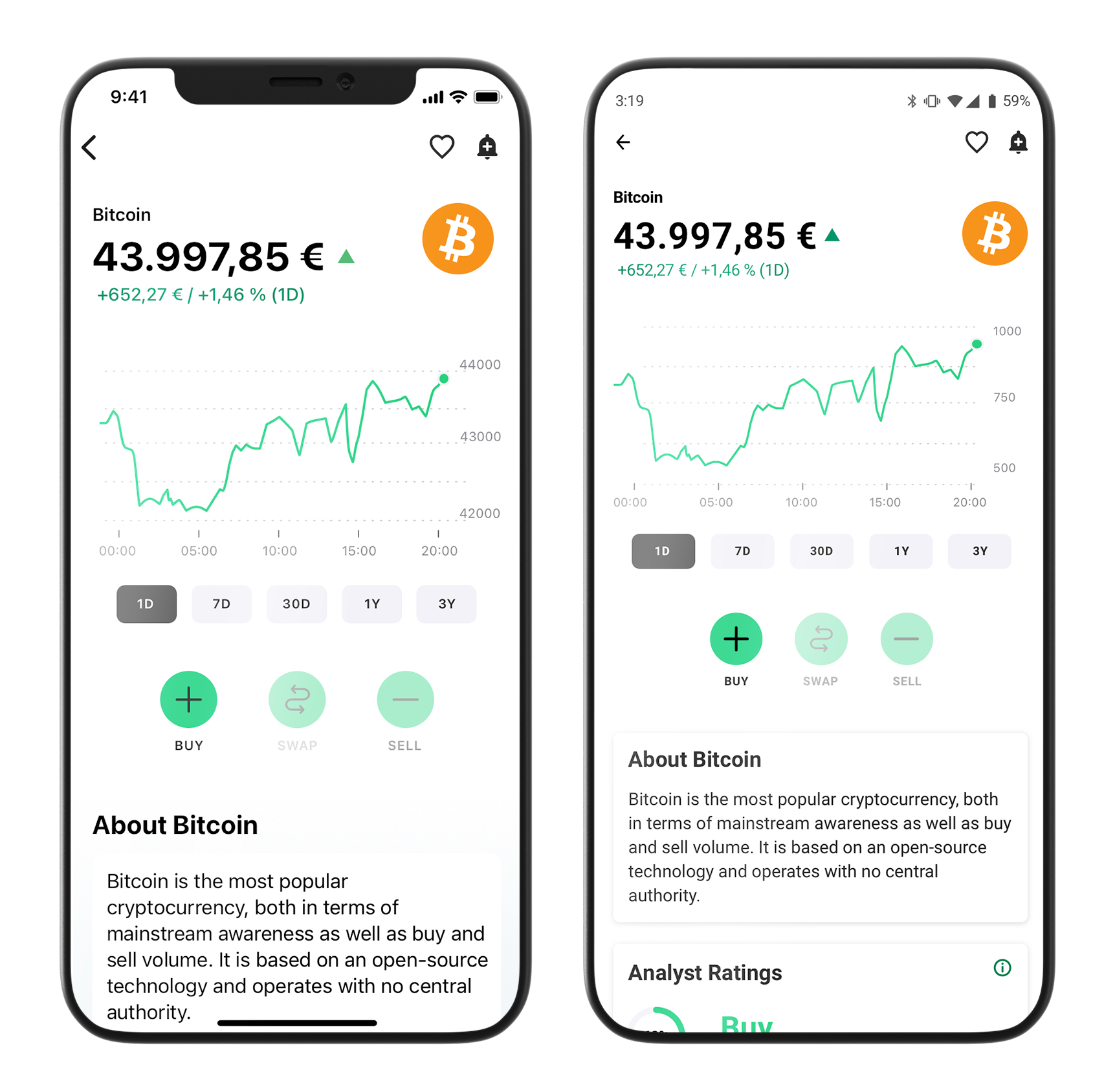
Bitpanda Interface: Mobile App and Web Platform Navigation is organized into a few clear sections:
- Wallet: An overview of your portfolio, featuring cryptocurrencies, metals, stocks, and ETFs all on one screen.
- Market: Main screen for buying, selling, and checking real-time prices.
- Staking and Earn: Direct access to staking, Cash Plus, and Earn in stablecoins.
- Bitpanda Pro: An advanced exchange with an order book and low fees.
Bitpanda also includes a detailed transaction history, price alerts, and an educational section (Bitpanda Academy) with content on investing and cryptoassets. The standard app prioritizes visual simplicity, while Bitpanda Pro adds more advanced charts and different order types.
In terms of execution, the standard app is limited to direct buying and selling, while Bitpanda Pro offers market, limit, and stop orders, providing an experience similar to that of a traditional exchange within the same ecosystem.
Pros
Multiple assets in a single app
Bitpanda Pro with advanced tools
Integrated Educational Academy
Customizable price alerts
Cons
Less transparent costs in the standard app
Pro may confuse new users
No copy trading or social features
Fewer cryptocurrencies than Binance or OKX
Final Verdict: Is Bitpanda Worth It in 2026?
Bitpanda works especially well for European investors looking to consolidate crypto, precious metals, stocks, and ETFs into a single account, backed by three concurrent MiCA licenses and more than a decade of experience in the market. Its Bitpanda Pro product, with fees of 0.10 % / 0.15 %, also allows users who don’t mind using a slightly more advanced interface to trade at competitive rates.
That said, Bitpanda has clear limitations. The standard app charges a fee of up to 1.49 %, which is included in the price—significantly more expensive than that of specialized exchanges like Bitvavo or Finst for simple cryptocurrency trading. The €70,000 fine imposed by the Austrian FMA in August 2026 for violations related to the crypto-asset white paper—while it does not compromise the validity of the license—serves as a reminder that MiCA oversight already has practical consequences.
All things considered, Bitpanda is a good option for European retail investors who want to invest in different types of assets from a single app and value regulatory robustness above all else, especially if they’re willing to use Bitpanda Pro for higher-volume trades. If your priority is solely the lowest possible cryptocurrency fees, it’s worth comparing Bitpanda first with specialized exchanges like Bitvavo or Finst.
This review is based on our actual experience using Bitpanda. We tested the platform by making deposits, purchases, sales, and withdrawals of cryptocurrencies, and we also evaluated its fees, security, and ease of use. The assessment you are reading reflects our hands-on experience, not a first impression or financial advice.
Is Bitpanda not right for you? Explore other options

Veteran exchange focused on security and compliance. Allows buying, selling, and staking, with pro tools and solid support.

Derivatives and copy trading-focused exchange with a fast app. Includes futures, multiple pairs, and advanced features for agile trading.

Leading global platform by trading volume. It offers spot and futures trading, staking, and a broad ecosystem with reduced fees through BNB.

European exchange with a clean interface and competitive fees. Ideal for trading crypto with SEPA transfers and stable liquidity in the European market.

Social trading and derivatives-focused platform with a simple interface. It includes copy trading, futures, and fast purchase options using a card.

Popular exchange for derivatives and spot trading, with high liquidity, a fast interface, and advanced tools geared toward active and professional traders.

Spanish exchange focused on ease of use, local support in Spanish, and integrated options for buying, saving, and custodial asset management.

Comprehensive platform offering spot, futures, and earn products. Strong global liquidity, pro tools, and a built-in Web3 wallet for active traders.