
Before we dive into the detailed analysis, here's a summary of BLOX's most important data at a glance.

BLOX Quick Summary
About BLOX: Origins and Who It's Intended For
BLOX is a Dutch platform for buying, selling, and earning returns on cryptocurrencies. It operates through BLOX B.V., a company registered in Nijmegen, and has built a community of more than 850,000 users with a focus on ease of use, regulation, and education.
Pros
MiCAR license granted by the Dutch AFM
Flat fee of 0.25 % for purchases and sales
More than 350 cryptocurrencies, with new additions almost every week
Earn rewards on all holdings and an integrated educational platform
Cons
No order book, API, or professional trading terminal
It does not normally allow users to freely withdraw cryptocurrencies to external wallets
Product lineup and features may vary by country
Earn returns are variable and not guaranteed
Since its launch, BLOX has primarily targeted retail users who want to enter the market without having to learn how to use a complex exchange. The platform allows users to buy starting at €1, check prices, set alerts, automate purchases, and activate Earn—all from a single, easy-to-use app.
Its home market is the Netherlands, and its sales channels are primarily concentrated in the Netherlands, Belgium, and Spain. However, its MiCAR authorization allows it to provide the services covered by its license throughout the European Union under the regulatory passport.
Who is BLOX for? For European users looking to buy and hold cryptocurrencies with easy-to-understand fees, receive weekly rewards, and learn right within the app.
One of its key differentiators is education. BLOX features an editorially curated news feed with articles within the app, sends weekly updates, and publishes biweekly market recaps via email, written by professional educators.
The platform thus combines trading, Earn, and content. Its goal is not to offer as many speculative products as possible, but to reduce friction so that users can invest and understand what they’re doing all within a single environment.
What level of security does BLOX offer?
BLOX combines a MiCAR license, asset segregation, a closed withdrawal system, and custody controls. The platform links the euro balance to a verified bank account held by the same account holder, reducing the possibility that a third party could withdraw funds to another account even if they gain access to the login credentials.
Public ratings from users are displayed as follows:
European Regulation and MiCA Authorization
BLOX B.V. is authorized by the Netherlands Authority for the Financial Markets as a crypto-asset service provider under MiCAR. The authorization took effect on October 1, 2025.
The AFM is considered a European jurisdiction with the highest regulatory standards. BLOX describes this Dutch environment as a “triple-A” jurisdiction, due to its standards for supervision, transparency, governance, and consumer protection.
Thanks to its MiCAR license, BLOX can operate in European Union countries, although its business activities are concentrated in the Netherlands, Belgium, and Spain. The license imposes obligations regarding custody, disclosure, conflicts of interest, and risk management, but it does not provide protection against market downturns.
Custody and protection of funds
Customers’ cryptoassets are stored separately from BLOX’s own assets and are managed through a dedicated custody structure. The contractual documentation refers to Stichting BLOX Custody in connection with custody and transfer processes.
BLOX uses advanced storage methods and requires multiple approvals to authorize transactions. The platform operates as a closed system: euros can only be deposited or withdrawn through a verified bank account in the user's name.
Key protection measures include:
- Client assets are segregated from BLOX's operating assets.
- Specific structure through Stichting BLOX Custody.
- Multiple approvals required to authorize sensitive transactions.
- Withdrawals in euros are limited to the account holder's verified bank accounts.
- Identity verification and manual review of new bank accounts.
- Option to hide the portfolio value within the app.
Reserve Test and transparency
BLOX states that client assets are held separately and are fully safeguarded. The MiCAR regulation requires custody controls and records, as well as procedures to distinguish user funds from the company’s resources.
We have not found a public cryptographic proof of reserves that allows each user to verify their balance using a Merkle tree. Therefore, we do not present regulatory segregation as if it were an individual on-chain proof: these are distinct transparency mechanisms.
The AFM license, asset segregation, and custody structure are positive signs, but they are no substitute for a comprehensive financial audit. Users should be aware of the counterparty risk inherent in any centralized custodian.
Account Security
BLOX uses identity verification, bank account linking, and access controls to protect your account. When a new IBAN is added, the company verifies that it belongs to the same account holder before enabling withdrawals.
The closed system reduces the risk of theft through withdrawals to an external wallet, but it also limits the user's control over their assets. As a general rule, users can deposit certain cryptocurrencies, sell them, and withdraw euros; freely sending cryptocurrency to an external address is not part of the standard process.
Pros
AFM MiCAR License Effective October 2025
Segregated Assets and the Structure of Stichting BLOX Custody
Closed system with withdrawals to a verified IBAN
Multiple Approvals and Bank Account Controls
Cons
MiCAR does not guarantee the value of cryptocurrencies
No Public Individual Cryptographic Proof of Reserves
The closed system limits self-custody and crypto withdrawals
Security also depends on the device and the user's credentials
Where is BLOX available?
BLOX holds a MiCAR license from the AFM and is authorized to provide its services throughout the European Union. This includes Germany, Austria, Belgium, Bulgaria, Croatia, Cyprus, the Czech Republic, Denmark, Estonia, Finland, France, Greece, Hungary, Ireland, Italy, Latvia, Lithuania, Luxembourg, Malta, the Netherlands, Poland, Portugal, Romania, Slovakia, Slovenia, Spain, and Sweden.
Regulatory coverage does not necessarily equate to the same level of commercial activity or functional availability. BLOX focuses its marketing, support, and growth efforts on the Netherlands, Belgium, and Spain, which should be highlighted on the map.
Payment methods, promotional campaigns, content, fiat currencies, and certain features may vary by country of residence. Before registering, be sure to select the correct country and check which services are available within the app.
BLOX Fees: How Much Does Trading Really Cost?
BLOX does not use a maker/taker structure because users do not trade directly on an order book. It charges a flat fee of 0.25 % for both buying and selling, which is displayed before the transaction is confirmed.
Trading commission: 0.25 % per buy or sell order
The 0.25 % fee does not depend on trading volume, account age, or VIP status. Buying €1,000 worth of Bitcoin incurs a €2.50 fee, and subsequently selling the same amount adds another €2.50, not counting the price movement between the two transactions.
| Platform | Maker | Taker |
|---|---|---|
 Bitget
|
0,10% | 0,10% |
 Bybit
Bybit
|
0,10% | 0,10% |
 Finst
Finst
|
0,15% | 0,15% |
 Bitvavo
|
0,15% | 0,25% |
 BLOX
BLOX
|
Not applicable | 0.25% flat |
 Coinbase
|
0,40% | 0,60% |
 eToro
eToro
|
1% | 1% |
Comparison based on initial spot rates for users without volume discounts.
This structure is easy to calculate and eliminates the need to distinguish between maker and taker orders. However, BLOX does not allow users to place an order in the order book to earn a lower commission, nor does it offer volume-based discounts.
Did you know? Buying €1,000 worth of Bitcoin at the flat rate of 0.25 % costs €2.50. If you later sell 1,000 €, you’ll pay another 2.50 €: the entire buy-and-sell process costs 5 € before taking price fluctuations into account.
Deposits and Withdrawals: Free SEPA and iDEAL
Deposits in euros via SEPA transfer and iDEAL are free of charge through BLOX. The platform also lists credit cards and Bancontact among its available payment methods, although coverage may vary by country.
One free withdrawal in euros is included each month. Starting with the second withdrawal, BLOX charges €0.35 per withdrawal for the remainder of the month. The minimum amount for deposits, withdrawals, purchases, or sales is €1.
A standard bank transfer can take between one and two business days. When you use a bank account for the first time or add a new IBAN, BLOX performs a manual account ownership verification that may take up to 24 hours.
BLOX Earn and Advanced Products Committee
BLOX allows you to enable Earn on all eligible positions in your portfolio with a single process, without having to actively trade. Rewards are paid weekly, and the advertised rates range from 0.25 % to 12.5 %, depending on the asset and the program terms.
Returns are neither fixed nor guaranteed. The contractual documentation warns that the service may depend on third parties, networks, or protocols, and that expected returns may change. Before activating the service, you should review the asset, the rate, liquidity, and exit conditions.
Overall, BLOX's policy is simpler than SwissBorg's: a flat fee for buying and selling, free bank deposits, and one free withdrawal per month. The biggest limitation lies not in the complexity of the fees, but in the closed system and the lack of professional tools.
| Concept | Cost in BLOX |
|---|---|
| Buying Cryptocurrencies | 0.25 % flat |
| Cryptocurrency Sales | 0.25 % flat |
| Deposit via SEPA transfer | 0 € per BLOX |
| Deposit via iDEAL | 0 € per BLOX |
| First euro withdrawal of the month | 0 € |
| Additional withdrawals for the month | €0.35 each |
| Opening and Maintaining an Account | 0 € in the standard account |
| BLOX Earn | Variable rate depending on the asset; check the terms in the app |
Step-by-Step Guide to Opening an Account with BLOX
Opening an account with BLOX requires a digital process involving registration, identity verification, and bank account linking. Residents of the European Union can use the services provided under the AFM’s MiCAR license.
Step 1: Initial registration
The process begins through the BLOX app or the web portal. You must select your country, create your login credentials, and confirm your contact information. There are no setup or maintenance fees for the standard account.
You must select your country of residence correctly, as this determines which documents, payment methods, and communication channels are available. BLOX is primarily aimed at the Netherlands, Belgium, and Spain, but it accepts residents from throughout the European Union.
Step 2: Identity Verification (KYC)
BLOX requires users to verify their identity before they can fully use the platform. The process includes:
- A photograph of a valid document, such as an ID card or passport.
- A selfie or facial verification to confirm identity.
It may also request information regarding your address, tax residence, occupation, and source of funds. The company may consult public and private databases to verify documents, political exposure, and compliance with anti-money laundering regulations.
Automated verifications are usually completed quickly. Cases that require manual review may take longer, especially when data does not match or when limits are reached that require additional documentation.
Step 3: Link a bank account
BLOX uses a closed system and requires a bank account in the same name as the account holder. Depending on the country, deposits can be made via:
- SEPA bank transfer.
- iDEAL in the Netherlands.
- Bancontact and credit cards, when available.
Did you know? The first time you use an IBAN or add a new account, BLOX manually verifies that it is in your name. The verification process can take up to 24 hours and prevents you from withdrawing euros to a third-party account.
Step 4: First deposit and first trade
Once the euros have been credited, select the cryptocurrency and the amount. BLOX lets you start with as little as €1 and displays the 0.25 % fee before you confirm the purchase.
The transaction appears in your portfolio immediately after it is executed. From there, you can set up alerts, schedule recurring purchases, check the news, or enable Earn on compatible assets.
Summary of Requirements for Opening an Account with BLOX
- Be older than 18.
- Reside in an eligible European Union country.
- Have a valid identification document.
- Complete the facial verification and the regulatory questionnaire.
- Use a bank account in the same name.
- Provide additional information regarding the source of funds upon request.
Important note: With a verified account, deposit limits of up to €25,000 per 24 hours and €500,000 per month apply, although BLOX may impose personal limits or request additional information.
Available cryptocurrencies: more than 350 worldwide
BLOX offers more than 350 cryptocurrencies and updates its catalog almost every week. It includes established assets such as Bitcoin, Ether, XRP, Solana, Cardano, BNB, Dogecoin, Chainlink, Litecoin, and Uniswap, as well as smaller-cap tokens.
Not all assets support exactly the same features. A cryptocurrency may be available for buying and selling, but not for external deposits or Earn. BLOX decides which assets to add, suspend, or remove, and, when possible, provides advance notice of a removal.
News and Education: Featured Content in the App
Education is one of BLOX's unique features. The app includes a curated news feed with articles designed to help users understand market trends and available projects.
| Product | Focus |
|---|---|
| News Channel | Selected articles within the app |
| Weekly Update | Periodic Summary of Relevant Developments |
| Biweekly Market Recap | Analysis via email written by professional educators |
| Cryptopedia | Guides on Cryptocurrencies, Networks, and Basic Concepts |
| Price Alerts | Customizable notifications about asset movements |
| DCA | Regular purchases to automate investing |
Beyond publishing news, BLOX aims to guide users through the process:
- The articles are integrated into the same app where you invest.
- Weekly updates ensure a steady flow of information.
- The biweekly summaries provide context for market performance.
- The content is developed and selected by professional educators.
BLOX Earn: Earnings on Your Cryptocurrencies
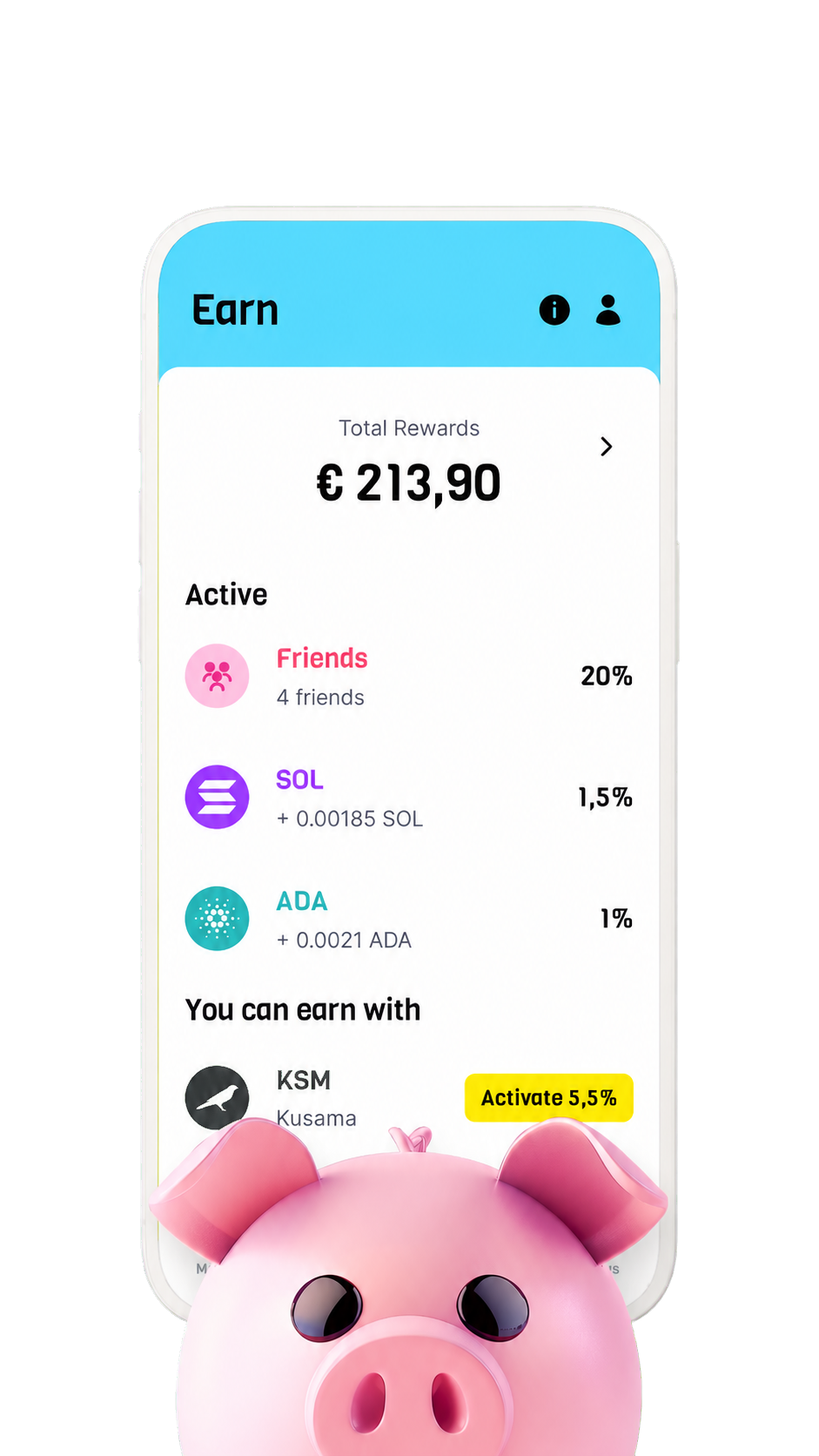
BLOX Earn lets you earn rewards on your holdings without selling them or trading manually. The program can be activated across your entire compatible portfolio and distributes rewards every week.
Rates vary depending on the asset and market conditions. BLOX reports returns ranging from 0.25 % to 12.5 %.
The highlights of BLOX Earn:
- Easy activation on all compatible devices.
- Rewards are paid out weekly.
- Announced rates ranging from 0.25 % to 12.5 %.
- No need to manually configure nodes or use external protocols.
Regular Purchases (DCA): Automate Your Purchases
BLOX allows you to schedule purchases at set intervals to implement a cost-averaging strategy. The user selects the asset, the amount, and the frequency without having to manually execute each order.
Each purchase is subject to a flat fee of 0.25 %. Dollar-Cost Averaging reduces reliance on a single entry price, but it does not eliminate volatility or guarantee profits.
Available order types
In addition to simple buying and selling, BLOX offers:
- Instant Purchase: Buy the asset at the price shown.
- Instant Sale: Convert cryptocurrency to euros.
- Regular purchases: Automate transactions using DCA.
- Price alerts: Notify you when the asset reaches the set level.
BLOX vs. Bitvavo
The most natural comparison pits BLOX against Bitvavo. Both are Dutch providers regulated by the AFM under MiCAR and allow trading in euros, but BLOX prioritizes simplicity and education, while Bitvavo offers a more comprehensive exchange environment.
| Characteristic | BLOX | Bitvavo |
|---|---|---|
| Foundation | 2018 | 2018 |
| Regulation | MiCA via AFM | MiCA via AFM |
| Trade Fee | 0.25 flat fee when buying and selling | 0.15% maker / 0.25% taker |
| Minimum deposit | 1 € | 1 € (minimum order of 5 €) |
| SEPA deposits | Free | Free |
| Cryptocurrencies | +350 | 430+ |
| Exchange type | Centralized | Centralized |
| Unique Product | Integrated Education and Earn on Holdings | Bots, Advanced Trading, and Web3 Wallets |
| Platform | App and Simplified Web Portal | Website + mobile app + Pro version |
| Ideal for | Beginners and Recurring Investments | European users interested in advanced trading |
BLOX is more straightforward: it always charges 0.25 %, limits external withdrawals, and brings together investing, Earn, and education in a simple interface. It’s easier to predict the cost and understand the workflow.
Bitvavo offers more control, order types, and volume discounts. For a beginner, BLOX may be more user-friendly; for someone who trades frequently or wants to withdraw crypto freely, Bitvavo is usually more flexible.
Apps and Platform: How Is BLOX Used in Everyday Life?
BLOX offers an app for iOS and Android and access via a web portal. The experience is designed to let you view your portfolio, buy, sell, activate Earn, set up DCA, and access educational content without having to navigate a complex trading platform.
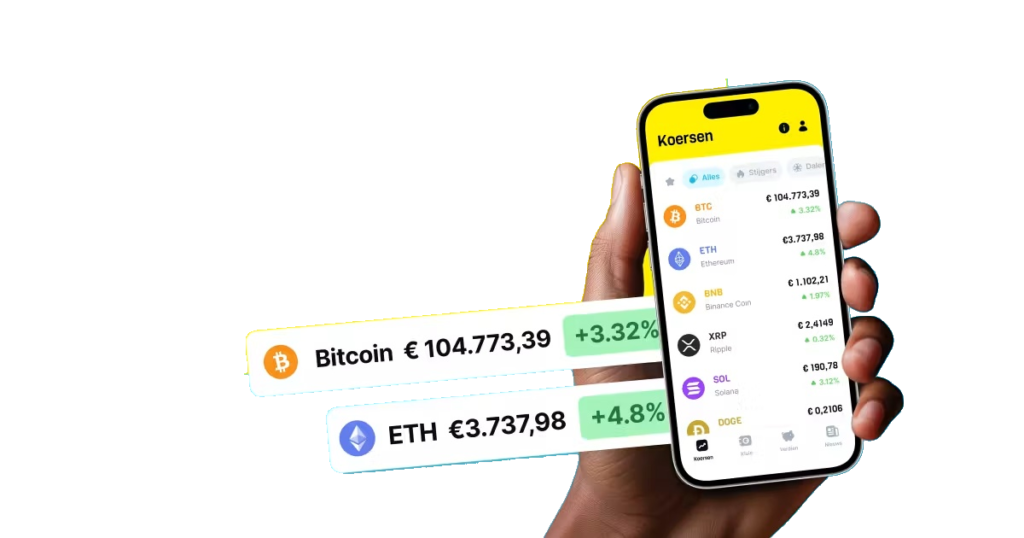
The navigation is organized into several sections:
- Wallet or Vault: balance in euros and cryptocurrencies held.
- Buying and Selling: Simple Transactions with Transparent Fees.
- Earn: Activation and tracking of weekly rewards.
- News and Cryptopedia: articles, analysis, and educational materials.
The platform includes price alerts, the option to hide the portfolio value, and recurring purchases. The news feed allows users to view basic market information without having to leave the app.
In terms of execution, BLOX does not attempt to compete with a professional trading platform. It does not offer an order book, futures, margin trading, a trading API, or advanced order types. Its simplicity is an advantage for beginners but a limitation for active traders.
Pros
Simple interface available in Spanish
Integrated news, education, and analysis
Earn, DCA, and alerts all in one app
Flat-rate cost that's easy to predict
Cons
No Pro terminal or advanced technical charts
No maker/taker order book
Very limited external crypto withdrawals
Less flexible for experienced traders
Final Verdict: Is BLOX Worth It in 2026?
BLOX works particularly well for European users looking for a regulated, user-friendly, and educational platform. The AFM’s MiCAR license, the flat fee of 0.25 %, over 350 cryptocurrencies, and the Earn feature that can be activated on holdings all come together to form a clear offering.
However, the closed system comes at a functional cost: you generally cannot freely send cryptocurrencies to an external wallet. There is also no order book, API, or advanced tools, so an active trader will find more options on Bitvavo, Kraken, or OKX.
With all of this in mind, BLOX is a good option for getting started, building your portfolio through dollar-cost averaging, and learning from Spain. Its integrated educational resources and professional summaries provide real value; those who prioritize self-custody or advanced trading should choose a more flexible platform.
This review is based on our actual experience using BLOX. We tested the platform by making deposits, purchases, sales, and withdrawals of cryptocurrencies, and we also evaluated its fees, security, and ease of use. The rating you see here reflects our hands-on experience, not just a first impression.
Is BLOX not right for you? Explore other options

Veteran exchange focused on security and compliance. Allows buying, selling, and staking, with pro tools and solid support.

Derivatives and copy trading-focused exchange with a fast app. Includes futures, multiple pairs, and advanced features for agile trading.

Leading global platform by trading volume. It offers spot and futures trading, staking, and a broad ecosystem with reduced fees through BNB.

European exchange with a clean interface and competitive fees. Ideal for trading crypto with SEPA transfers and stable liquidity in the European market.

Social trading and derivatives-focused platform with a simple interface. It includes copy trading, futures, and fast purchase options using a card.

Popular exchange for derivatives and spot trading, with high liquidity, a fast interface, and advanced tools geared toward active and professional traders.

Spanish exchange focused on ease of use, local support in Spanish, and integrated options for buying, saving, and custodial asset management.

Comprehensive platform offering spot, futures, and earn products. Strong global liquidity, pro tools, and a built-in Web3 wallet for active traders.