
Before we dive into the detailed analysis, here's a summary of Gemini's key metrics at a glance.

Gemini Quick Summary
| Score | |
| Established in | 2014 |
| Headquarters | United States |
| Regulator | NYDFS (U.S.), Ireland |
| Cryptocurrencies | +80 |
| Maker/Taker | 0,60 % / 1,20 % |
| MiCA regulation | Yes, but Gemini closed all EEA accounts on April 6, 2026. |
| Minimum deposit | No general minimum for ACH |
About Gemini: Its Origins and Who It's Intended For
Gemini is a cryptocurrency exchange founded in New York in 2014 by Cameron and Tyler Winklevoss. The platform began operating in 2015 and offers simple trading, Gemini ActiveTrader, institutional custody, staking, OTC trading, APIs, a rewards credit card, and regulated market products depending on the country.
Pros
New York trust company with a strong regulatory focus
ISO 27001, SOC 1 Type 2, and SOC 2 Type 2 Certifications
Simple platform and advanced terminal with an API
Staking, institutional custody, and cards in supported markets
Cons
The service was discontinued in the United Kingdom, the EEA, and Australia in April 2026
ActiveTrader starts at a high of 0.60 for % makers and 1.20 for % takers
Trustpilot shows numerous complaints about outages and customer support
Lower trading volume and liquidity than Binance, Coinbase, or Kraken
Gemini was founded with the goal of creating a crypto infrastructure that could operate within the regulated U.S. financial system. Its parent company, Gemini Trust Company, LLC, holds a trust charter from the State of New York and is supervised by the New York State Department of Financial Services.
In September 2025, Gemini Space Station, Inc. began trading on Nasdaq under the ticker symbol GEMI. This status requires the company to disclose financial information and material events to the SEC, although it does not eliminate the operational, custody, or market risks inherent in an exchange.
Who is Gemini for? Primarily for users in the United States who value local regulation, custody, and an interface that allows them to switch from a simple purchase to ActiveTrader.
The platform offers two experiences. Gemini mode simplifies buying, selling, converting, and recurring orders, but includes a commission calculated on each transaction and a spread. ActiveTrader uses an order book, charts, an API, and maker/taker tiers tied to 30-day volume or asset balance.
Its international reach shrank significantly in 2026. Despite having obtained a MiCA license from the MFSA in August 2025, Gemini decided to close all customer accounts in the United Kingdom, the European Economic Area, and Australia effective April 6, 2026.
This change makes availability a central focus of the review. A resident of Spain cannot open or maintain a trading account as of August 2026. The assessment must be conducted on a global basis, but without using the former European license as proof that the exchange remains available in the EU.
What level of security does Gemini offer?
Gemini is one of the exchanges that has invested the most in formal certifications, custody controls, and regulatory oversight. It requires two-factor authentication, keeps the majority of its assets in cold storage, and subjects its systems to periodic SOC audits.
The public rating is displayed as follows:
U.S. Regulation and Withdrawal from Europe
Gemini does not operate under a single global license. In the United States, Gemini Trust Company, LLC is a New York limited trust company, with NMLS number 1518126, and is regulated by the NYDFS. It also holds the state licenses or registrations required to provide services nationwide.
The facility was expanded in 2025 and 2026. Gemini Moonbase, LLC, NMLS 2403509, offers certain products and assets to eligible U.S. customers. In December 2025, Gemini Titan, LLC received Designated Contract Market status from the CFTC for its prediction market.
In April 2026, Gemini Olympus, LLC obtained a license from the CFTC to operate as a Derivatives Clearing Organization. This authorization allows the company to act as a clearinghouse for regulated markets, including prediction contracts, and is part of its expansion into futures and options in the United States.
In Singapore, customers were transferred to Gemini Digital Payments Singapore, Pte. Ltd. after the company received preliminary approval for a Major Payment Institution license from the Monetary Authority of Singapore. The scope and final status must be verified before publication.
The situation in Europe requires a separate explanation. Gemini received MiCA authorization from the Malta Financial Services Authority in August 2025 and a MiFID II investment firm license, but subsequently announced its commercial withdrawal from the United Kingdom, the EEA, and Australia. As of April 6, 2026, those accounts have been closed; therefore, the license does not equate to available service.
Custody and protection of funds
Gemini states that it keeps the majority of its assets in its cold storage system. Keys and sensitive operations are protected through access controls, segregation of duties, and processes designed to limit the exposure of connected wallets.
Digital assets are not covered by the FDIC. Certain fiat balances held by U.S. customers may be eligible for pass-through coverage when held at participating banks and certain conditions are met, but this protection does not automatically extend to bitcoin, ether, or other cryptoassets.
Gemini maintains an insurance policy for certain assets held in hot wallets. Coverage is subject to limits, exclusions, and conditions; it should not be construed as comprehensive insurance against any loss, user fraud, or decline in market value.
Key protection measures include:
- Storage is primarily offline in cold wallets.
- Two-step authentication is required for every account.
- Passkeys and support for security keys, when available.
- Approved Addresses to limit pickup locations.
- ISO 27001 certifications and SOC 1 Type 2 and SOC 2 Type 2 audits.
- Anti-money laundering controls, identity verification, and transaction monitoring.
Reserve Test and transparency
Gemini publishes regulatory information, corporate filings as a publicly traded company, and trust and security pages. However, as of August 2026, it does not offer a public Proof of Reserves tool using a Merkle tree that would allow users to individually verify the inclusion of their account balance.
SOC reviews assess controls related to security, availability, confidentiality, and financial operations, but they do not constitute a real-time cryptographic audit of assets and liabilities. Similarly, NYDFS requirements do not replace a public audit of reserves.
Being listed on Nasdaq entails disclosures to the SEC and greater corporate visibility. Even so, a Gemini account still involves counterparty risk: the user delegates custody and does not control the private keys as long as the assets remain on the exchange.
It is also worth noting the agreement reached with Genesis and the regulators regarding the former Gemini Earn program. Customers ultimately recovered their assets in kind, but the incident demonstrated that a yield product can involve risk from a third party other than the exchange and should not be confused with current staking practices.
Account Security
Gemini requires 2FA and recommends using Authy, passkeys, or a hardware token instead of relying solely on SMS. Approved Addresses lets you create a list of authorized destinations and block withdrawals to new addresses until the security period is complete.
Changes to passwords, devices, authentication methods, or bank accounts can result in temporary holds. These controls reduce the risk of fraud, although public opinion surveys show that compliance reviews and account unblocking are a frequent source of frustration.
Pros
Trust company regulated by the NYDFS
ISO 27001, SOC 1 Type 2, and SOC 2 Type 2
Cold storage, mandatory 2FA, and approved addresses
Limited insurance for certain assets in hot wallets
Cons
There is no global license, nor is there identical protection in all countries
It does not provide a public individual Merkle Proof of Reserves
Public complaints mention restricted accounts and slow support
The former Earn program exposed users to third-party counterparty risk
Where is Gemini available?
Gemini claims to be available in more than 50 countries and in all 50 U.S. states. The specific list depends on the user's location, the contracting entity, the asset, and the product. Not all features are available in every market.
In North America and the Caribbean, the list includes the United States, the Bahamas, Bermuda, the Cayman Islands, the British Virgin Islands, Mexico, Panama, the Dominican Republic, Saint Lucia, and Saint Vincent and the Grenadines, among other territories listed on the official website.
In South America, Gemini lists availability in Argentina, Brazil, Chile, Ecuador, Peru, and Uruguay. In Asia, the list includes Israel, Singapore, and Turkey; in Africa, Egypt, Ghana, and South Africa. The selection of fiat currencies and tradable tokens may be much more limited than in the United States.
As of April 6, 2026, Gemini no longer provides services to customers in the United Kingdom, the EEA, or Australia. The affected accounts were previously switched to withdrawal-only mode, and users were required to withdraw their funds. Spain and the rest of the European Union should be listed as unavailable, although some older pages may still mention the MiCA license.
Gemini Fees: How Much Does Trading Really Cost?
Gemini uses two different models. The simple mode calculates a variable fee and adds a spread to instant orders, recurring orders, and conversions. ActiveTrader uses maker/taker tiers based on 30-day volume or total asset balance.
ActiveTrader Commission: 0.60 % maker and 1.20 % taker
Starting July 9, 2026, the initial ActiveTrader tier charges a 0.60 % maker fee and a 1.20 % taker fee. The tiers are recalculated daily, and users are assigned the most favorable tier based on their volume over the past 30 days and their eligible balance.
| Platform | Maker | Taker |
|---|---|---|
 Bitget
|
0,10% | 0,10% |
 Bybit
Bybit
|
0,10% | 0,10% |
 Finst
Finst
|
0,15% | 0,15% |
 Bitvavo
|
0,15% | 0,25% |
 Coinbase Advanced
|
0,40% | 0,60% |
 Gemini
|
0,60% | 1,20% |
Comparison based on initial spot rates for users without volume discounts.
The next tier begins at $10,000 in volume or $1 million in assets and reduces fees to 0.40 % for makers and 0.80 % for takers. Costs continue to decrease, reaching 0 % for makers and 0.02 % for takers in the $250 million tier.
Did you know? A $1,000 order on ActiveTrader costs $6 if executed as a maker and $12 as a taker at the initial price level.
Global Fiat Deposits and Withdrawals
The methods vary by country. In the United States, ACH deposits and withdrawals are free. Gemini does not charge a fee for receiving a wire transfer, although the bank may do so; a wire withdrawal in USD costs $25.
Purchases made with a debit card, Apple Pay, or Google Pay incur a platform fee of 3.49 % plus the trading commission. PayPal, available to U.S. customers, charges 2.50 % on the deposit or purchase, in addition to the trading cost.
In Singapore, FAST withdrawals cost 3 SGD and wire transfers cost 25 SGD. Crypto deposits are free. Crypto withdrawals are subject to a dynamic fee intended to cover network costs, which is displayed before confirmation.
Staking and Advanced Products Committee
Gemini Staking allows users to delegate compatible assets with no minimum amount and no transfer or withdrawal fees. The agreement published in July 2026 establishes a service fee of 35 % on the rewards generated by the protocol.
International perpetual contracts start at 0.02 % for makers and 0.07 % for takers. Availability varies by jurisdiction and should not be confused with U.S. regulated markets. Gemini Margin applies ActiveTrader fees plus interest on the loan and a 0.50 % settlement fee.
| Concept | Cost on Gemini |
|---|---|
| ActiveTrader, Beginner Level | 0.60 % maker / 1.20 % taker |
| Gemini Mode | Variable commission shown before confirming additional trading commission |
| Selected Stablecoins | From 0 % maker / 0–0.01 % taker depending on the pair |
| ACH or wire transfer | 0 €/$ via Gemini; the bank may charge a fee |
| Shop with a credit card | 3.49 % platform fee plus trading commission |
| Deposit or purchase with PayPal | 2.50 % plus trading commission |
| ACH Withdrawal | Free |
| USD Wire Transfer Withdrawal | 25 USD |
| Crypto Withdrawal | Dynamic pricing based on network |
Step-by-Step Guide to Opening an Account on Gemini
Registration requires that the user's country be eligible, that the user pass identity verification, and that the user link a payment method. Residents of the United Kingdom, the EEA, and Australia cannot open an account as of August 2026.
Step 1: Initial registration
The process begins on the official website or app. You enter your name, email address, password, and country of residence, and then verify your email address and phone number.
Gemini assigns the entity and products based on location. You should not use a VPN or declare a different residence to circumvent restrictions, as this could result in your account being closed or frozen.
Step 2: Identity Verification (KYC)
Gemini requires KYC verification before you can trade. The process may include:
- Valid ID, driver's license, or passport.
- Selfie or biometric verification.
It may also request your address, tax ID number, employment status, assets, purpose of the account, and source of funds. Additional reviews are common when a deposit, withdrawal, or other activity does not match the declared profile.
Automatic verification can be completed in minutes, but there is no guaranteed turnaround time for manual review. Public reviews show that customer support and account restrictions are among Gemini's weak points.
Step 3: Link a bank account
The available methods vary by region:
- ACH and wire transfers in the United States.
- FAST and wire in Singapore.
- Debit card, Apple Pay, or Google Pay for eligible purchases.
- PayPal for U.S. customers.
- Institutional solutions such as CUBIX or xPULSE, as appropriate.
The bank account must be in the verified user's name. An initial transfer can be used to verify ownership and enable withdrawals.
Did you know? Depositing via ACH or bank transfer may be free, while buying $1,000 with a card adds a $34.90 platform fee, not including the trading commission and any potential spread.
Step 4: First deposit and first trade
After funding their account, users can use Simple Mode or activate ActiveTrader. Simple Mode displays a fixed price, the commission, and the spread; ActiveTrader allows users to select the market, limit, stop, and other conditions.
For a small first purchase, it’s a good idea to review the total cost and then check the withdrawal process. Anyone using ActiveTrader should understand when a limit order acts as a maker or is executed immediately as a taker.
Summary of Requirements for Opening an Account with Gemini
- Be older than 18.
- Reside in one of the more than 50 eligible countries.
- You must not reside in the United Kingdom, the EEA, or Australia.
- Have a valid ID and phone number.
- Complete KYC and provide the requested regulatory information.
- Enable two-step verification.
- Use a bank account or payment method in the account holder's own name.
Important note: The opening requirements, limits, and withholdings depend on the financial institution, the method, and the risk profile. Before depositing a large amount, it is advisable to verify the country's eligibility and make a test withdrawal.
Available cryptocurrencies: approximately 80 assets
Gemini supports approximately 80 tradable cryptoassets, including native coins, stablecoins, and tokens on the Ethereum and Solana blockchains. The list includes Bitcoin, Ether, XRP, Solana, Dogecoin, Avalanche, Litecoin, Chainlink, Arbitrum, Polkadot, Cosmos, SUI, USDC, GUSD, and numerous ERC-20 and SPL tokens.
Some assets are only available to U.S. customers registered with Gemini Moonbase. USDT is not available in New York or Canada; Zcash is restricted in Singapore; and other tokens vary by state or jurisdiction.
Gemini has also developed tokenized assets and prediction products for specific markets. These should not automatically be included in the count of cryptocurrencies or presented as available in all countries.
Cryptopedia and ActiveTrader: Education and Advanced Tools
Gemini combines a user-friendly interface with ActiveTrader, an API, TradingView, custody, and institutional services. Cryptopedia brings together explanations of assets, networks, security, and market concepts.
| Product | Focus |
|---|---|
| Gemini Mode | Simple buying, selling, conversion, and recurring orders |
| ActiveTrader | Order book, charts, API, and advanced order types |
| Gemini Staking | Protocol Rewards on Supported Assets |
| Gemini Custody | Institutional custody and contractually segregated assets |
| Gemini Credit Card | Crypto Rewards for Eligible U.S. Customers |
| Predictions and Derivatives | Regulated or international products, depending on the entity and country |
Beyond buying and selling, Gemini allows you to:
- Set up price alerts and recurring purchases.
- Trade using market, limit, and stop-limit orders.
- Connect strategies via API.
- Use staking with no minimum in supported jurisdictions.
- Access OTC trading, clearing, and institutional custody.
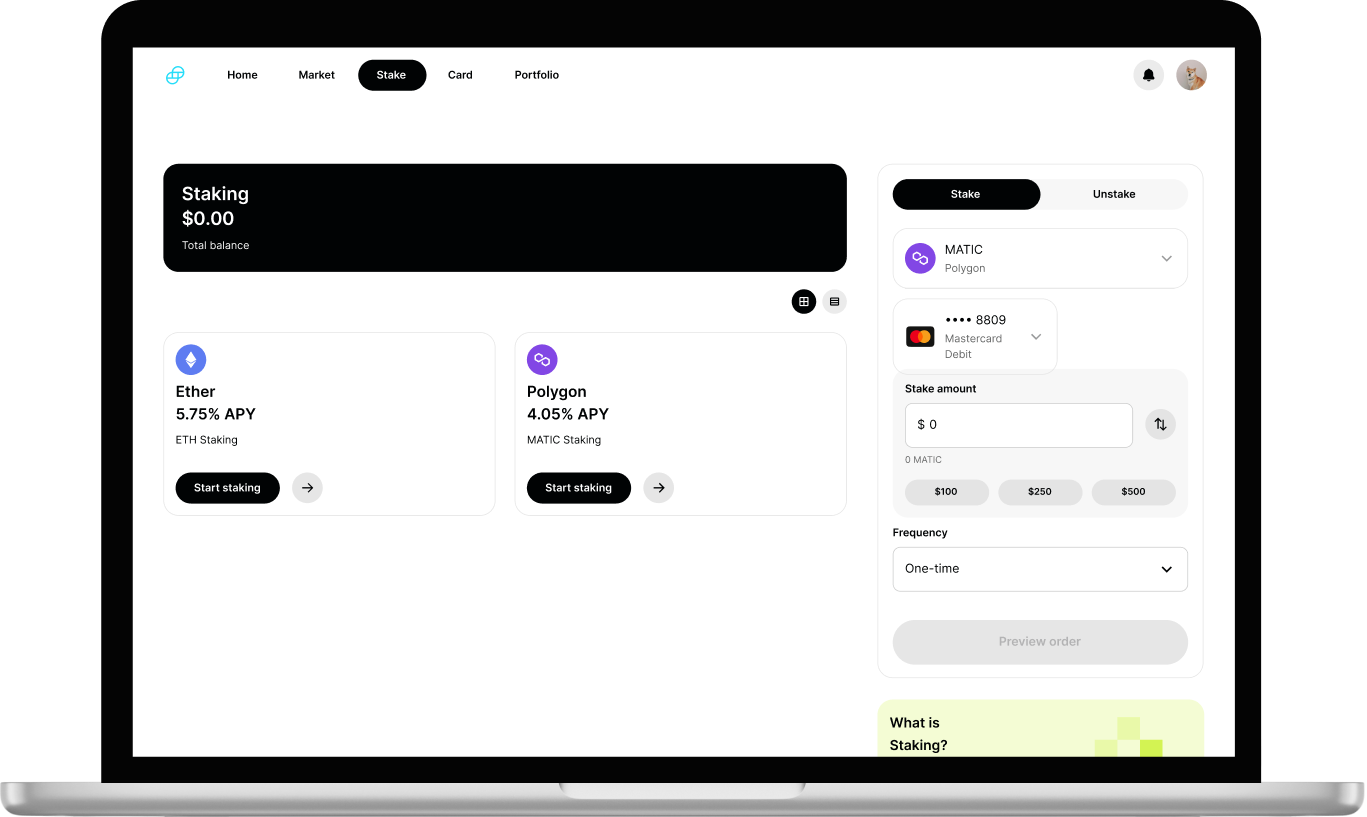
Gemini Staking: Earn Returns on Your Cryptocurrencies
Gemini offers staking on compatible proof-of-stake assets. The website advertises rewards of up to approximately 6 % APR in its main offering, but the percentage is indicative, variable, and depends on the protocol.
The most important thing about Gemini Staking:
- There is no general minimum amount required.
- There are no transfer or refund fees.
- Deduct 35 % from the rewards as a service fee.
- There may be activation and unlock periods.
- There is a risk of slashing, protocol-related issues, liquidity issues, and loss of value.
Regular Purchases (DCA): Automate Your Purchases
Gemini allows you to schedule recurring purchases using the simple mode. The user selects the asset, amount, frequency, and payment method from among the options available in their country.
Each recurring purchase includes the fee calculated by Gemini and a price spread. If you pay with a credit card or PayPal, the fees associated with that payment method are also added, so automating small amounts can be expensive.
Available order types
ActiveTrader offers a more comprehensive trading experience:
- Market order: Executes immediately and incurs the taker fee.
- Limit order: Sets the price and may pay a maker fee if it remains on the order book.
- Stop-limit: Triggers a limit order when the stop price is reached.
- Maker-or-Cancel: Cancels the order if it would be executed immediately.
The availability of margin trading, perpetual contracts, and other products varies by country and financial institution. They should not be presented as available to all exchange customers.
Gemini vs. Coinbase
The most natural comparison is between Gemini and Coinbase. Both were founded in the United States, are listed on Nasdaq, combine a user-friendly interface with an advanced trading platform, and offer services to both individual and institutional clients.
| Characteristic | Gemini | Coinbase |
|---|---|---|
| Foundation | 2014 | 2012 |
| Headquarters | New York, United States | United States |
| Regulation | NYDFS Trust Companies, State Licenses, and Regional Entities | U.S. and International Licenses and Registrations |
| Initial Advance Commission | 0.60 % maker / 1.20 % taker | Approximately 0.40 % maker / 0.60 % taker in the reference tranche |
| Simple Buy and Sell | Variable commission plus spread | Variable commission plus spread |
| Countries | More than 50; excluding the United Kingdom, the EEA, and Australia | More than 100, with varying functions |
| Cryptocurrencies | About 80 | More than 250, depending on the region |
| Security | NYDFS, ISO 27001, SOC 1/2 Type 2, and cold storage | Institutional oversight, regional controls, and public disclosure |
| Unique Product | ActiveTrader, GUSD, staking, and custody | Advanced, USDC, Base, and a larger ecosystem |
| Platform | Web, app, ActiveTrader, and API | Web, App, Advanced, Wallet, and API |
| Ideal for | U.S. users who prioritize compliance and custody | Users looking for a larger selection and international coverage |
Gemini stands out for its New York trust charter, its certifications, and the integration of ActiveTrader with custody. It also offers a consistent experience for U.S. users who value the local regulatory framework.
Coinbase offers a wider range of assets, countries, liquidity, and products. In addition, its initial premium fees are lower. For residents of Spain and the rest of the EEA, the comparison ends quickly: Gemini ceased to be available in April 2026, while Coinbase continues to operate through its European structure.
Apps and Platform: How Do You Use Gemini on a Daily Basis?
Gemini offers a web platform, iOS and Android apps, ActiveTrader for mobile and web, an API, and institutional services. The "Simple" mode is designed for buying, selling, converting, scheduling purchases, and tracking your portfolio.
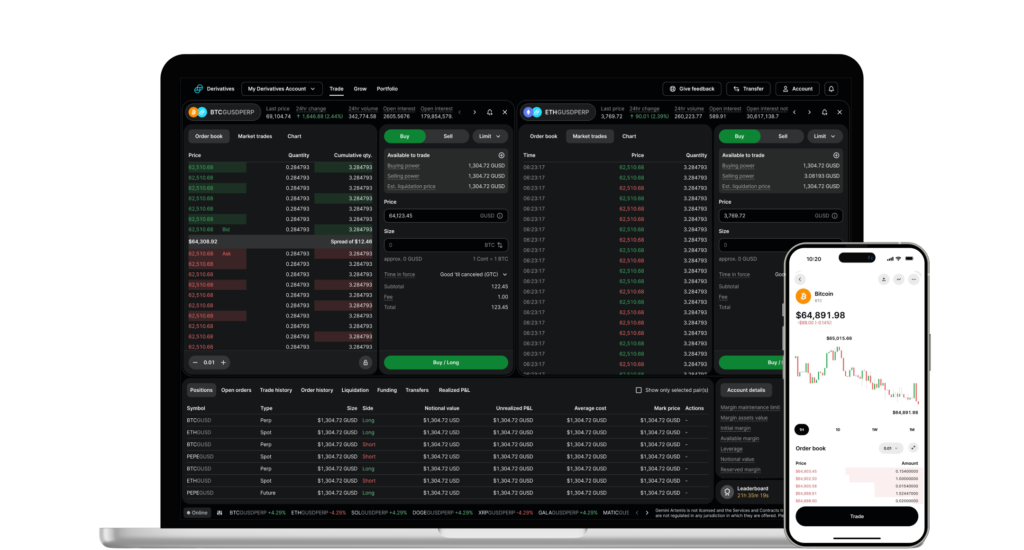
The navigation is organized into several sections:
- Portfolio: Balances, Performance, and Asset Allocation.
- Market: prices, assets, and easy buying or selling.
- ActiveTrader: charts, order book, and advanced execution.
- Staking: Assets, APR, and Cumulative Rewards.
- Transfers: Fiat or crypto deposits and withdrawals.
Switching between Gemini Mode and ActiveTrader allows you to adapt to different trading styles. The basic interface is straightforward, but it can be more expensive; the advanced interface reduces reliance on the spread and offers control over orders, although the initial commission rate remains high.
Final Verdict: Is Gemini Worth It in 2026?
Gemini remains a leading exchange for U.S. users who value a trust company regulated by the NYDFS, SOC and ISO certifications, cold storage, and a platform that combines simplicity with ActiveTrader.
However, its global position weakened in 2026. The withdrawal of the United Kingdom, the EEA, and Australia drastically reduces its coverage, and this is particularly important for a review in Spanish: a resident of Spain cannot open a trading account in August 2026.
Fees are another weak point. ActiveTrader starts at 0.60 % for makers and 1.20 % for takers, while the basic mode adds a variable fee and spread. Trustpilot reviews also show that outages and customer support are factors to consider, although many reviews confuse the exchange with Google’s AI.
With all of this in mind, Gemini may be worth considering in the United States and certain supported markets if regulation, custody, and integrated products are your top priorities. For frequent trading, a wider selection of products, or European residency, there are more competitive and readily available alternatives.
This review is based on our actual experience using Gemini. We tested the platform by making deposits, purchases, sales, and withdrawals of cryptocurrencies, and we also evaluated its fees, security, and ease of use. The rating you see here reflects our hands-on experience, not just a first impression.
Not Gemini for you? Explore other alternatives

Veteran exchange focused on security and compliance. Allows buying, selling, and staking, with pro tools and solid support.

Derivatives and copy trading-focused exchange with a fast app. Includes futures, multiple pairs, and advanced features for agile trading.

Leading global platform by trading volume. It offers spot and futures trading, staking, and a broad ecosystem with reduced fees through BNB.

European exchange with a clean interface and competitive fees. Ideal for trading crypto with SEPA transfers and stable liquidity in the European market.

Social trading and derivatives-focused platform with a simple interface. It includes copy trading, futures, and fast purchase options using a card.

Popular exchange for derivatives and spot trading, with high liquidity, a fast interface, and advanced tools geared toward active and professional traders.

Spanish exchange focused on ease of use, local support in Spanish, and integrated options for buying, saving, and custodial asset management.

Comprehensive platform offering spot, futures, and earn products. Strong global liquidity, pro tools, and a built-in Web3 wallet for active traders.
(FAQ) Frequently Asked Questions About Gemini

To buy Bitcoin or Ethereum safely and in a regulated manner seems like a good option to me. The problem is that it has few cryptocurrencies available, and as soon as you want something a bit more specific, you have to go to another exchange anyway.
It's a good exchange and a good platform overall. Trades go through smoothly, and the experience is quite positive. The only downside is that it can be a little complicated to understand at first, and it takes some time to get used to all the features. Once you get familiar with the platform, it works quite well.
My overall experience with Gemini has been quite good, and the platform runs smoothly. I especially like its focus on security and regulation, but I find the fees a bit high, and the selection of cryptocurrencies is more limited than on other exchanges. Additionally, the fact that it is no longer available in Europe is an important point to consider.